
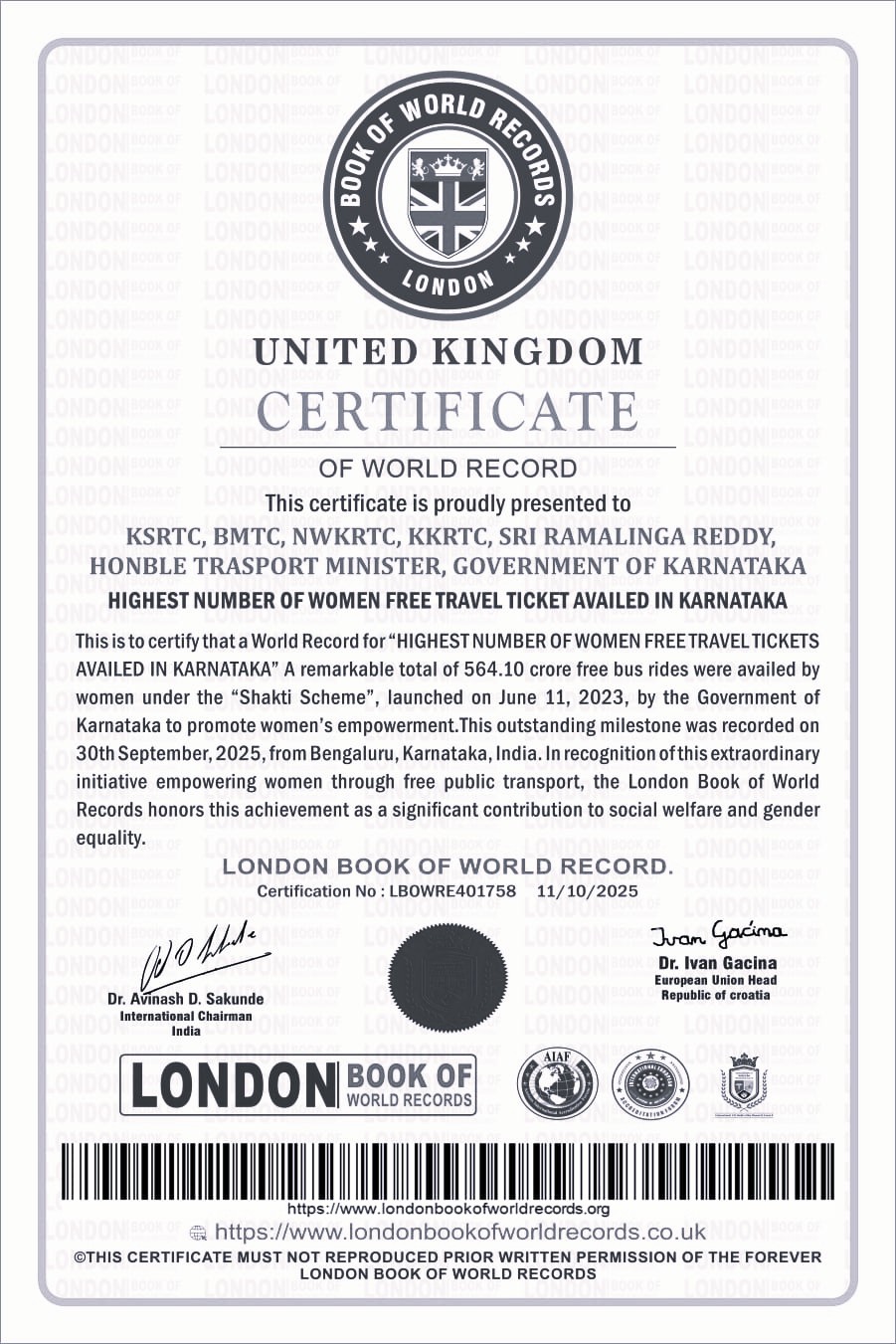
Karnataka bags Two London World Records
Karnataka has made headlines with two prestigious recognitions from the London Book of World Records, announced by Chief Minister Siddaramaiah. The state has been lauded for the Shakti Scheme, recording 564.10 crore free bus rides for women since 2023, and for the Karnataka State Road Transport Corporation (KSRTC), which has earned 464 national and international awards since 1997. As a key poll promise by the Congress-ruled Karnataka government, this scheme underscores a bold welfare initiative, but its national replication raises questions about fiscal sustainability and inter-state dynamics.
Differentiating the Two Awards
The first award celebrates the Shakti Scheme’s unprecedented scale, with 564.10 crore free rides averaging 770 million annually offering women free travel on state buses. Launched on June 11, 2023, as part of five pre-poll guarantees, the scheme has empowered women’s mobility, with a state-run Fiscal Policy Institute study noting increased workforce participation and pilgrimage site visits. The estimated ticket value for 229 crore rides in the first year alone was Rs 5,500 crore, suggesting a total expenditure nearing Rs 13,500 crore for the recorded rides, funded through state coffers. The second award honors KSRTC’s operational excellence, recognizing 464 awards since 1997, including the Golden Peacock Innovative Product/Service Award and the National e-Governance Award. This accolade reflects the corporation’s innovations, such as low-floor buses, and its status as a global leader in public transport management, distinct from the rider-focused Shakti Scheme.
Significance of the Awards
The Shakti Scheme’s record signifies a massive social experiment, with 564.10 crore rides translating to substantial empowerment for women across urban and rural Karnataka. However, the financial outlay projected at over Rs 13,500 crore highlights the scheme’s cost, a burden borne by the state amid competing priorities like infrastructure. KSRTC’s award, conversely, validates decades of transport innovation, enhancing Karnataka’s global reputation but offering little direct insight into ride numbers or costs.
National Award and Interstate Impact
While the London Book of World Records recognitions are international, Karnataka’s Shakti Scheme also earned a national nod in 2024 from the Ministry of Housing and Urban Affairs for promoting gender-inclusive transport. This accolade could inspire other states, but its impact varies. States like Telangana and Andhra Pradesh have adopted similar freebie schemes—Telangana’s Mahalakshmi Scheme and Andhra Pradesh’s Stree Shakti Scheme—mirroring Karnataka’s model. These initiatives boost women’s mobility and voter goodwill, as seen in Congress’s 2023 Karnataka victory, potentially pressuring other states to follow suit ahead of elections.
Impact on Telangana, Andhra Pradesh, and Tamil Nadu
Telangana’s Mahalakshmi Scheme, offering free rides since December 2023, has seen 200 crore rides by mid-2025, costing Rs 4,800 crore annually. Andhra Pradesh’s Stree Shakti Scheme, launched by the TDP-led NDA coalition on August 15, 2025, logs 50 crore rides (projected for the first six months) at an estimated Rs 1,200 crore, benefiting 2.62 crore women. Tamil Nadu, contrary to earlier reports, does not offer statewide free bus travel for women; subsidized and festival-specific free rides exist but lack a continuous policy like Karnataka’s. These states benefit from increased female participation Telangana reports a 15% rise in rural women’s market access but face similar overcrowding and fiscal pressures. Collective spending across Telangana and Andhra Pradesh exceeds Rs 6,000 crore annually, a trend that could escalate if scaled further.
Ahead
Karnataka’s dual records spotlight a transformative welfare model, but their national replication poses a fiscal tightrope. While empowering women and boosting electoral support, the scheme’s sustainability hinges on robust funding and infrastructure upgrades. As other states follow, the Indian government must balance these freebies with broader developmental goals, lest they become a financial burden overshadowing essential services.