
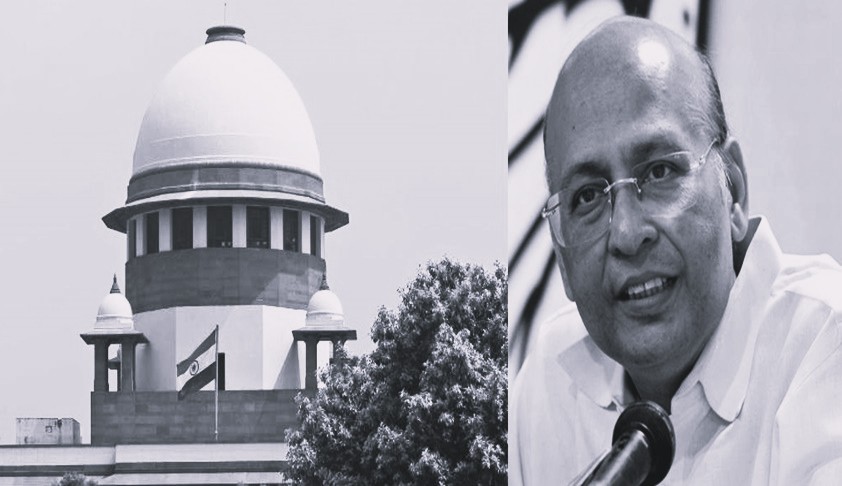
Judicial Backlog a Paradox for India’s Legal System, Says Abhishek Manu Singhvi
Senior advocate and Rajya Sabha MP Abhishek Manu Singhvi on Tuesday highlighted the growing backlog of cases in the Indian judiciary, describing it as a paradox for a country known for producing some of the most influential constitutional doctrines in the world. Speaking at the seminar titled “Delivering Justice in Time: Global Practices and Indian Experiences”, jointly organised by O.P. Jindal Global University and National Law University Delhi, Singhvi stressed the need for urgent reforms to tackle delays in the justice delivery system.
Delivering the keynote address, Singhvi said India has produced remarkable legal concepts such as the Basic Structure Doctrine , Public Interest Litigation , and Judicial Review , which have shaped constitutional jurisprudence globally. However, despite these achievements, the country continues to face a massive backlog of cases. According to him, between 4.7 crore and 5.5 crore cases are currently pending across courts in India, reflecting a serious challenge for the justice system.
He pointed out that a large portion of the pending cases is concentrated in a few High Courts. Around 54 per cent of the pendency is in five High Courts—Allahabad, Punjab and Haryana, Madras, Bombay and Rajasthan. Singhvi said criminal cases constitute the overwhelming share of these pending matters and emphasised the need for focused reforms to address the problem effectively.
Highlighting structural shortcomings, Singhvi noted that judicial vacancies continue to aggravate the situation. He said that at any given time nearly one-third of sanctioned High Court posts and about one-fourth of district and subordinate judiciary posts remain vacant. He stressed that appointing more judges and implementing a consistent policy reform for five to seven years could significantly help in reducing the backlog.
Singhvi also suggested that courts should adopt modern statistical analysis and case management techniques to improve efficiency. According to him, courts can introduce multiple tracks to deal with fresh filings and older cases separately, enabling quicker disposal of long-pending cases .
Raising the issue of judicial appointments, Singhvi questioned why provisions allowing the appointment of ad-hoc judges have rarely been used in High Courts. He said retired judges with experience could temporarily fill vacancies and assist in clearing the backlog.
The senior advocate also highlighted the importance of alternative dispute resolution mechanisms. Referring to the Mediation Act 2023 , he said mediation can play a crucial role in resolving disputes before they reach courts. He also noted that Lok Adalats settled more than 20 crore cases in 2023, though their scope currently remains limited to certain categories of disputes.
Singhvi further pointed out that India currently has only about 13,000 trained mediators , while the country requires nearly 2.5 lakh mediators to effectively manage disputes outside the courts. Strengthening mediation and conciliation systems, he said, would significantly reduce pressure on the judiciary.
Addressing the criminal justice system, Singhvi noted that India has one of the highest numbers of undertrial prisoners in the world. Many undertrials have already served half of their maximum possible sentence while awaiting trial, often because of poverty and lack of access to legal resources. He suggested experimenting with electronic monitoring systems that would allow certain undertrials to remain confined to designated locations instead of being kept in overcrowded prisons.
He also emphasised the need to strengthen the broader justice delivery infrastructure, including police personnel and prison staff , as shortages across the system continue to affect the speed and effectiveness of judicial processes.