
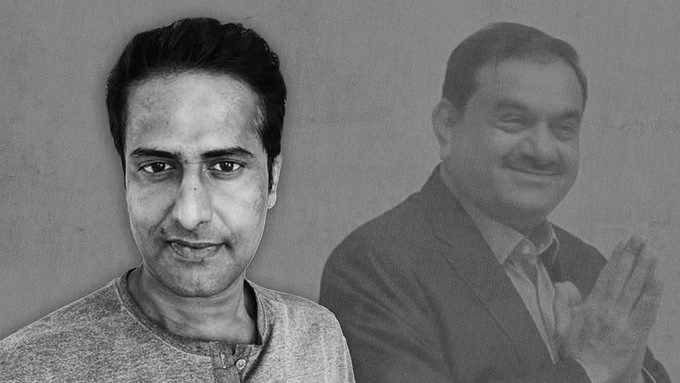
Journalist Ravi Nair convicted in Adani defamation case, sentenced to one year jail
A magistrate court in Gujarat’s Gandhinagar district has convicted journalist Ravi Nair in a criminal defamation case filed by Adani Enterprises Ltd (AEL) and sentenced him to one year of imprisonment along with a fine , bringing to a close a legal battle that has drawn attention to the uneasy relationship between corporate power and independent journalism.
The complaint was filed by AEL in September 2021 , after Nair published a series of posts between October 2020 and July 2021 on his social media handle and on a watchdog website, adaniwatch.org , where he regularly wrote critical commentary about the conglomerate. The company alleged that these posts carried defamatory allegations that could harm its reputation and investor confidence.
Court reporting indicates that Nair’s posts broadly questioned the Adani Group’s business practices and political proximity , suggesting that certain government policy decisions could disproportionately benefit the conglomerate. The posts reportedly linked to critical media reports and included pointed commentary alleging corruption, manipulation of regulations, misuse of government agencies and undue political patronage . He had also shared and commented on an international investigation by The Washington Post which claimed, citing internal documents, that Indian officials had considered directing nearly $3.9 billion from the state-owned Life Insurance Corporation of India into Adani companies during a period of financial stress and U.S. charges , an allegation that LIC and the government denied. According to court summaries, such remarks were framed as assertions rather than opinion or analysis, and the magistrate held that they were capable of damaging the company’s credibility among investors and the public, ultimately treating them as defamatory.
After what the court described as a full-fledged trial , the magistrate concluded that the company had established its case and found Nair guilty under criminal defamation provisions. He was awarded a one-year jail term and a fine. Nair could not be reached for immediate comment following the verdict.
The ruling, however, has sparked a wider debate beyond the courtroom. Media observers point out that corporate reporting often involves tough questions and uncomfortable scrutiny, and distinguishing between false claims and sharp criticism can be complex. Press freedom advocates argue that when large corporations pursue criminal defamation proceedings against individual journalists , the legal process itself can become intimidating, potentially discouraging investigative reporting and creating a chilling effect.
The verdict also drew sharp criticism from civil liberties voices. Senior lawyer Prashant Bhushan described the order as ‘totally unfair & wrong,’ and said Nair was ‘ one of the finest investigative journalists in the world’ who ‘ never wrote anything against Adani which was not true or unjustified. ’ Nair has not been reported to be taken into custody following the conviction, and it remains unclear whether he has filed or will file an appeal against the sentence.