
Jharkhand notifies PESA rules, deepening tribal self-governance in scheduled areas
The Jharkhand government has notified the long-pending rules under the Panchayat Extension of Scheduled Areas (PESA) Act, a move expected to significantly strengthen grassroots democracy and protect the constitutional rights of tribal communities in the state’s Scheduled Areas.
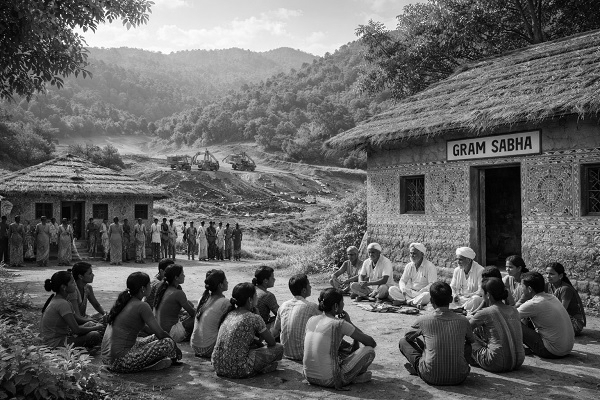
According to a notification issued by the Panchayati Raj Department on Friday night, the rules aim to restore and safeguard tribal control over land, water, forest resources, culture and traditional governance systems. By vesting wide-ranging powers in gram sabhas, the framework extends decentralised democracy to tribal regions in line with the Fifth Schedule of the Constitution.
The Fifth Schedule applies to tribal-dominated areas across 10 states Jharkhand, Chhattisgarh, Odisha, Maharashtra, Madhya Pradesh, Gujarat, Rajasthan, Telangana, Andhra Pradesh and Himachal Pradesh. Among them, Madhya Pradesh has the largest geographical area under the Fifth Schedule , followed by Odisha, Jharkhand and Chhattisgarh. These provisions are designed to protect indigenous communities from displacement, exploitation and erosion of customary rights.
Under the Jharkhand rules, Deputy Commissioners (DCs) have been entrusted with recognising and publishing traditional villages, gram sabhas and their boundaries. Each DC will form a block-level team to identify and document these boundaries in consultation with traditional village heads and gram sabha members. While a traditional gram sabha will generally correspond to a revenue village, variations will be officially recorded to reflect customary practices.
The Jharkhand Cabinet approved the PESA rules on December 23 last year. Full implementation will take place in 13 districts Ranchi, Khunti, Lohardaga, Gumla, Simdega, Latehar, East Singhbhum, West Singhbhum, Seraikela-Kharswan, Dumka, Jamtara, Sahibganj and Pakur and partial implementation in Palamu, Godda and Garhwa . Scheduled Areas in the state cover 16,022 villages and 2,074 panchayats .
A central feature of the rules is the requirement of prior gram sabha consent for land acquisition, rehabilitation and resettlement, ensuring that development projects cannot proceed without community approval. The rules also provide for a complete prohibition on child labour and mandate that gram sabhas be informed when villagers are taken outside for employment.
The manufacture, storage and sale of liquor will require gram sabha approval, reinforcing community-based social regulation. Police authorities have also been directed to inform gram sabhas about arrests made within Scheduled Areas, enhancing transparency and local oversight.
The rules grant gram sabhas ownership and management rights over minor forest produce (MFP) , including its collection, use and marketing. Minor forest produce includes non-timber forest products such as tendu leaves, mahua, bamboo, lac, honey and medicinal plants, which are vital to tribal livelihoods. This is distinct from major forest produce , such as timber and large commercial forest resources, which remain under state control. By securing MFP rights, the rules aim to boost incomes and reduce exploitation by intermediaries.
Further strengthening grassroots governance, gram sabhas have been empowered to monitor schools, anganwadis, health centres and public distribution system (PDS) shops in rural areas, improving accountability in service delivery.
Each gram sabha may also establish a “Gram Kosh” (village fund) comprising grain, labour, goods and cash components. Revenue from minor forest produce, pond leases, market management fees, sand ghats and other local sources will be deposited into this fund, enabling villages to plan and finance development activities independently.
The PESA Act was enacted by Parliament in 1996 to extend constitutional self-governance provisions to Scheduled Areas. However, despite Jharkhand’s formation in 2000, the law remained unimplemented for over two decades due to the absence of state-specific rules.
Both the Congress, a constituent of the ruling Jharkhand Mukti Morcha-led alliance and the opposition BJP had repeatedly demanded the notification of the PESA rules. Draft rules were released in July 2023, followed by public consultations, workshops and discussions across the state in 2024, culminating in the final notification.
Officials said the implementation of the rules is expected to empower tribal communities by shifting decision-making authority to the village level, strengthening grassroots democracy and ensuring that development in Scheduled Areas proceeds with community consent and constitutional safeguards.