
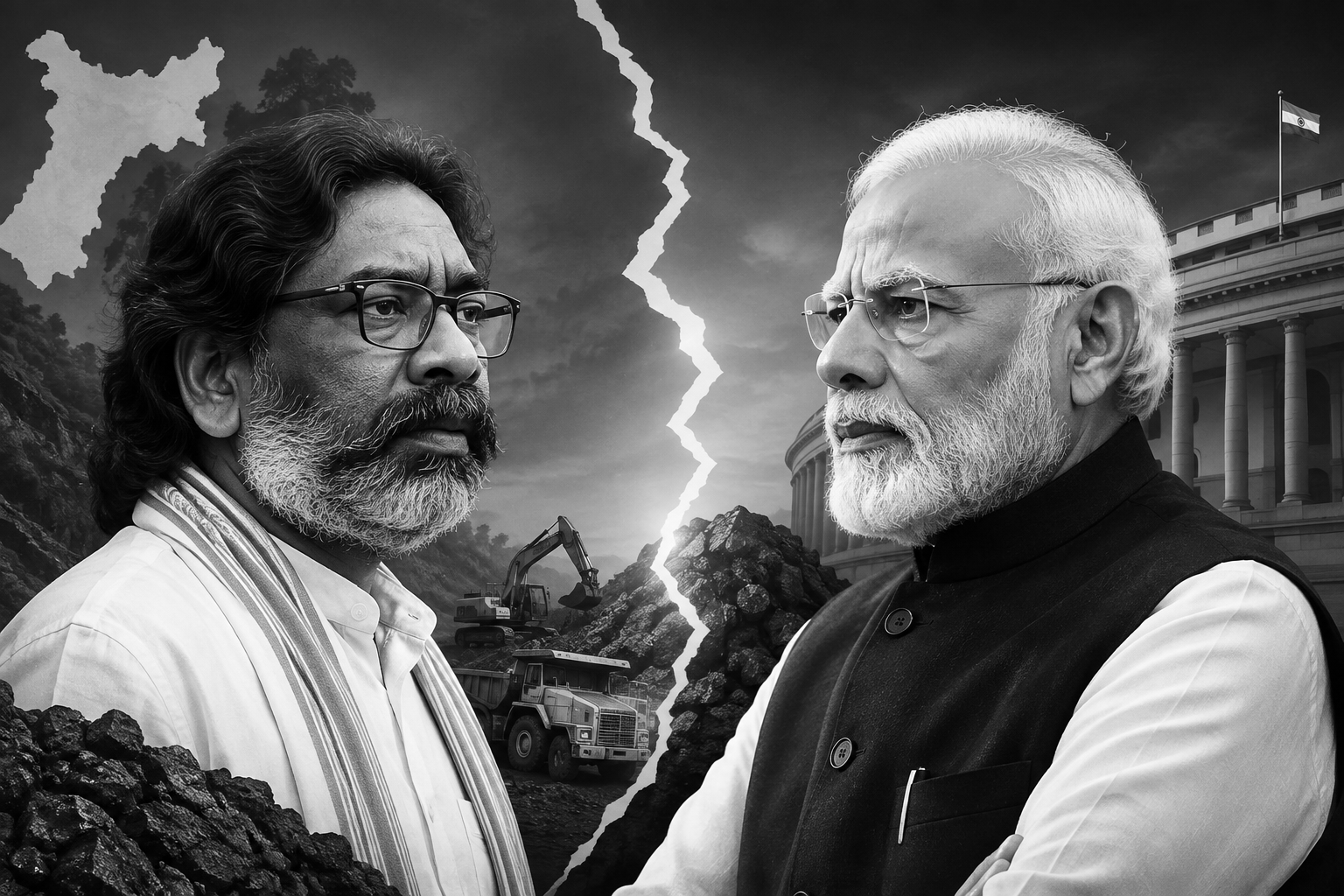
Jharkhand CM Soren Takes On Centre Over Mining Bill, Jharkhand Fears Rs 10,000-Crore Revenue Loss
Jharkhand Chief Minister Hemant Soren has strongly opposed the Centre’s Mines and Minerals (Development and Regulation) Amendment Bill, 2026, warning that it could curb the state’s revenue-raising powers and cost it thousands of crores. Soren has urged Prime Minister Narendra Modi to reconsider the legislation, which was passed by the Lok Sabha on August 12 and the Rajya Sabha on August 13 and is now awaiting President Droupadi Murmu’s assent.
But what does the Bill actually do? The legislation seeks to change the legal framework governing levies imposed on mineral rights and mineral-bearing land. Its most contentious provision is Section 9D, which bars states from imposing taxes, cesses or other levies on mineral rights or mineral-bearing land, except under conditions prescribed by the Centre. It also provides that certain unpaid or uncollected levies could become invalid once the amendment takes effect.
The Centre says the change is aimed at preventing multiple, unpredictable and retrospective mineral levies imposed by different states. It argues that such levies increase mining costs, create uncertainty for businesses and lead to non-uniform mineral prices. Union Mines Minister G Kishan Reddy has said states will “not lose even a single rupee”, maintaining that the reform will create a level playing field and support planned coal and mineral exchanges.
Jharkhand, however, sees the provision as a threat to its financial autonomy. The state holds roughly 40 per cent of India’s mineral reserves, including nearly 27 per cent of the country’s coal reserves, around 26 per cent of its iron ore and about 18.5 per cent of copper ore.
Mining is also crucial to Jharkhand’s finances. The state’s 2026-27 Budget estimates Rs 14,656 crore in revenue from the Mineral Bearing Land Cess. Soren has separately warned that the legislation could result in an annual revenue loss of Rs 8,000–10,000 crore, potentially affecting infrastructure, healthcare and welfare programmes.
The dispute also has a major constitutional dimension. In its landmark 2024 nine-judge judgment, the Supreme Court held that states have the power to tax mineral rights and mineral-bearing land. The legal debate now centres on whether Parliament can restrict the practical exercise of that state taxation power while legislating on mineral development.
The Centre is continuing to challenge aspects of the 2024 ruling and filed a curative petition in 2025. The new legislation has therefore brought the issue back to the forefront of India’s debate over fiscal federalism and the division of powers between the Centre and states.
After Parliament cleared the Bill, Soren on August 13 announced plans for a statewide agitation if it is not withdrawn. For Jharkhand, the immediate concern is whether it can protect the Rs 14,656-crore cess revenue budgeted for 2026-27. For the Centre, the argument is that a uniform taxation framework will make India’s mineral sector more predictable, competitive and investment-friendly.