
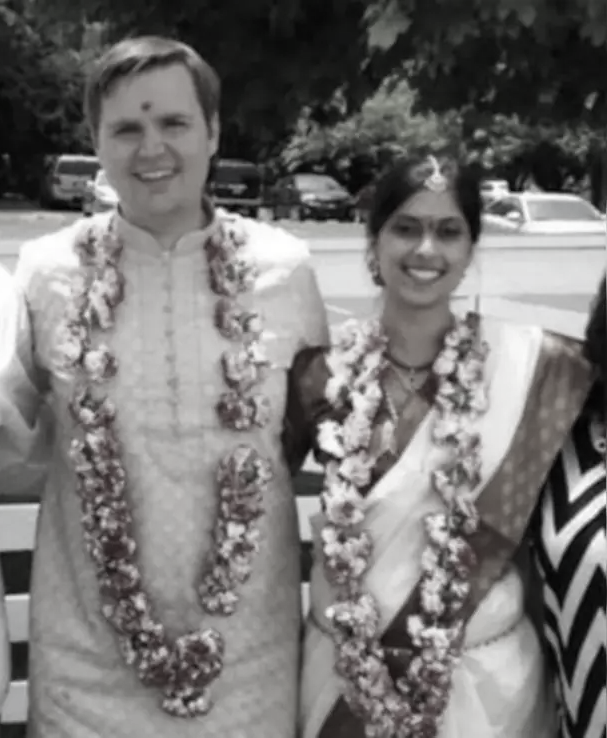
JD Vance responds to criticism over comments on his Hindu wife, Usha Vance
US Vice President JD Vance has defended his remarks about his interfaith marriage with his Hindu wife, Usha Vance, after facing criticism for expressing hope that she might one day embrace Christianity. His comments, made at a conservative event in Mississippi, have reignited debate over faith, identity, and the boundaries of belief in modern relationships.
During the Turning Point USA event, Vance was asked whether he hoped his wife would “come to Christ.” He responded candidly before a crowd of nearly 10,000 people:
“Now, most Sundays, Usha will come with me to church. As I’ve told her, and as I’ve said publicly, and as I’ll say now in front of 10,000 of my closest friends - do I hope, eventually, that she is somehow moved by the same thing that I was moved by in church? Yeah, I honestly do wish that because I believe in the Christian Gospel and I hope eventually my wife comes to see it the same way.
But if she doesn’t, then God says everybody has free will, and so that doesn’t cause a problem for me. That’s something you work out with your friends, with your family, with the person that you love.”
Vance, who converted to Catholicism in 2019, described how the couple manages their interfaith household:
“My wife did not grow up Christian. I think it’s fair to say that she grew up in a Hindu family, but not a particularly religious family in either direction. Everybody has to come to their own arrangement here. The way we arrived at our arrangement is that she’s my best friend. We discuss this topic with each other. We’ve decided to raise our kids Christian. Our two oldest children, who attend school, attend a Christian school. Our 8-year-old had his First Communion about a year ago. That’s the way that we have come to our arrangement.”
Following backlash online, including from Canadian journalist Ezra Levant, who accused him of being insensitive to his wife’s Hindu faith, Vance posted a detailed clarification on X:
“What a disgusting comment, and it’s hardly been the only one along these lines.
First off, the question was from a person seemingly to my left, about my interfaith marriage. I’m a public figure, and people are curious, and I wasn’t going to avoid the question.
Second, my Christian faith tells me the Gospel is true and is good for human beings. My wife - as I said at the TPUSA - is the most amazing blessing I have in my life. She herself encouraged me to reengage with my faith many years ago. She is not a Christian and has no plans to convert, but like many people in an interfaith marriage - or any interfaith relationship - I hope she may one day see things as I do.
Regardless, I’ll continue to love and support her and talk to her about faith and life and everything else, because she’s my wife.
Third, posts like this wreak of anti-Christian bigotry. Yes, Christians have beliefs. And yes, those beliefs have many consequences, one of which is that we want to share them with other people. That is a completely normal thing, and anyone who’s telling you otherwise has an agenda.”
Vance’s remarks were met with applause from the conservative audience but also sparked a broader discussion about religious identity and interfaith marriage in America.
According to recent studies by the Pew Research Center, about 26% of married adults in the United States say their spouse belongs to a different religion, while among those married since 2010, the number rises to nearly 39%. The trend highlights how interfaith marriages are becoming increasingly common in modern America, even as some still face tension and misunderstanding from traditional or political circles.
Usha Vance, born to Indian-origin parents from Andhra Pradesh, was raised in a Hindu household rooted in cultural and moral values rather than strict religious practice. Reports confirm she continues to identify with her Hindu background and has not converted to Christianity, though she supports her husband’s faith and their decision to raise their children in the Christian tradition.
How much of herself must a woman give up for her marriage to be called complete?
Beyond the political spotlight, their marriage touches on a universal theme that transcends borders, the quiet transformation many women undergo within marriage. In societies like India, women are still often expected to reshape their identities around their husbands, changing their names, faiths, and family affiliations to fit new roles. It is celebrated as love or duty, but in truth, it can be a subtle form of erasure.
A woman’s identity doesn’t vanish in one act, it fades slowly, piece by piece. First her surname, then her traditions, then her choices. It is what many call tradition, but what often feels like surrender. Men rarely notice the quiet compromises, because society has taught them not to.
Usha’s story mirrors that of countless women across the world, women who love deeply, support selflessly, and yet see their individuality gradually dissolve into someone else’s narrative. This is not loud oppression, but a silent killer of identity, one that hides behind affection, expectation, and cultural conformity.
In the end, whether in the Vances’ American household or an Indian one thousands of miles away, the question remains the same: How much of herself must a woman give up for her marriage to be called complete?