
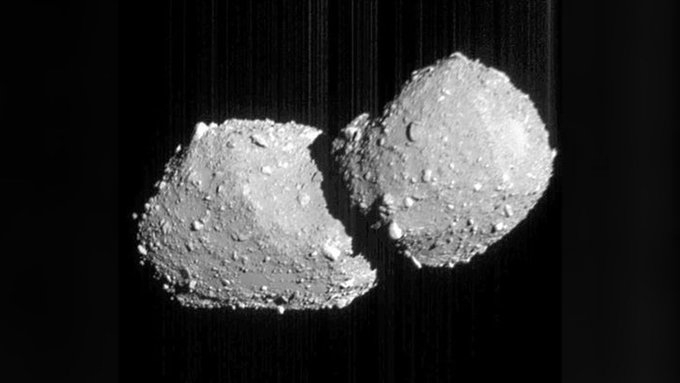
Japan's Hayabusa2 Probe Snaps Stunning Photo of Two Headed Asteroid 100 Million Km From Earth
Japan's space agency has released the closest ever photographs of a near Earth asteroid after its Hayabusa2 probe completed a record flyby of the space rock named Torifune . The Japan Aerospace Exploration Agency , known as JAXA , confirmed the operation was carried out on July 5, 2026 at 18:30 Japan Standard Time, with the spacecraft passing within an estimated 800 metres of the asteroid at a speed exceeding 18,000 kilometres per hour.
Torifune is a 450 metre wide asteroid currently travelling roughly 100 million kilometres from Earth. It belongs to the Apollo group of near Earth asteroids whose orbits intersect that of our planet, completing one solar orbit every 383 days and rotating once every five hours. The images captured by Hayabusa2's Optical Navigation Camera and its Thermal Infrared Imager revealed Torifune has an elongated, double lobed shape resembling a snowman, a detail previously unknown to scientists.
JAXA scientist Yuya Mimasu said the imagery and accompanying data gave him goosebumps, adding he had not expected such clarity and was over the moon with the results. The flyby was not part of Hayabusa2's original mission plan and had been described by the science team as a risky operation given how little was known about the asteroid beforehand.
The primary objective of the mission was to demonstrate optical and radio hybrid navigation techniques that could one day help deflect a hazardous asteroid away from Earth. Additional instruments including a near infrared spectrometer and a light detection and ranging system were also used during the approach to measure distance and search for signs of water on the asteroid's surface. Only part of the collected data has been transmitted so far, with the remainder expected in future operations.
Hayabusa2 previously made history in December 2020 when it delivered samples from asteroid Ryugu , located nearly 300 million kilometres from Earth, back to a landing site in the Australian desert. Those samples, estimated to be around 4.5 billion years old, helped researchers understand conditions during the early solar system.
Having completed the Torifune flyby, Hayabusa2 is now set for its next target, asteroid 1998 KY26 , a much smaller 36 foot object that the probe is expected to reach in 2031. JAXA and the European Space Agency are separately collaborating on another planetary defence mission focused on asteroid Apophis, which will make a close pass of Earth in April 2029.