
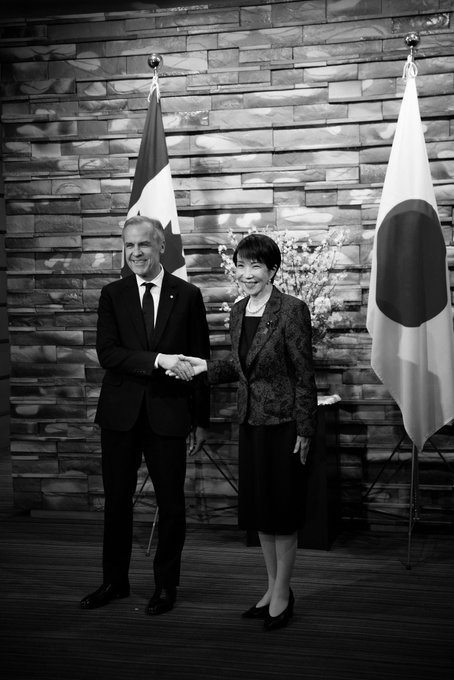
Japan, Canada sign strategic agreement in defence and energy amid global uncertainty
Japan and Canada on Friday elevated their bilateral relationship to a comprehensive strategic partnership , committing to deeper cooperation on defence, economic security, technology, trade and energy as both countries respond to rising geopolitical risks and shifting global economic dynamics. This marks the first summit‑level joint statement between Tokyo and Ottawa in over two decades and reflects a broader shift in Canada’s foreign policy toward diversification of strategic alliances.
Japanese Prime Minister Sanae Takaichi and Canadian Prime Minister Mark Carney signed the Canada‑Japan Comprehensive Strategic Roadmap , outlining detailed cooperation on economic security, cybersecurity, critical mineral supply chains, clean energy and advanced technologies. The roadmap commits both governments to launch new bilateral dialogues on economic security and cyber policy to shore up supply chains, coordinate on emerging technologies including artificial intelligence and quantum computing, and expand cooperation on joint coast guard patrols, international emergency response and combined military exercises.
The leaders also reaffirmed nearly $40 billion in two‑way annual trade , planning to modernize economic dialogue mechanisms, boost two‑way investment through trade missions and pension funds, and expand energy cooperation, including liquefied natural gas (LNG), hydrogen and nuclear fuels. Japan, the world’s fifth‑largest economy , remains a key market for Canadian exporters and a major source of foreign direct investment.
Under the defence pillar, the partnership calls for increased interoperability between Canadian and Japanese forces, with expanded joint training and potential participation by Japan in Canada’s Operation NANOOK in the Arctic. The roadmap also emphasizes cooperation on space security, information sharing, and resilience against cross‑border cyber threats.
Beyond bilateral ties, officials say the expanded partnership fits into Canada’s broader strategy of diversifying its global engagements beyond heavy reliance on the United States , especially in the face of trade uncertainty and recent U.S. tariff pressures. Canadian leaders have sought deeper ties across the Indo‑Pacific with partners including Japan, India and Australia, and are negotiating expanded economic agreements aimed at reducing dependence on a single major market and enhancing access to dynamic Asian economies.
The comprehensive strategic partnership reflects a growing recognition among Ottawa and Tokyo that trusted, diversified alliances are essential to navigating a rapidly evolving global landscape.