
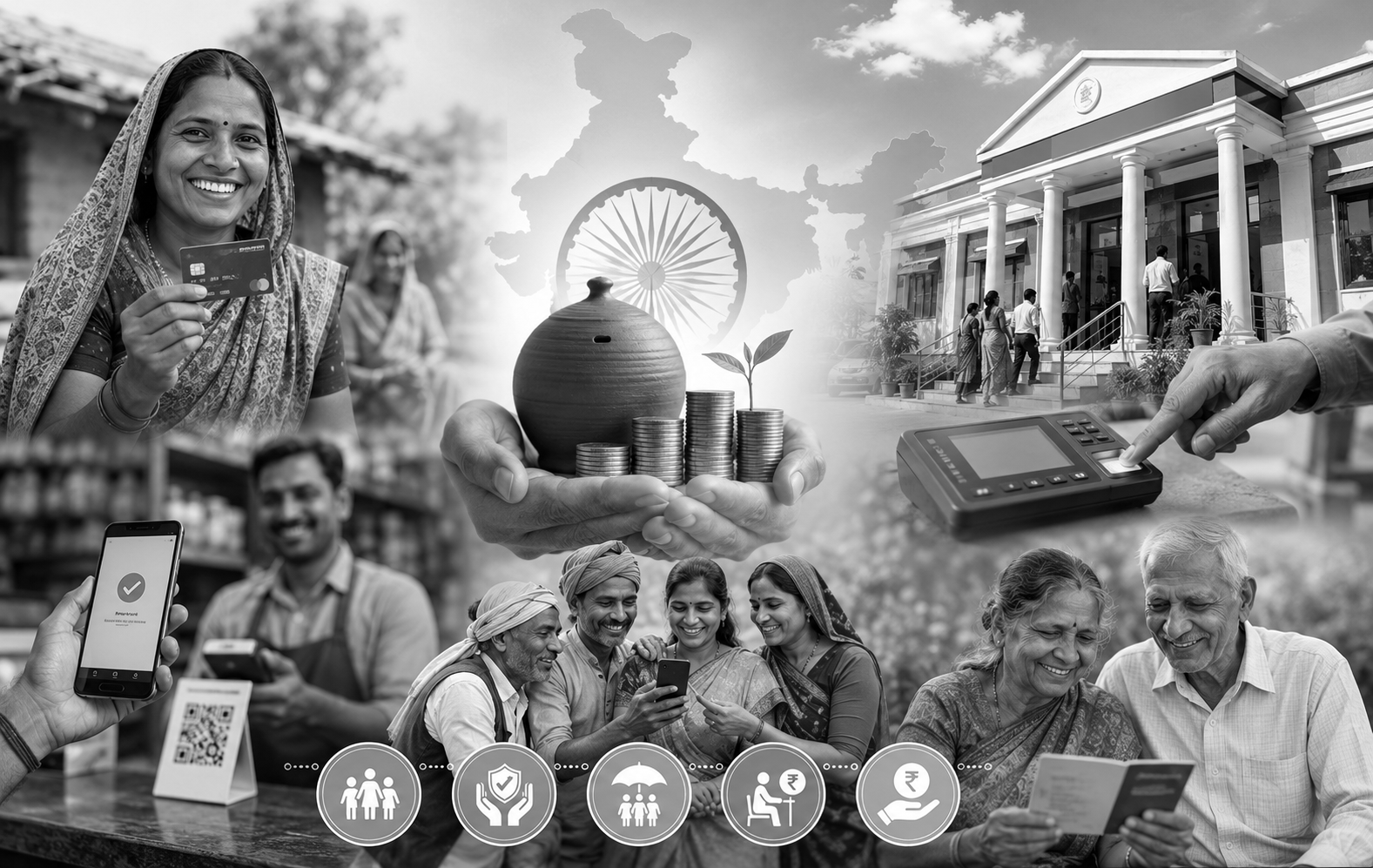
Jan Dhan Deposits Cross ₹3 Lakh Crore, Marking New Inclusion Milestone
Economic development is often measured by rising incomes, expanding infrastructure or industrial growth. Equally important, however, is the ability of ordinary citizens to access banking, savings, insurance and affordable credit. Nearly twelve years after the launch of the Pradhan Mantri Jan Dhan Yojana (PMJDY), India has reached a significant milestone, with deposits in Jan Dhan accounts surpassing ₹3 lakh crore. More than a financial statistic, the achievement reflects the country's steady progress towards building a more inclusive and digitally connected economy.
A Landmark in India's Financial Inclusion Journey
According to data tabled in the Rajya Sabha, 58.63 crore Jan Dhan accounts had been opened as of July 1, 2026, with cumulative deposits reaching ₹3,08,333 crore. The figures were shared by Minister of State for Finance Pankaj Chaudhary, who said the government's National Mission for Financial Inclusion (NMFI) continues to expand access to banking, social security and institutional credit for every section of society, particularly marginalised and underserved communities.
The latest figures underline how financial inclusion has become a key pillar of India's development strategy, bringing millions of citizens into the formal financial system while strengthening the delivery of welfare, pensions, insurance and credit.
What is PM Jan Dhan Yojana?
Launched on August 28, 2014, the Pradhan Mantri Jan Dhan Yojana (PMJDY) is the Centre's flagship National Mission for Financial Inclusion, aimed at providing universal access to banking services for every unbanked household and, subsequently, every adult citizen. Built around the principles of "banking the unbanked, securing the unsecured and funding the unfunded," the scheme enables individuals to open Basic Savings Bank Deposit (BSBD) accounts with zero minimum balance, making formal banking accessible to even the poorest households.
However, PMJDY is far more than a bank account-opening programme. Every eligible account holder receives a RuPay debit card, while the accounts serve as the primary channel for Direct Benefit Transfers (DBT) under various government welfare schemes. They also provide access to overdraft facilities, subject to eligibility and bank norms, and act as the gateway to social security schemes such as the Pradhan Mantri Jeevan Jyoti Bima Yojana (PMJJBY), Pradhan Mantri Suraksha Bima Yojana (PMSBY) and the Atal Pension Yojana (APY). Over the past decade, PMJDY has evolved into the backbone of India's financial inclusion ecosystem, connecting millions of citizens with banking, digital payments, insurance, pensions and formal credit.
From Zero-Balance Accounts to ₹3.08 Lakh Crore in Deposits
The latest achievement is the result of sustained growth over nearly twelve years.
In 2015, PMJDY had 14.72 crore accounts with deposits of ₹14,641 crore. Deposits rose steadily to ₹35,672 crore in 2016, ₹62,972 crore in 2017, ₹78,494 crore in 2018, ₹96,107 crore in 2019, and crossed ₹1.18 lakh crore in 2020. The momentum continued with deposits increasing to ₹1.45 lakh crore in 2021, ₹1.66 lakh crore in 2022, ₹1.99 lakh crore in 2023, ₹2.32 lakh crore in 2024, ₹2.60 lakh crore in 2025, before crossing ₹3.08 lakh crore as of July 1, 2026.
The figures indicate that Jan Dhan accounts are no longer merely zero-balance accounts opened to meet enrolment targets. Instead, they have become active savings accounts used for welfare transfers, digital payments and everyday banking.
The programme has also achieved remarkable social inclusion. Of the total accounts, 32.68 crore (55.74%) belong to women, while 45.62 crore (77.80%) are located in rural and semi-urban areas, highlighting the mission's success in extending formal banking to previously underserved populations.
JAM Trinity Changed the Welfare Delivery Model
A major reason behind the success of PMJDY has been its integration with the JAM Trinity - Jan Dhan, Aadhaar and Mobile.
The digital ecosystem enabled the government to implement Direct Benefit Transfer (DBT) on an unprecedented scale. Welfare benefits under schemes such as PM-KISAN, MGNREGS, PAHAL LPG subsidy, PM Awas Yojana, scholarships, pensions and numerous state welfare programmes are now credited directly into beneficiaries' bank accounts.
The system has reduced dependence on intermediaries, improved transparency, shortened payment timelines and helped minimise leakages in welfare delivery. During the COVID-19 pandemic, Jan Dhan accounts also became the principal channel for transferring emergency financial assistance directly to beneficiaries, particularly women, demonstrating the strength of India's digital public infrastructure.
Building a Financial Safety Net
Financial inclusion has expanded well beyond banking into insurance and pension coverage.
Under the Pradhan Mantri Jeevan Jyoti Bima Yojana (PMJJBY), 27.84 crore cumulative enrolments have been recorded as of July 1, 2026, providing a ₹2 lakh life insurance cover in the event of death due to any cause.
The Pradhan Mantri Suraksha Bima Yojana (PMSBY) has registered 58.78 crore cumulative enrolments, offering accidental insurance of ₹2 lakh for death or permanent total disability and ₹1 lakh for permanent partial disability.
Similarly, the Atal Pension Yojana (APY) has enrolled 9.29 crore subscribers as of June 30, 2026, providing guaranteed monthly pensions to eligible workers in the unorganised sector.
Together, these schemes have transformed PMJDY from a banking initiative into a comprehensive social security platform.
Expanding Access to Institutional Credit
Financial inclusion has also translated into easier access to formal credit.
Under the Pradhan Mantri Mudra Yojana (PMMY), 59.14 crore collateral-free loans worth ₹41.71 lakh crore have been sanctioned as of June 26, 2026, supporting micro and small enterprises engaged in manufacturing, trading, services and agriculture-related activities. Individual loans of up to ₹20 lakh are available under the scheme.
Meanwhile, the Stand-Up India Scheme has sanctioned 2.75 lakh loans amounting to ₹62,790 crore as of March 31, 2025, enabling Scheduled Caste, Scheduled Tribe and women entrepreneurs to establish greenfield enterprises.
The Policies That Powered the Mission
The expansion of financial inclusion has been driven by a combination of technology, infrastructure and awareness campaigns.
The government strengthened the Business Correspondent (Bank Mitra) network, taking banking services to villages where bank branches were limited. Beneficiaries received RuPay debit cards, while UPI, BHIM, Aadhaar Enabled Payment System (AEPS), mobile banking and micro-ATMs enabled convenient digital transactions.
Banks and government agencies also organised Financial Literacy Camps, Gram Panchayat enrolment drives, village banking camps, Financial Inclusion Saturation Campaigns and awareness programmes through Financial Literacy Centres (FLCs). These initiatives encouraged citizens to save regularly, enrol in insurance and pension schemes and make greater use of formal financial services.
Why the Milestone Matters
Economists view financial inclusion as an important driver of long-term development because it expands access to savings, credit, insurance and digital payments.
The steady rise in Jan Dhan deposits suggests that millions of households are not only opening bank accounts but actively using them to save money and receive welfare benefits. Higher participation by women, deeper banking penetration in rural India, wider social security coverage and easier access to institutional credit have collectively strengthened household financial resilience and expanded economic opportunities.
The growing deposit base also indicates increasing public confidence in the formal banking system. Household savings mobilised through banks provide resources for lending and investment, supporting entrepreneurship, employment and broader economic activity.
Challenges and the Road Ahead
Despite the remarkable progress, experts caution that financial inclusion should not be measured by account ownership alone. The next phase of the mission will depend on improving financial literacy, encouraging regular account usage, expanding productive access to institutional credit and ensuring that financial services translate into higher incomes, entrepreneurship and sustainable livelihoods.
The journey from ₹14,641 crore in deposits in 2015 to ₹3.08 lakh crore in 2026 reflects far more than the success of a banking scheme. Today, the financial inclusion mission encompasses 58.63 crore Jan Dhan accounts, 27.84 crore PMJJBY enrolments, 58.78 crore PMSBY enrolments, 9.29 crore APY subscribers, 59.14 crore MUDRA loans worth ₹41.71 lakh crore, and 2.75 lakh Stand-Up India loans worth ₹62,790 crore.
As India advances towards becoming a developed economy, the ₹3 lakh crore deposit milestone represents more than a banking achievement. It signifies the evolution of a nationwide financial ecosystem that combines banking, digital public infrastructure, welfare delivery, social security and institutional credit, making financial empowerment an increasingly important pillar of the country's inclusive growth story.