
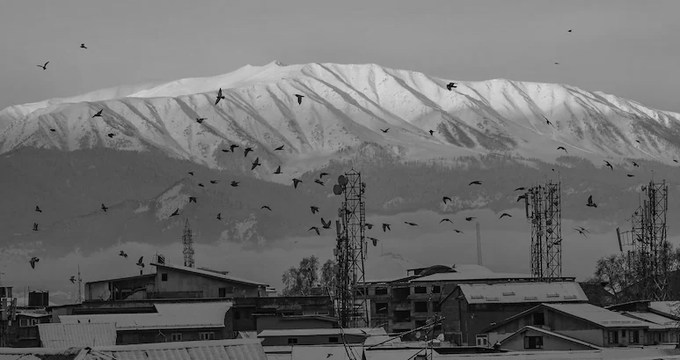
Jammu and Kashmir Warming Faster Than World Average, Scientists Warn of Himalayan Tipping Point
Jammu and Kashmir is warming significantly faster than the global average, with scientists warning that the Himalayan region is approaching a dangerous climate tipping point that could reshape glaciers, water resources, agriculture, biodiversity, and the lives of millions across South Asia. A new peer reviewed study published in Scientific Reports found that the Union Territory's high altitude regions have warmed by nearly 1°C over the past two decades, with mountain areas heating much faster than the plains.
The research, titled Warming of the High Mountainous Climate Sensitive Jammu and Kashmir During the Period 1980–2024, analysed decades of meteorological data from stations across the region. Scientists observed the sharpest warming in Gulmarg, Pahalgam, Kupwara, Kargil, and other higher Himalayan locations. In contrast, parts of the Jammu plains showed only marginal warming and, in some places, even slight cooling, a trend researchers attribute to regional weather patterns and local environmental factors.
Researchers say the findings confirm that elevation dependent warming, where higher altitude regions heat faster than lower elevations, is becoming increasingly evident across the Himalayas. Snow covered surfaces are shrinking, exposing darker land that absorbs more solar radiation and further accelerates warming. Reduced snow cover, changing cloud patterns, and shifts in atmospheric circulation are also contributing to the rapid rise in temperatures.
The warming trend threatens to accelerate glacier retreat, disrupt snowfall patterns, increase the risk of glacial lake outburst floods (GLOFs), cloudbursts, flash floods, and landslides, while altering the flow of rivers such as the Jhelum, Chenab, and Indus, which support millions of people downstream. Scientists warn that these changes could significantly impact drinking water supplies, irrigation, hydropower generation, and food security across northern India and neighbouring countries.
The study adds to growing evidence that the Hindu Kush Himalayan region, often called Earth's "Third Pole" because it contains the largest reserve of ice outside the Arctic and Antarctica, is among the world's most climate vulnerable regions. Previous assessments have projected that even if global warming is limited to 1.5°C, the region could lose around one third of its glaciers by 2100. Under higher emission scenarios, glacier loss could exceed 50 to 67 percent, dramatically altering river systems and ecosystems.
Scientists caution that the impacts are already visible in Kashmir. Earlier snowmelt, declining snowfall, erratic rainfall, and increased sediment from melting glaciers are affecting lakes, wetlands, forests, tourism, horticulture, and fisheries. Government data cited in recent reports show that 315 of Kashmir's 697 natural lakes have disappeared since 1967, while another 203 lakes have shrunk, reflecting the combined impact of climate change, pollution, and unplanned development.
Environmental experts warn that continued warming could push parts of the Himalayan ecosystem beyond critical thresholds, leading to irreversible ecological changes. Such tipping points may permanently alter glaciers, alpine vegetation, wildlife habitats, and water availability, making adaptation increasingly difficult for mountain communities and downstream populations alike.