
Jal Jeevan Mission: Transforming Rural India’s Access to Safe Drinking Water
For millions of families living in rural India, access to safe drinking water was once a daily struggle. In many villages, people depended on distant wells, hand pumps, ponds, or rivers for their water needs. Women and children often spent hours walking long distances every day just to fetch water for cooking and drinking. In many cases, the available water sources were contaminated, leading to frequent outbreaks of waterborne diseases.
Recognising the urgency of this problem, the Government of India launched the Jal Jeevan Mission in August 2019. Popularly known through the slogan “Har Ghar Jal,” the mission aims to provide functional tap water connections to every rural household . The programme is designed not only to ensure safe drinking water but also to improve health conditions, reduce the burden on women, and enhance the quality of life in villages.
The Situation Before the Mission
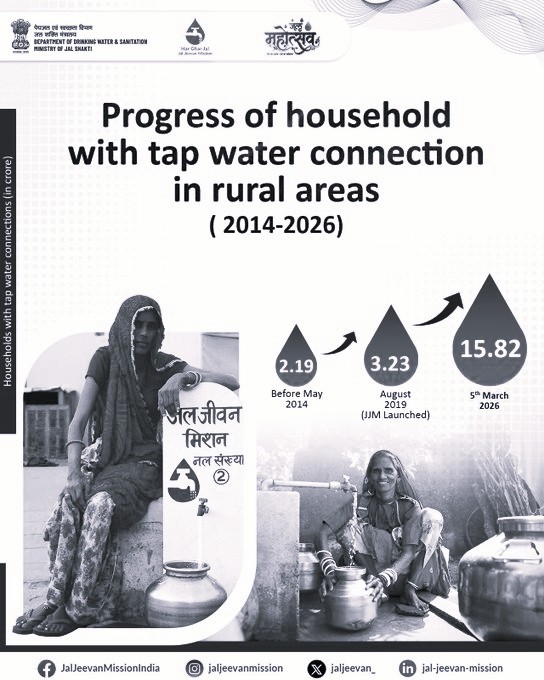
When the programme began in 2019, rural water access in India was extremely limited. Out of approximately 19.36 crore rural households , only 3.23 crore homes had tap water connections . This meant that just 16.7 percent of rural families could receive drinking water directly at home.
Most rural households depended on alternative sources such as wells, hand pumps, ponds, rivers, or water tankers . In several regions, these water sources were located far from residential areas, forcing women to walk several kilometres every day. This routine affected not only their health but also family life and children's education.
Recognising the need for a comprehensive solution, the government launched a nationwide infrastructure initiative aimed at ensuring “Har Ghar Jal” across rural India.
Massive Expansion of Water Infrastructure
The Jal Jeevan Mission focuses on developing large-scale rural water infrastructure across the country. Major investments have been made to construct pipeline networks, water treatment plants, storage tanks, pumping systems, and household tap connections .
The programme is implemented through close coordination between the central government and state governments , making it one of the largest rural infrastructure initiatives undertaken in India.
Progress Achieved by 2026
Since its launch, the mission has made significant progress in expanding drinking water access.
According to data from states and Union Territories, by March 3, 2026 , more than 12.58 crore additional rural households had received tap water connections under the programme.
As a result, about 15.82 crore rural households out of the total 19.36 crore now have access to tap water supply , representing 81.71 percent coverage across rural India.
Several states have already announced 100 percent tap water coverage , while others continue to expand infrastructure rapidly. In many villages, newly built pipelines, water purification facilities, and storage tanks have transformed the way communities access drinking water.
To improve transparency, the government has introduced a digital dashboard that provides detailed information about tap water connections at the state, district, and village levels , allowing citizens to track the mission’s progress.
Key Objectives of the Programme
The Jal Jeevan Mission is not merely a water supply project; it is designed as a comprehensive programme aimed at improving rural living standards.
One of its core targets is to ensure that every rural household receives safe drinking water through a tap connection , delivering at least 55 litres of water per person per day .
The mission also focuses on continuous monitoring of water quality , development of sustainable water sources , and increased community participation in water management . Another important objective is to empower women to take leadership roles in local water governance .
Community Participation in Water Management
A distinctive feature of the Jal Jeevan Mission is its decentralised and demand-driven implementation model .
Instead of relying solely on government agencies, the programme encourages active participation from local communities. Each village forms a Village Water and Sanitation Committee (VWSC) , which plays a key role in planning, managing, and maintaining water supply systems.
Women are given significant representation in these committees, ensuring that those most affected by water scarcity play a leading role in decision-making.
The programme also emphasises service delivery , ensuring that water supply systems remain reliable and provide sufficient quantities of safe drinking water.
Challenges in Implementation
Despite its achievements, the mission faces several challenges.
In some regions, reliable water sources are limited , particularly in drought-prone areas where groundwater levels decline during summer. Maintaining a consistent supply in such areas remains difficult.
In other places, groundwater contains high levels of fluoride, arsenic, or iron , which can pose serious health risks. Addressing water contamination requires additional treatment infrastructure.
Geographical challenges also complicate implementation. Building pipeline networks in hilly terrain, forest areas, and remote villages can be technically complex and expensive. Scattered settlements often increase the cost of infrastructure development.
Additionally, rising construction material prices and delays in environmental clearances have sometimes slowed project execution.
Government Measures to Overcome Challenges
To address these issues, the government has taken several steps.
States have been provided with additional financial support through special assistance funds for capital expenditure to accelerate project implementation.
Dedicated State Project Management Units and District Project Management Units have been established to strengthen project monitoring and coordination.
At the village level, the “Nal Jal Mitra” programme trains local youth in maintaining pipelines, pumps, and water supply systems. This initiative helps build local technical capacity while ensuring long-term sustainability of infrastructure.
The government has also launched the “Jal Shakti Abhiyan: Catch the Rain” campaign , which promotes rainwater harvesting, restoration of ponds, and groundwater recharge to strengthen water resource sustainability.
Performance and Functionality of Tap Connections
To ensure that water connections remain functional, the government periodically conducts independent evaluations.
A functionality assessment carried out in 2024 revealed encouraging results. Among the surveyed villages, 98.1 percent of households had tap water connections .
Of these households, 87 percent reported receiving water during the previous week , while 84 percent said water supply followed the scheduled timing .
Around 80 percent of households were receiving at least 55 litres of water per person per day .
In terms of water quality, 76 percent of tested samples were free from bacterial contamination , while 81 percent were free from chemical contamination . Overall, about 76 percent of tap connections were found to be fully functional .
Transparency and Monitoring
Transparency is another important aspect of the Jal Jeevan Mission.
Infrastructure projects are monitored using geo-tagging technology , while beneficiary identification is linked to Aadhaar . Construction quality is verified through third-party inspections , and project progress is made publicly accessible through digital dashboards.
These measures help ensure accountability and effective monitoring of the programme.
Impact on Rural Communities
The impact of the Jal Jeevan Mission is already visible in many rural communities.
Women and children no longer need to travel long distances to collect water, saving valuable time and reducing physical hardship. Access to clean drinking water is expected to reduce waterborne diseases and improve overall health conditions.
Children can devote more time to education, while families experience better living standards and improved sanitation conditions.
Within just a few years, the programme has increased rural tap water coverage from around 16 percent in 2019 to more than 80 percent today , marking a significant transformation in rural India’s water sector.
Mission Extended Until 2028
Recognising the importance of the programme, the Union Cabinet has decided to extend the Jal Jeevan Mission until December 2028 .
The total financial outlay of the mission has been increased to ₹8.69 lakh crore , with the central government contributing ₹3.59 lakh crore . Compared with the ₹2.08 lakh crore approved in 2019 , an additional ₹1.51 lakh crore has been allocated.
The government also plans to introduce a nationwide digital framework called “Sujalam Bharat.” Under this initiative, each village will receive a unique “Sujal Gaon ID,” enabling digital mapping of the entire water supply chain from water sources to household taps.
Local institutions such as Gram Panchayats and village water committees will play an important role in implementing and maintaining these systems.
A Transformational Programme
The Jal Jeevan Mission has emerged as one of the most significant rural development initiatives in India. If the programme continues to progress successfully, it has the potential to permanently solve rural drinking water challenges and become a historic milestone in India’s development journey .