
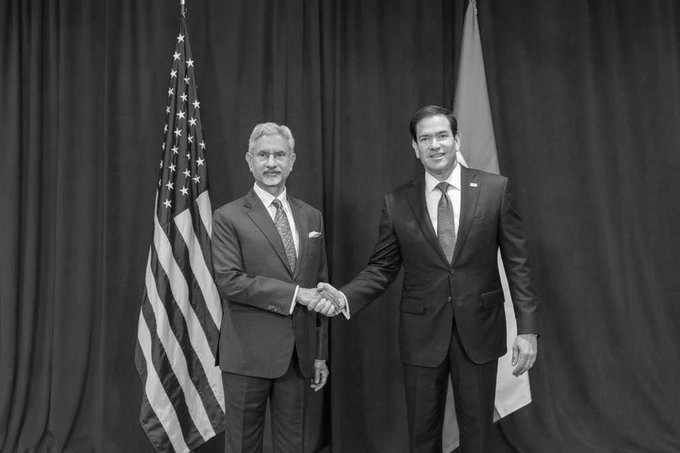
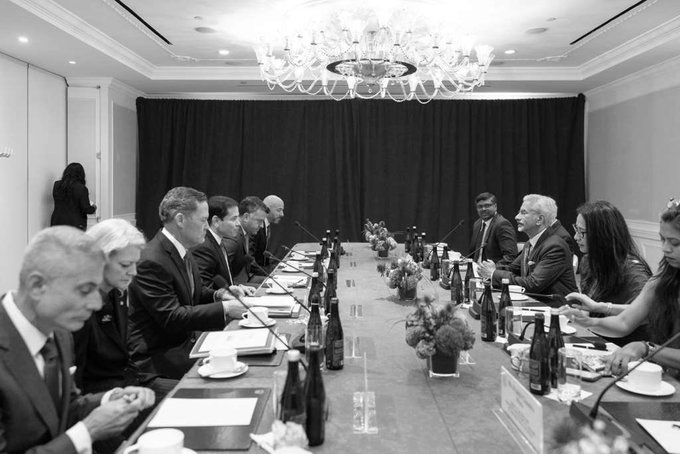
Jaishankar Meets Rubio On UNGA Sidelines, Raises Concerns Over Russia Sanctions Act
External Affairs Minister S Jaishankar’s meeting with US Secretary of State Marco Rubio on the sidelines of the UN General Assembly in New York has put Russia sanctions, Russian oil, tariffs and the stalled India-US trade deal back in focus.
Jaishankar said he had reiterated India’s “interests and concerns” over the Sanctioning Russia and Iran Act (SRIA) while discussing the Gulf and Ukraine. Rubio said the two sides were building on their strategic partnership and coordinating on regional and multilateral priorities. Washington also stressed that the US was well positioned to help partners address their energy-security needs.
The SRIA, signed by President Donald Trump on September 18, gives Washington authority to impose tariffs of up to 100% on countries purchasing significant quantities of Russian oil and gas. India is among the countries potentially exposed to the measure. However, the 100% tariff is not automatic and its application remains subject to presidential action and waiver provisions.
For India, the central issue is energy security. New Delhi has maintained that its energy decisions are based on national interests, affordability and market conditions, with reliable supplies essential for 1.4 billion people. India has also warned that the US sanctions law could affect bilateral ties and global energy markets.
The dispute comes alongside the unresolved India-US trade deal. An interim framework announced in February envisaged an 18% US reciprocal tariff on Indian goods. But that 18% rate was never ultimately implemented. The earlier 25% Russia-oil penalty was withdrawn, while the current framework has since changed following US legal and tariff actions. India now faces a 10% additional Section 301 tariff on covered goods, apart from applicable existing duties and sectoral tariffs.
Washington has also pursued two separate Section 301 investigations. The forced-labour probe covered 60 economies, including India, China, Pakistan and the Philippines. India, Pakistan and several others were ultimately placed in a 10% additional-tariff tier.