
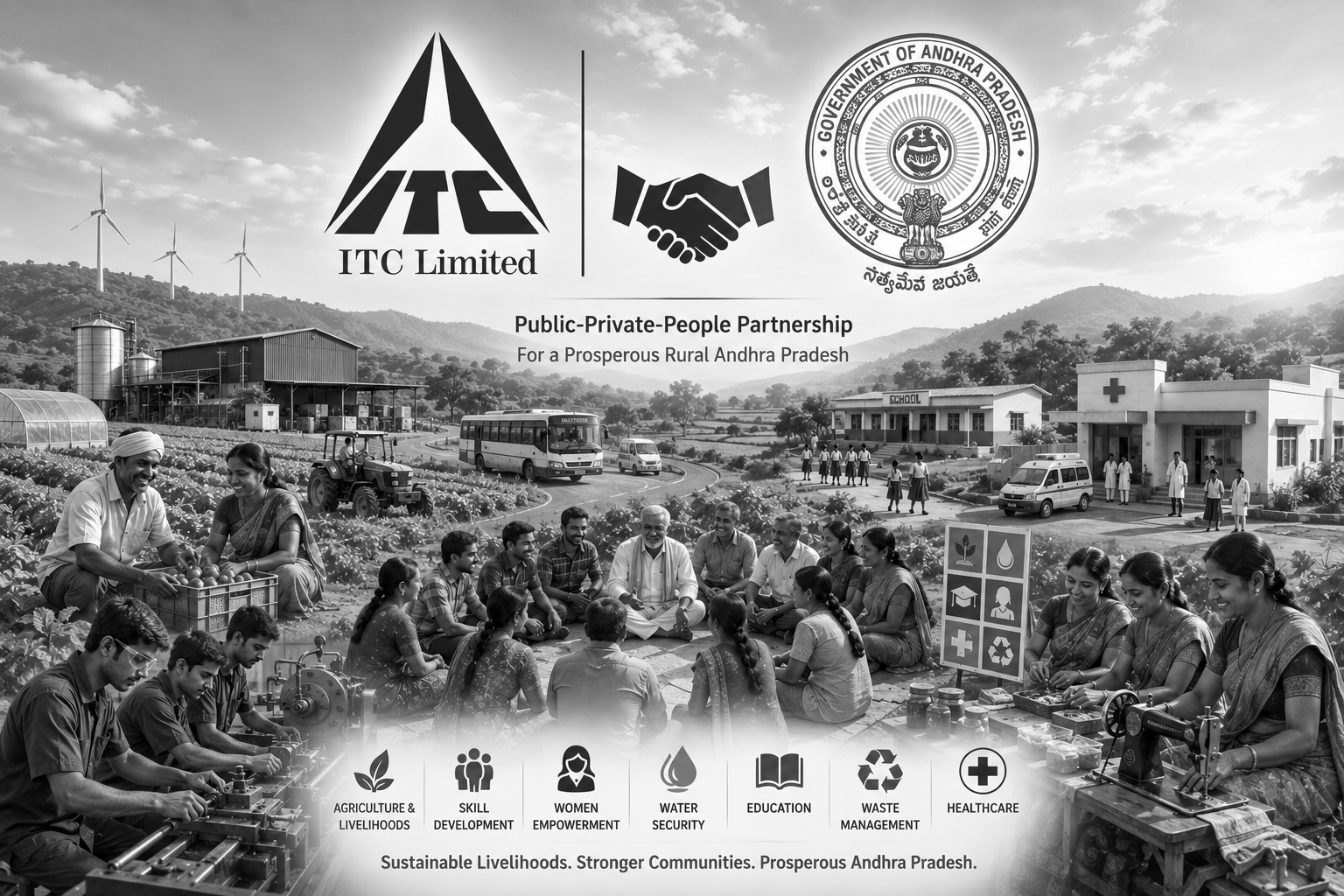
ITC Joins P4: Can Private Capital Reshape Andhra’s Rural Economy?
ITC Ltd’s decision to partner with the Swarna Andhra P4 Foundation (SAPF) to adopt 100 villages across nine districts has placed Andhra Pradesh’s ambitious zero-poverty programme at the centre of a larger question: can private capital, corporate expertise and community participation transform villages from welfare-dependent settlements into productive economic centres?
Under the agreement, 15 villages will be developed as P4 Lighthouse Villages, intended to demonstrate integrated rural-development models that can potentially be replicated elsewhere. ITC’s proposed interventions span agriculture, livelihoods, skilling, women’s empowerment, water security, education and waste management, placing the initiative well beyond conventional charitable assistance.
The experiment comes as Andhra Pradesh seeks to strengthen its position among India’s major economies. With a FY2024-25 GSDP of about ₹15.93 lakh crore, Andhra Pradesh ranked eighth among the country's largest state economies, behind Maharashtra, Tamil Nadu, Uttar Pradesh, Karnataka, West Bengal, Rajasthan and Telangana, while remaining ahead of Madhya Pradesh. The challenge for the state is no longer merely generating economic growth, but ensuring that its benefits reach rural households, young people, women and historically disadvantaged communities.
The Shift From Welfare to Wealth Creation
The P4, or Public-Private-People Partnership, framework attempts to change the traditional relationship between government and poor households. Vulnerable families are identified as Bangaru Kutumbalu, while individuals, companies and other contributors participating in the programme are designated Margadarsis. The framework provides for family adoption, community adoption and funding of specific needs, with interventions ranging from livelihoods and agriculture to business start-ups, skills, employment, education and healthcare.
The central idea is not that a Margadarsi should permanently support a family. Instead, assistance can become a bridge towards productive assets, skills, employment or entrepreneurship. A sewing machine, cattle, farm equipment or business support becomes economically meaningful when it is combined with training, working capital, market access and mentoring.
The early experience from Kuppam indicates the direction. Corporate CSR funds of ₹5.29 crore supported 761 families, with 444 families assisted through dairy farming and 155 through sheep and goat rearing. Other interventions included tailoring, retail, food businesses, vegetable trading and transport. The significance lies not merely in the assistance provided, but in whether these assets generate continuing income and eventually create employment for others.
From Farm Gates to Value Chains
Agriculture could become the strongest bridge between P4 and the wider economy. Instead of rural producers remaining at the bottom of the value chain, the model could connect them to aggregation, grading, storage, processing, packaging and organised markets.
A farmer selling raw produce earns from production. A village that processes, packages and markets that produce captures value at multiple stages. Andhra Pradesh’s Food Processing Policy 2024-29 already provides for Food Parks, Primary Processing Centres and cold-chain infrastructure, creating a potential ecosystem for such rural value addition.
The long-term chain could therefore run from farmer to FPO, collection centre, processor, MSME, corporate buyer and finally domestic or export market. ITC’s experience in agriculture, procurement and consumer markets makes its 100-village intervention particularly significant in this context. However, the company's detailed commercial or procurement linkages for the project have not yet been publicly specified.
The Rural MSME Revolution
The next major driver could be the creation of micro-enterprises and MSMEs. Rural economies cannot depend entirely on agriculture to absorb their growing workforce. Electricians, mechanics, food processors, transporters, retailers, digital service providers, tailors and small manufacturers can form a second economic layer around agriculture.
Andhra Pradesh’s MSME and Entrepreneur Development Policy 2024-29 already focuses on finance, infrastructure, technology, markets, skills and entrepreneurship, while recognising women, SC/ST/BC entrepreneurs, start-ups and backward regions as important areas of intervention.
P4 could become a pipeline into that ecosystem: identify a capable youth or family, provide mentoring and seed support, connect them with formal credit and technology, and then help them access markets. The progression would be household activity → micro-enterprise → formal MSME → expansion → employment.
Youth Need Jobs — and Reasons to Create Them
For the model to succeed, skill must end with either a job or a business. A certificate without an employer does little to reduce migration.
There is already a P4 example in this direction. MEIL’s skill-development centre in Ramakuppam trains candidates as electricians, provides food and a ₹10,000 monthly stipend, with eligible trainees expected to receive employment opportunities. MEIL has also adopted 1,500 families in Gudlavalleru, covering areas including education, employment, health, housing, skills and mentorship.
The larger opportunity is to align training with actual corporate demand. Companies can identify the skills needed in their factories, vendors and supply chains, while training institutions prepare rural youth accordingly. Entrepreneurship can follow a similar path: business idea → mentor → seed capital → MSME registration → credit → market → expansion.
Women, Children and Healthcare as Economic Capital
A successful rural economy must also bring women into productive activity and protect the next generation's human capital. Women-led enterprises in food processing, tailoring, livestock, handicrafts and services can increase household income when equipment is combined with training and market access.
For children, poverty reduction must extend beyond household income to nutrition, health, education and digital skills. Andhra Pradesh already has public child-health programmes and a wide healthcare network, while emerging digital-health systems can potentially improve screening, telemedicine, referral and follow-up. Private players can supplement public healthcare through diagnostics, technology, equipment and specialist access rather than replacing government systems.
Building Villages That Can Sustain Growth
The ultimate test will be whether P4 creates the infrastructure required for businesses and families to thrive. Roads, reliable power, water, broadband, warehouses, cold chains, healthcare, schools, sanitation, waste management and local commercial facilities can convert a village from a residential settlement into an economic ecosystem.
The model can also improve resilience against inflation. P4 cannot control inflation, which depends on monetary policy, fuel prices, global commodities and supply conditions. But higher agricultural productivity, reduced post-harvest losses, shorter supply chains, diversified incomes and stronger local production can help rural households withstand price shocks.
The Lighthouse Test
Corporate village development is not new in India. Tata Motors Foundation’s Integrated Village Development Programme has expanded to nearly 200 villages across 103 gram panchayats in five states, while Reliance Foundation and Adani Foundation operate large rural-development programmes across thousands of villages.
What makes P4 potentially distinctive is its attempt to place private companies, individual mentors, communities and government coordination inside one statewide zero-poverty architecture.
That makes ITC’s 15 Lighthouse Villages particularly important. Their success should not be measured simply by the number of families receiving assistance. The real indicators should be new enterprises, sustainable jobs, higher farm incomes, women entrepreneurs, MSMEs entering formal value chains, improved healthcare and education, infrastructure created and private investment attracted.
If these outcomes materialise, the pathway could become self-reinforcing: productive household → entrepreneur or worker → MSME → value chain → employment → higher income → stronger consumption → more businesses → greater investment.
The ultimate ambition of P4, therefore, is bigger than poverty reduction. If government coordination, private capital and community participation work together, Andhra Pradesh could use its rural hinterland as a new engine of inclusive economic growth — where villages do not simply receive development, but increasingly generate it themselves.