
Italy PM Meloni Plans Burqa-Niqab Ban, Foreign Student Cap In Schools
Italian Prime Minister Giorgia Meloni is preparing measures to limit the number of foreign students in classrooms and prohibit the wearing of burqas and niqabs in schools, as her government takes a tougher approach to immigration and integration.
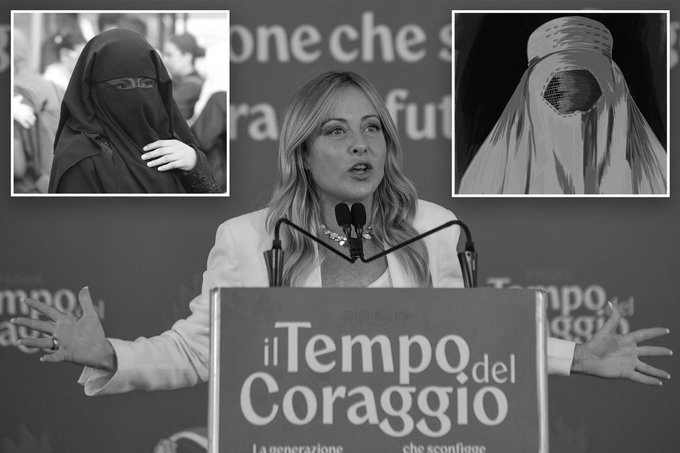
Meloni announced the plans on Sunday while addressing the youth wing of her nationalist conservative Brothers of Italy party at the Gioventù Nazionale national festival in Rome.
The proposed package would also require Italian-language lessons for parents of foreign students facing what Meloni described as “serious difficulties integrating into the school system”.
“For us, anyone who comes to Italy and wants to build their future here must learn our language, understand our culture, and respect our rules,” Meloni said to a standing ovation. “It is the only serious way to welcome them.”
Meloni said the government would soon present a measure to the Council of Ministers to legally establish a maximum number of foreign students per class. However, she has not specified what the new limit would be. Italy already has a 30% framework for foreign students in classrooms, although its implementation has been debated in areas with high concentrations of migrant families.
The proposed restrictions would affect a significant part of Italy’s school population. Around 930,000 students without Italian citizenship are enrolled in Italian schools, accounting for about 11.6% of all students, according to research institute Fondazione ISMU. ISMU has also reported a 4.5% decline in the number of foreign minors in Italy over the past decade.
Meloni argued that the concentration of students who do not understand Italian can make integration more difficult.
“If there is only one child in a class who doesn't understand Italian, that child will likely be able to learn the language and integrate quickly with the help of classmates and teachers,” she said. “However, if the number of children who don't understand the language becomes large or even the majority that is no longer integration; it is neglect.”
The government also plans to ban burqas and niqabs in schools. Meloni said students should attend school with their faces uncovered and argued that no one should be able to require a young woman to hide her face in the name of tradition.
The hijab, which covers the hair but leaves the face visible, was not specifically mentioned in Meloni’s announcement.
Italy is among the European countries most exposed to migrant arrivals because of its central Mediterranean location. Integration, particularly of migrants from Muslim-majority countries, remains a contentious issue in Italian politics and society.
Meloni, whose political roots lie in the nationalist right, has maintained a strong focus on migration since becoming prime minister. Her government is also approaching a general election expected next year, adding political significance to its latest integration measures.
The proposals are not yet law. Once approved by the government, the measure would require parliamentary approval within 60 days to take effect.
Earlier this month, Meloni’s administration also became Italy’s longest-serving uninterrupted government since World War II.
The move has reignited debate over whether face-covering veils can be justified in the name of tradition and integration. Critics argue that restricting them could instead fuel discrimination and social exclusion against Muslim women.