
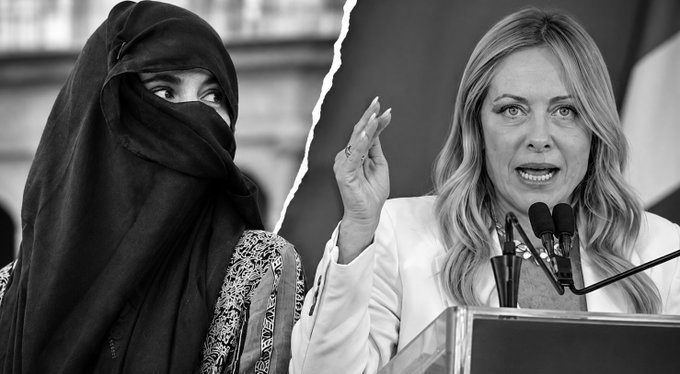
Italy Bans Burqas And Niqabs In Schools, Introduces 30% Cap On Foreign Students
Italy has passed a new education law prohibiting students from wearing burqas and niqabs in schools, while introducing a 30 percent cap on foreign students in certain classrooms. The legislation, backed by Prime Minister Giorgia Meloni's government, aims to promote integration, improve language proficiency and establish common rules in educational institutions.
The Chamber of Deputies approved the legislation on November 26, with 142 votes in favour, 112 against and four abstentions. The Senate had approved the measure on November 20, completing its passage through Parliament.
Under the new law, students cannot participate in school activities with their faces covered in a way that prevents identification. This effectively prohibits burqas and niqabs, which conceal the face. However, the restriction does not cover hijabs, which leave the face visible.
Defending the measure, Meloni had argued that compulsory face coverings could undermine women's rights and integration. "When a woman or worse, a young girl is forced to cover her face, she is being denied fundamental rights and the very integration that is so often loudly championed," she said in a television interview.
The legislation also introduces a 30 percent limit on foreign students in first-year classrooms. The restriction primarily targets students who lack sufficient Italian language proficiency, with exemptions based on their educational background and command of the language.
Under the provisions, eligibility for the cap also depends on factors such as citizenship, whether a child was born in Italy and the number of years spent in the Italian education system. Schools unable to meet the prescribed limit can arrange for students to be distributed among nearby institutions.
The government has also proposed Italian language classes for foreign parents whose limited knowledge of the language affects their children's education.
However, the legislation has drawn criticism from opposition parties and child rights groups, which warn that the restrictions could discriminate against migrant children and deepen social divisions.
During the parliamentary vote, opposition lawmakers displayed a placard reading, "At school nobody is a foreigner".
Education Minister Giuseppe Valditara defended the legislation, saying it would promote "genuine integration" through better knowledge of Italian and respect for common rules. Save the Children, meanwhile, warned that the classroom cap could create "first-class" and "second-class" students.
Italy's decision comes amid wider European restrictions on full-face veils. France and Belgium introduced nationwide public-space bans in 2011, followed by Bulgaria in 2016, Austria in 2017 and Denmark in 2018.
The Netherlands and Luxembourg have adopted partial restrictions covering places such as schools, hospitals and public transport. Germany has varying rules across its states, while Spain, Portugal and Sweden do not have nationwide bans on full-face veils. Greece has also witnessed disputes over religious head coverings in institutional settings.