
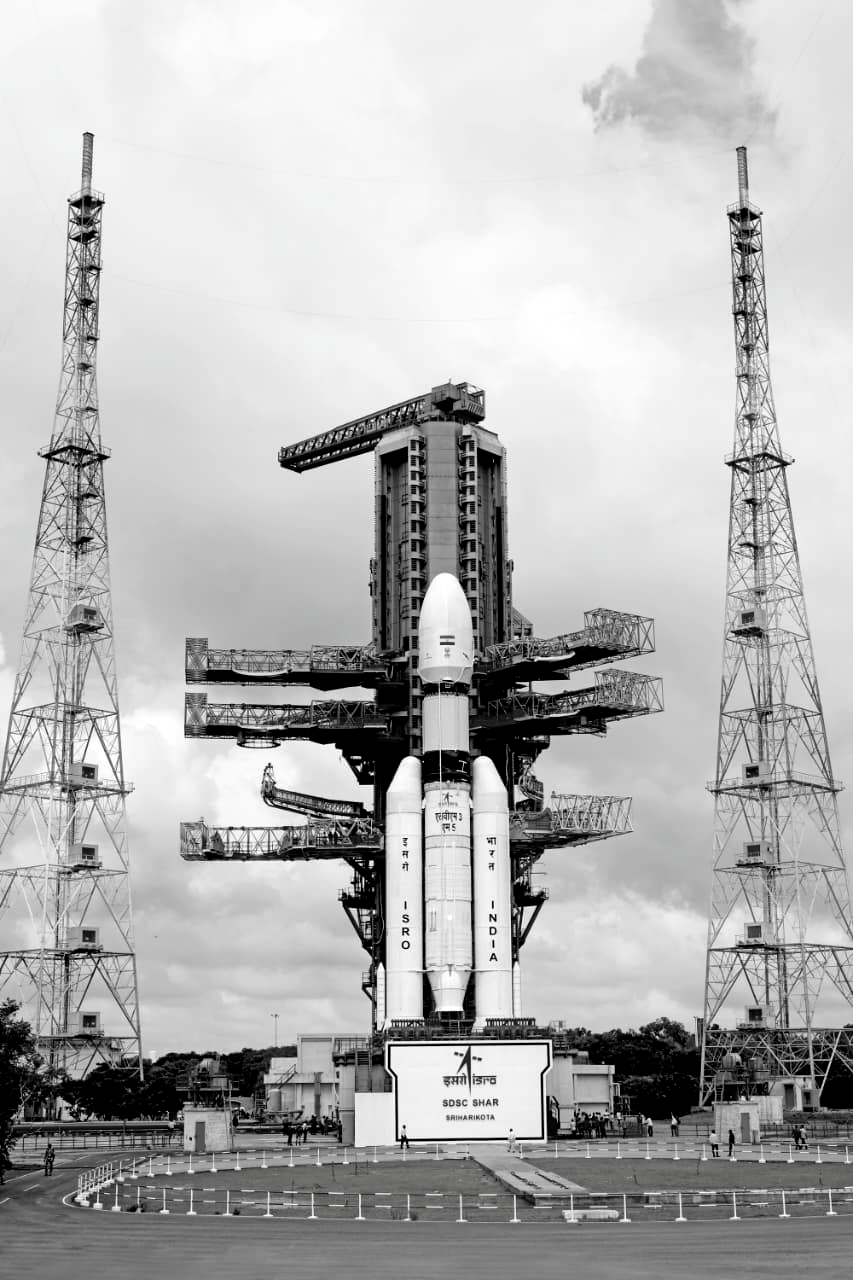
ISRO’s LVM3-M5 ready to launch heaviest communication satellite CMS-03 on Nov2
India’s space agency ISRO is gearing up for its next major launch, as the Launch Vehicle Mark-3 5th operational flight (LVM3-M5) mission prepares to lift off on November 2, 2025, carrying CMS-03, the country’s heaviest communication satellite to date. The 4,400 kg satellite will be launched from the Satish Dhawan Space Centre (SDSC-SHAR) at Sriharikota and placed in a Geosynchronous Transfer Orbit (GTO).
According to ISRO, the LVM3 launch vehicle has been fully integrated with the Communication Satellite-03 (CMS-03) satellite and was moved to the launch pad on October 26 for final pre-launch operations. This will be the fifth operational flight of the LVM3 rocket, which previously launched the successful Chandrayaan-3 lunar mission in 2023, making India the first nation to land near the Moon’s south pole.
Heaviest Indian communication satellite
CMS-03 is a multi-band communication satellite designed to provide seamless connectivity across the Indian mainland and adjoining oceanic regions, including the Bay of Bengal, the Arabian Sea and parts of the Indian Ocean. It will support television broadcasting, mobile networks, VSAT links, and maritime communications, thereby strengthening the country’s digital and communication infrastructure.
At around 4,400 kg, CMS-03 will be the heaviest communication satellite ever launched from Indian soil, showcasing ISRO’s growing capability to handle large payloads on its own launch vehicles.
Single payload mission
Unlike smaller missions that carry multiple satellites, LVM3-M5 will deploy only one payload — CMS-03. The powerful three-stage rocket, also known as GSLV Mk III, is designed primarily for heavy-lift missions to GTO and deep-space exploration.
ISRO’s roadmap for upcoming launches
With CMS-03 ready for orbit, ISRO is also advancing a busy launch schedule over the next year, covering navigation, Earth observation, and human spaceflight missions.
Navigation Satellites (NavIC series):
ISRO is preparing to launch NVS-02, NVS-03, and NVS-04, which will expand the Navigation with Indian Constellation (NavIC) system India’s indigenous satellite-based navigation network that provides regional positioning services similar to GPS.
Earth Observation Missions: Several Earth observation satellites are in the pipeline, including Resourcesat-3S/3SA for agricultural and land-use monitoring, Oceansat-4 for ocean and coastal studies, and GISAT-1A, a geostationary imaging satellite that will enable real-time observation of the Indian subcontinent.
Gaganyaan Human Spaceflight Programme: Under India’s flagship human spaceflight mission, ISRO plans to conduct two uncrewed test flights (TV-D2 and TV-D3) before the first crewed mission, tentatively scheduled for late 2026. The programme aims to send three Indian astronauts into low Earth orbit for a mission lasting up to five days.
Planetary and Science Missions: Looking beyond Earth, ISRO’s Shukrayaan-1 mission to Venus is under advanced planning for 2026–27, aiming to study the planet’s atmosphere and surface. Meanwhile, the Aditya-L1 spacecraft, launched in 2023, continues to provide valuable solar data from the L1 point between the Earth and the Sun.
Expanding launch vehicle capabilities
ISRO is also working on next-generation launch vehicles. The Small Satellite Launch Vehicle (SSLV) will cater to quick, low-cost launches for small payloads, while the Next Generation Launch Vehicle (NGLV) a reusable heavy-lift rocket is under development to eventually replace LVM3 in the 2030s.
India’s expanding space ambition
The CMS-03 mission marks another step in India’s growing space profile, combining communication, navigation, and exploration capabilities under a unified long-term vision. With an active launch calendar, indigenous technology development, and international collaborations through NewSpace India Limited (NSIL), ISRO continues to strengthen its position among the world’s leading space agencies.
If successful, the November 2 launch will reaffirm India’s ability to independently place heavy satellites into orbit and further solidify its role in global space communications and technology.