
ISRO unveils advanced lunar data to map Moon’s polar regions
The Indian Space Research Organisation (ISRO) has released new data from the Chandrayaan-2 Orbiter, which has been orbiting the Moon since 2019. The data focuses on the Moon’s north and south polar regions, areas of high scientific interest as they may contain water-ice and important clues about the early solar system.
A key instrument on Chandrayaan-2 is the Dual Frequency Synthetic Aperture Radar (DFSAR). This advanced radar sends and receives signals in two directions, vertical and horizontal, allowing scientists to study both the surface and shallow layers beneath it. DFSAR is the first radar to map the Moon in full-polarimetric L-band at a sharp resolution of 25 meters per pixel, providing highly detailed views of surface features.
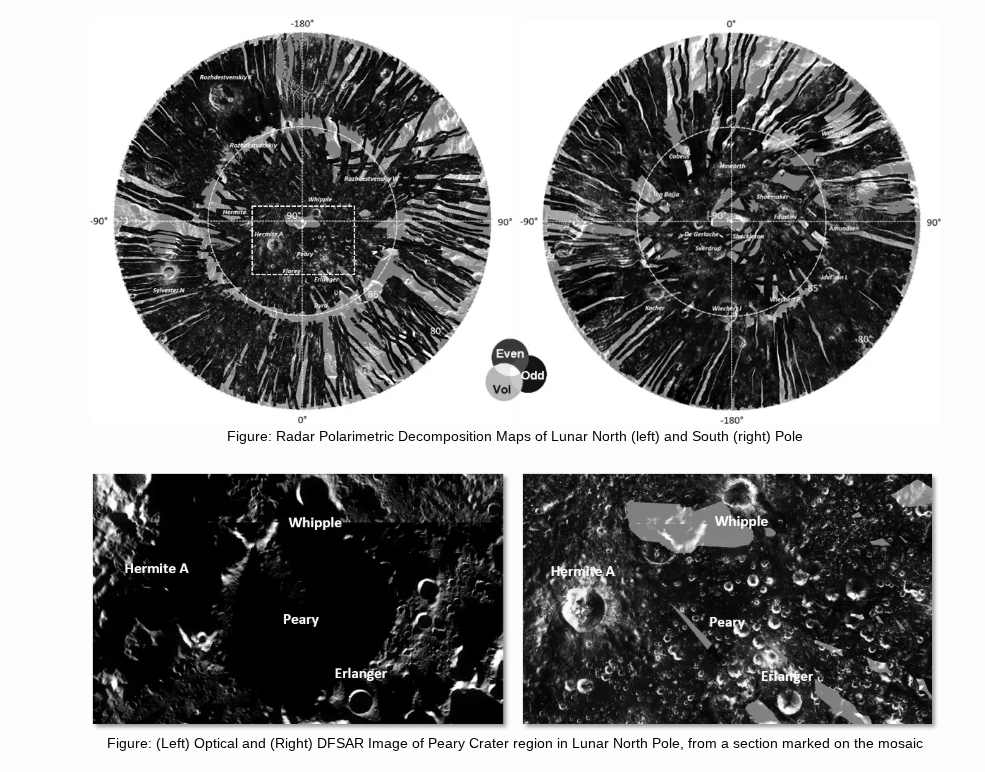
Using approximately 1,400 radar datasets, scientists at the Space Applications Centre (SAC), Ahmedabad, created polar mosaics of the lunar poles. These mosaics help researchers examine key properties of the Moon’s surface, such as the possible presence of water-ice, surface roughness, and soil density and porosity.
The radar images provide this information through several parameters. The Circular Polarization Ratio (CPR) indicates areas that may contain ice. The Single Bounce Eigenvalue Relative Difference (SERD) measures surface roughness. The T-Ratio relates to soil density and porosity. Additionally, polarimetric decomposition components show how radar signals scatter, helping scientists distinguish between rocks, loose soil, and layered structures.
These Level 3C Polar Mosaic products are now freely available on ISRO’s PRADAN portal and can also be visualized using CH2 MapBrowse. The ready-to-use data will assist scientists in planning future lunar missions and studying the Moon’s polar regions in detail. It also complements other studies that map minerals on the Moon’s surface.
By providing this data, ISRO is encouraging researchers worldwide to explore the least understood yet scientifically promising regions of the Moon, which could reveal important information about its formation and the early solar system.