
ISRO Detects Possible Subsurface Ice on Moon Using Chandrayaan-2 Data
India's lunar ambitions have reached a compelling scientific milestone . Scientists analysing data from ISRO's Chandrayaan-2 orbiter have identified strong evidence of subsurface water-ice buried beneath craters near the Moon's South Pole , one of the coldest and most enigmatic environments in the entire solar system. Remarkably, this discovery comes from an orbiter that lost its lander during descent in 2019, yet has continued delivering high-quality scientific data for years thereafter, a testament to the enduring value of well-engineered orbital platforms.
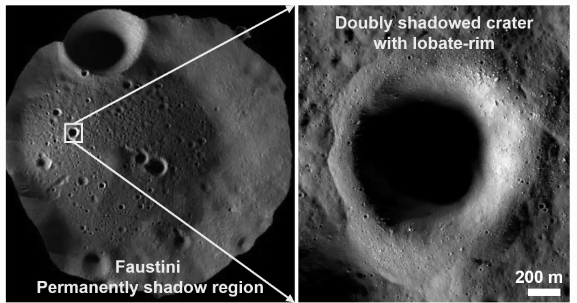
The breakthrough was achieved using the Dual Frequency Synthetic Aperture Radar (DFSAR) , the first fully polarimetric synthetic aperture radar ever deployed to the Moon, operating across both L-band and S-band frequencies. Researchers from the Physical Research Laboratory in Ahmedabad focused their analysis on a rare class of doubly shadowed craters nestled within permanently shadowed regions, where sunlight never penetrates and temperatures plunge to a bone-chilling minus 248 degrees Celsius, or nearly 25 Kelvin . Such extreme conditions make these sites extraordinary natural vaults, capable of locking away water-ice for billions of years without any thermal disturbance.
To distinguish genuine ice deposits from deceptively similar rough rocky terrain, the team developed a refined method combining two critical radar parameters, Circular Polarization Ratio (CPR) and Degree of Polarization (DOP) . Where CPR values exceeded one and DOP values fell below 0.13, the data revealed unmistakable signatures of volumetric scattering, a phenomenon strongly associated with buried ice. Four doubly shadowed craters yielded these compelling signatures, with a small 1.1-kilometre crater inside the larger Faustini crater emerging as the strongest candidate, further distinguished by distinctive lobate-rim features, flow-like formations believed to have formed when an ancient impact struck an ice-rich subsurface layer.
The stakes could hardly be higher. Lunar water-ice is a transformative resource for deep-space exploration, offering a viable pathway to producing drinking water, breathable oxygen, and rocket propellant directly on the Moon through in-situ resource utilisation, dramatically reducing dependence on Earth-supplied cargo.
Coming in the wake of Chandrayaan-3's historic 2023 polar landing , this discovery reaffirms India's growing scientific authority in unravelling the Moon's most closely guarded secrets and strengthens its position at the forefront of global lunar exploration .