
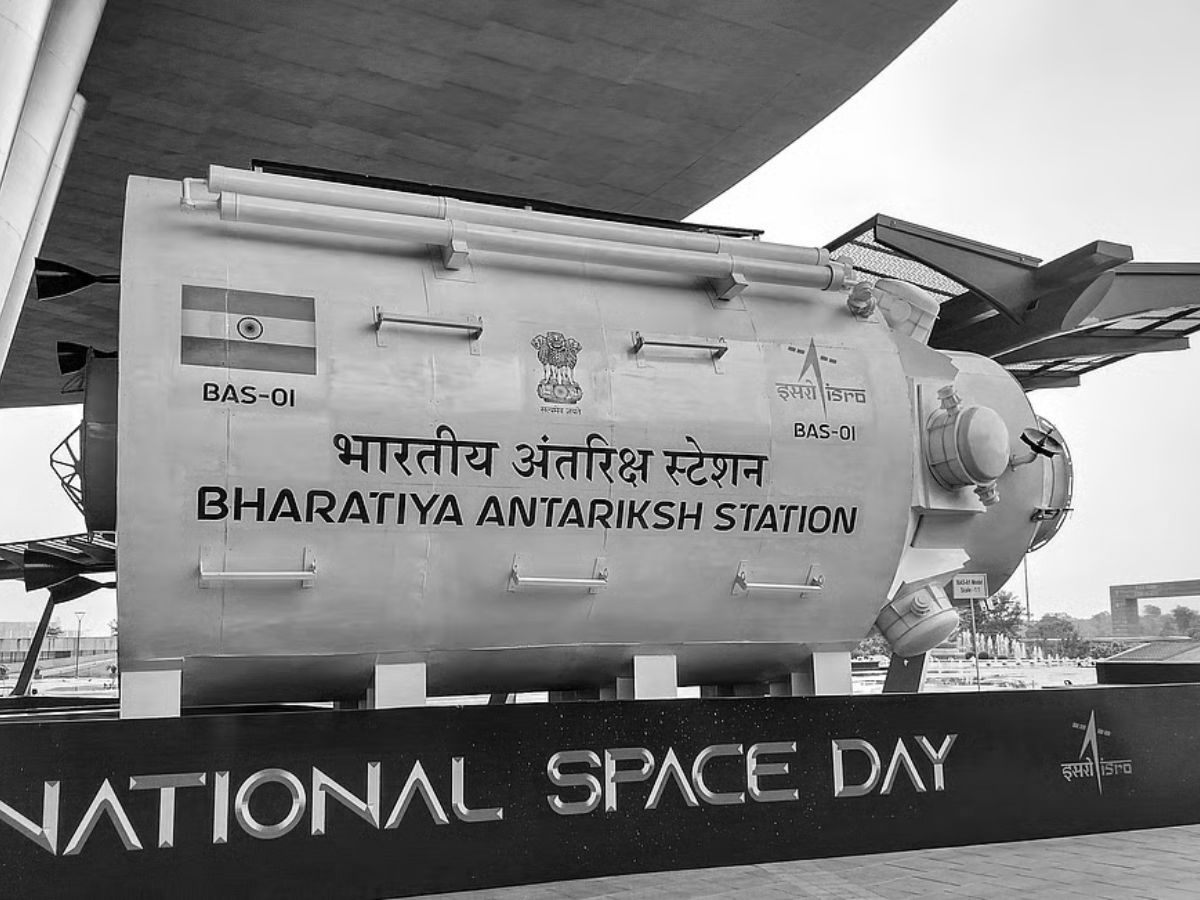
ISRO Builds Path to Orbital Lab as BAS-01 Targets 2028 Launch
India is steadily charting a new course in space exploration with the development of the Bharatiya Antariksh Station (BAS) , a project that signals its transition from episodic missions to a sustained human presence in orbit. Conceived as a multi-module space station , BAS will comprise five interconnected units , with the first module, BAS-01 , targeted for launch by 2028 . The project, approved by the Union Cabinet as part of the expanded Gaganyaan Programme , has an allocated cost of ₹1,763 crore for its initial phase spanning 2025 to 2028 , while the complete station is expected to become operational by 2035 .
The Indian Space Research Organisation (ISRO) has already finalized the station’s configuration, which has undergone review at the national level, indicating that the mission has entered a mature planning stage. Work on system engineering and subsystem technologies is progressing across multiple ISRO centres, reflecting a coordinated national effort. Importantly, the Vikram Sarabhai Space Centre (VSSC) has invited Indian industries to participate in building the structure of the first module, underlining a strategic shift toward public-private collaboration and the creation of a robust domestic space manufacturing ecosystem.
BAS is closely linked to the Gaganyaan mission, which serves as a technological precursor. While Gaganyaan focuses on sending Indian astronauts into low-Earth orbit for short-duration missions , BAS aims to extend this capability into long-duration habitation and research . The knowledge gained from Gaganyaan—particularly in crew safety, life-support systems, launch escape mechanisms, and recovery operations —will directly feed into the development of BAS, ensuring a gradual and risk-managed expansion of India’s human spaceflight capabilities.
At its core, the BAS programme is as much about technological advancement as it is about human spaceflight. Key systems under development include rendezvous and docking technologies , essential for assembling modules in orbit and enabling crew transfers; robotic systems for maintenance and operations; and in-orbit refueling , which could extend mission lifespans and support future deep-space endeavors. The station will also feature advanced crew quarters, intra-vehicular suits , and dedicated infrastructure for microgravity experiments .
Scientifically, BAS is expected to open new frontiers in microgravity research , with a focus on life sciences, pharmaceuticals, material sciences, and advanced manufacturing technologies . Experiments conducted in the absence of gravity could lead to breakthroughs in drug development, human physiology, and high-precision materials , with significant applications on Earth. This positions BAS not only as a scientific laboratory in space but also as a driver of innovation across multiple industries.
The project also carries substantial economic and geopolitical significance . By encouraging private sector participation, BAS could catalyze the growth of India’s NewSpace ecosystem , fostering startups and high-tech manufacturing capabilities. On the global stage, the timing of BAS is notable, as the International Space Station (ISS) is expected to be phased out in the coming years. With China already operating its own space station, BAS could enable India to emerge as a key player in providing orbital research infrastructure , potentially opening avenues for international collaboration.
However, the road ahead is complex. Developing reliable life-support systems for extended missions , ensuring astronaut safety, and maintaining cost and timeline discipline will be critical challenges. Achieving the 2028 launch target for the first module will require seamless coordination between government agencies, research institutions, and private industry.
Despite these challenges, the Bharatiya Antariksh Station represents a transformational leap in India’s space ambitions . It moves the country beyond its reputation as a cost-efficient launch provider toward becoming a comprehensive space power —one capable of supporting human life in orbit, conducting advanced research, and shaping the future of space exploration.