
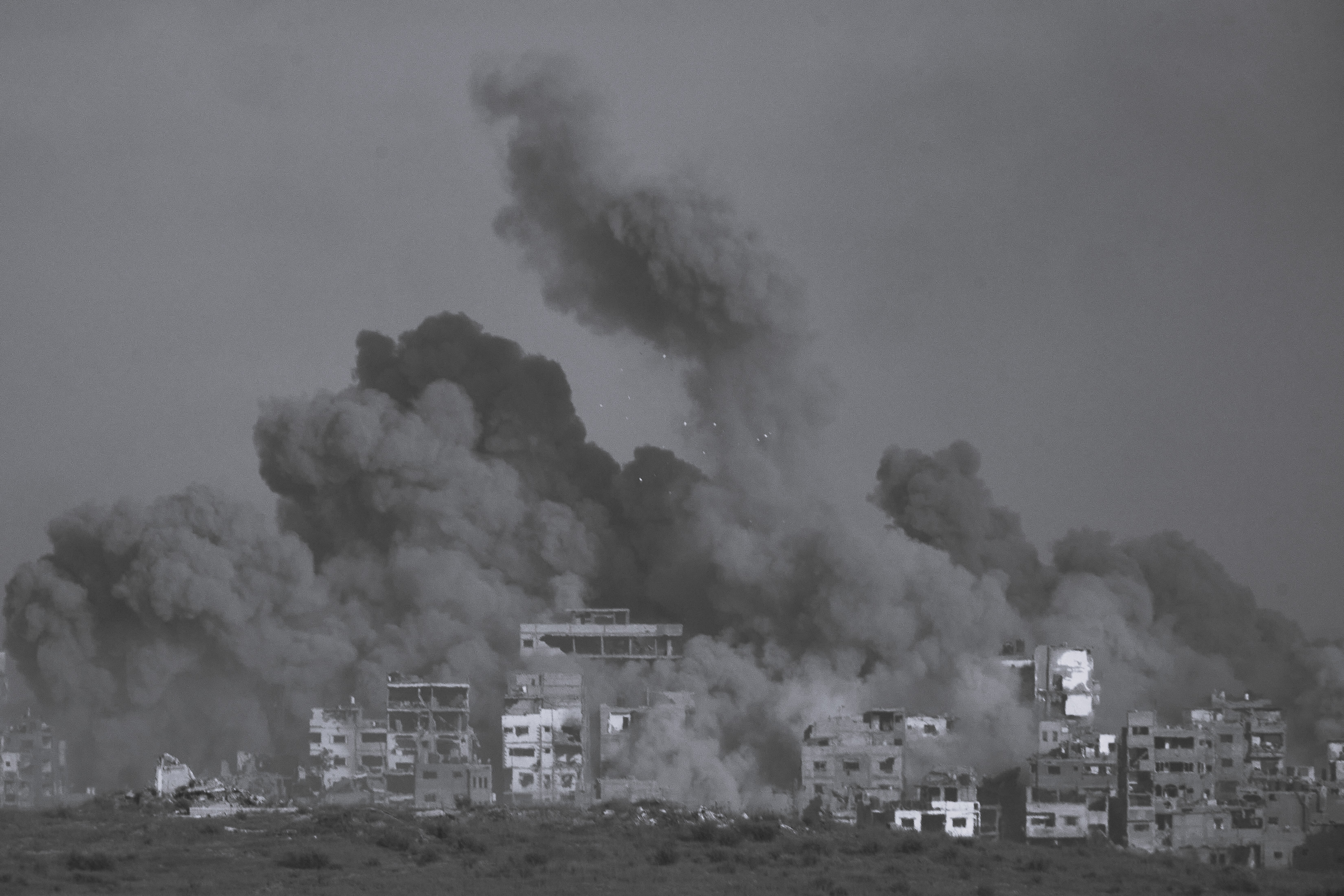
Israel, Hamas launch indirect talks in Egypt on eve of Gaza war anniversary
Israeli and Hamas officials launched indirect talks Monday at an Egyptian resort regarding a U.S.-drafted peace plan aimed at ending the devastating war in Gaza, on the eve of its second anniversary.
The talks, which lasted several hours, took place amid questions about the plan presented last week by U.S. President Donald Trump, including the disarmament of Hamas a key Israeli demand and the future governance of Gaza. Trump has suggested that an agreement on Gaza could pave the way for a broader Middle East peace process. Despite Trump calling for Israel to halt its bombing, Israeli forces continued airstrikes on Gaza, killing at least 19 people in the past 24 hours, according to the territory's Health Ministry.
An Egyptian official familiar with the negotiations said Monday’s round concluded at the Red Sea resort of Sharm el-Sheikh, with discussions set to resume Tuesday afternoon. Speaking on condition of anonymity due to the sensitivity of the talks, the official said both sides had agreed on most first-phase terms, including the release of hostages and establishing a ceasefire.
The Israeli delegation is led by top negotiator Ron Dermer, while Khalil al-Hayyah heads the Hamas team. Prime Minister Benjamin Netanyahu's office confirmed that foreign policy adviser Ophir Falk would also participate for Israel. Egypt's state-owned Al-Qahera News reported that the talks began with a meeting between Arab mediators and Hamas, followed by discussions with the Israeli delegation. U.S. envoy Steve Witkoff and Trump’s son-in-law Jared Kushner were also expected to join.
Hamas stated that negotiations would focus on the first stage of a ceasefire, including partial withdrawal of Israeli forces and the release of hostages held by militants in Gaza, in exchange for Palestinian prisoners detained in Israel. This peace effort follows Hamas’s acceptance of certain elements of the U.S. plan, which Israel has also supported. Under the plan, Hamas would release the remaining 48 hostages about 20 of whom are believed to be alive—within three days, surrender power, and disarm.
Netanyahu said the talks would be “confined to a few days maximum,” though some Hamas officials warned that additional time might be needed to locate hostages’ bodies buried under rubble. Egyptian President Abdel-Fattah el-Sisi praised Trump’s efforts, highlighting the importance of preserving the U.S.-crafted “peace system” in the Middle East since the 1970s, which he described as a strategic framework for regional stability. El-Sisi made the remarks in a televised address commemorating the anniversary of the 1973 war with Israel, which led to Egypt reclaiming the Sinai Peninsula.
U.S. calls for Israeli bombing to stop
The U.S. has stated that Israel’s heavy bombardment of Gaza must cease for the hostages to be released. Israel says it is largely complying with Trump’s call. The Israeli military claims its strikes are mostly defensive, though dozens of Palestinians have been killed since a Saturday night statement. Gaza’s Health Ministry reported that 19 people, including two killed by Israeli strikes and gunfire, were brought to hospitals over the past 24 hours, with another 96 wounded. Since Hamas’s October 7, 2023, attack triggered the war, the ministry reports a Palestinian death toll of 67,160, with nearly 170,000 wounded. The ministry does not distinguish civilians from combatants but notes that over half of the deaths were women and children.
Hamas abducted 251 people and killed around 1,200, mostly civilians, during the October 7 attack. Most Israeli hostages have since been released in ceasefires or other deals. Meanwhile, families of Israeli hostages petitioned the Nobel Prize Committee to award Trump the Peace Prize for his efforts to secure their release.
“At this very moment, President Trump's comprehensive plan to release all remaining hostages and finally end this terrible war is on the table,” the families wrote. “For the first time in months, we are hopeful that our nightmare will finally be over.” At a commemoration ceremony for Israelis killed at Nir Oz Kibbutz, Daniel Lifshitz emphasized the importance of swiftly releasing all remaining hostages.
“Israel will pay painful concessions by releasing mass murderers and terrorists who killed many of our friends and families, but we cherish life and trust Trump to make it happen,” Lifshitz said, grandson of slain hostage Oded and released hostage Yocheved Lifshitz.
Living in fear, War, and displacement
In Gaza, families of Palestinian babies born on the day the war began hoped to celebrate their second birthday with laughter instead of bombs. Many have been repeatedly displaced and live in constant fear, lacking access to health care. Amal al-Taweel and her husband, Mostafa, had their son Ali after three years of trying to conceive. They now live in a tent without proper sanitation, food, vaccinations, or toys. “I envisioned a different life for him… He couldn’t experience what a safe family life feels like,” al-Taweel said.
The Vatican marked the second anniversary of the October 7 attacks by condemning the “inhuman massacre” of innocent Israelis and calling for hostages’ return. It also criticized Israel’s bombing of Gaza as disproportionate and urged countries to stop supplying weapons for the war. “Those who are attacked have a right to defend themselves, but even legitimate defense must respect proportionality,” Vatican Secretary of State Cardinal Pietro Parolin said. “The perverse chain of hatred can only generate a spiral that leads nowhere good.”