
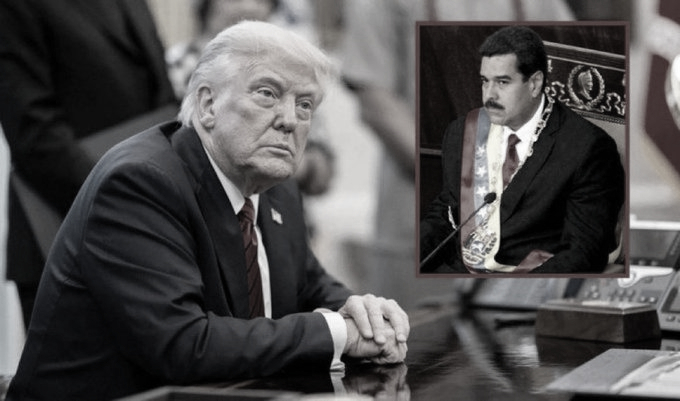
Is US attack on Venezuela imminent?
A dramatic U.S. military buildup in the Caribbean has escalated fears of an imminent confrontation with Venezuela, as the Trump administration intensifies operations in the region amid drug trafficking allegations and political brinkmanship.
Operation Southern Spear, launched earlier this month. The U.S. claims the mission targets narcotics trafficking networks, but it has already included 19 airstrikes on Venezuelan ships, killing 76 people. Washington labels these vessels as “drug boats,” yet no trials or concrete evidence have been presented. Analysts suggest the operation could be a pretext for broader military action.
In a striking show of force, the U.S. Navy rerouted the USS Gerald R. Ford, the world’s largest and most advanced aircraft carrier, from the Mediterranean to the Caribbean. The 100,000-ton vessel carries 5,500 personnel, 75 attack and surveillance aircraft including FA-18 fighters, and is supported by five missile-guided destroyers. Alongside it, nine additional U.S. warships, including amphibious assault ships, missile cruisers, destroyers, and a nuclear submarine, have entered the Caribbean. Air assets deployed in the region include B-52 strategic bombers, B1B supersonic bombers, F-35 fighter jets, and MQ-9 Reaper drones.
This military buildup is complemented by a 10,000-strong U.S. troop presence in the Caribbean, with half stationed in Puerto Rico, roughly 800 kilometers from Venezuela. The reopening of a U.S. military base on the island signals long-term strategic planning and potential readiness for a wider operation.
Alongside Southern Spear, the U.S. plans five days of exercises in Trinidad and Tobago starting Sunday, involving the U.S. Marine Corps’ 22nd Marine Expeditionary Unit. While Trinidadian authorities describe the drills as aimed at combating gang violence and drug trafficking, Venezuela has condemned them as a “grave threat” to Caribbean peace.
President Nicolás Maduro has responded with a “massive mobilization” of troops, weapons, and equipment, staging military drills and warning of an “imperialist threat.” He told supporters, “The strength of the country will always be that of the people and not the oligarchs or the imperialists.”
Opposition leader Maria Corina Machado has openly welcomed U.S. measures, calling Maduro a “real threat to U.S. national security” and urging military personnel to “be heroes, not criminals,” framing foreign intervention as a path toward a “bright future.”
The diplomatic fallout is already apparent. At the recent G7 summit, U.S. Senator Marco Rubio faced questioning from allies over possible strikes on Venezuela, with several nations warning against unilateral action that could destabilize the region. The United Kingdom, which maintains five Caribbean overseas territories, has reportedly stopped sharing intelligence with the U.S. in protest against the airstrikes.
Analysts outline three potential scenarios: limited strikes on Venezuelan military facilities to weaken Maduro’s grip, attacks on oil infrastructure, the backbone of Venezuela’s economy or a political negotiation, such as Maduro’s reported offers to grant future oil and gold contracts to U.S. companies while ending agreements with Russia and China, which Trump is said to have rejected.
Despite the capability of the U.S. to inflict damage, it is warned by experts that a force of 15,000 troops would be insufficient to occupy a nation of nearly 30 million, leaving the long-term strategy unclear. Questions over Washington’s motives are being raised: whether a show of toughness on drugs is being made, an effort to topple a socialist regime is being attempted, or control over Venezuela’s natural resources is being sought. As the Caribbean is being braced for continued U.S. military exercises and Operation Southern Spear is being carried out, the world is being watched anxiously, awaiting the next move, or the next strike.