
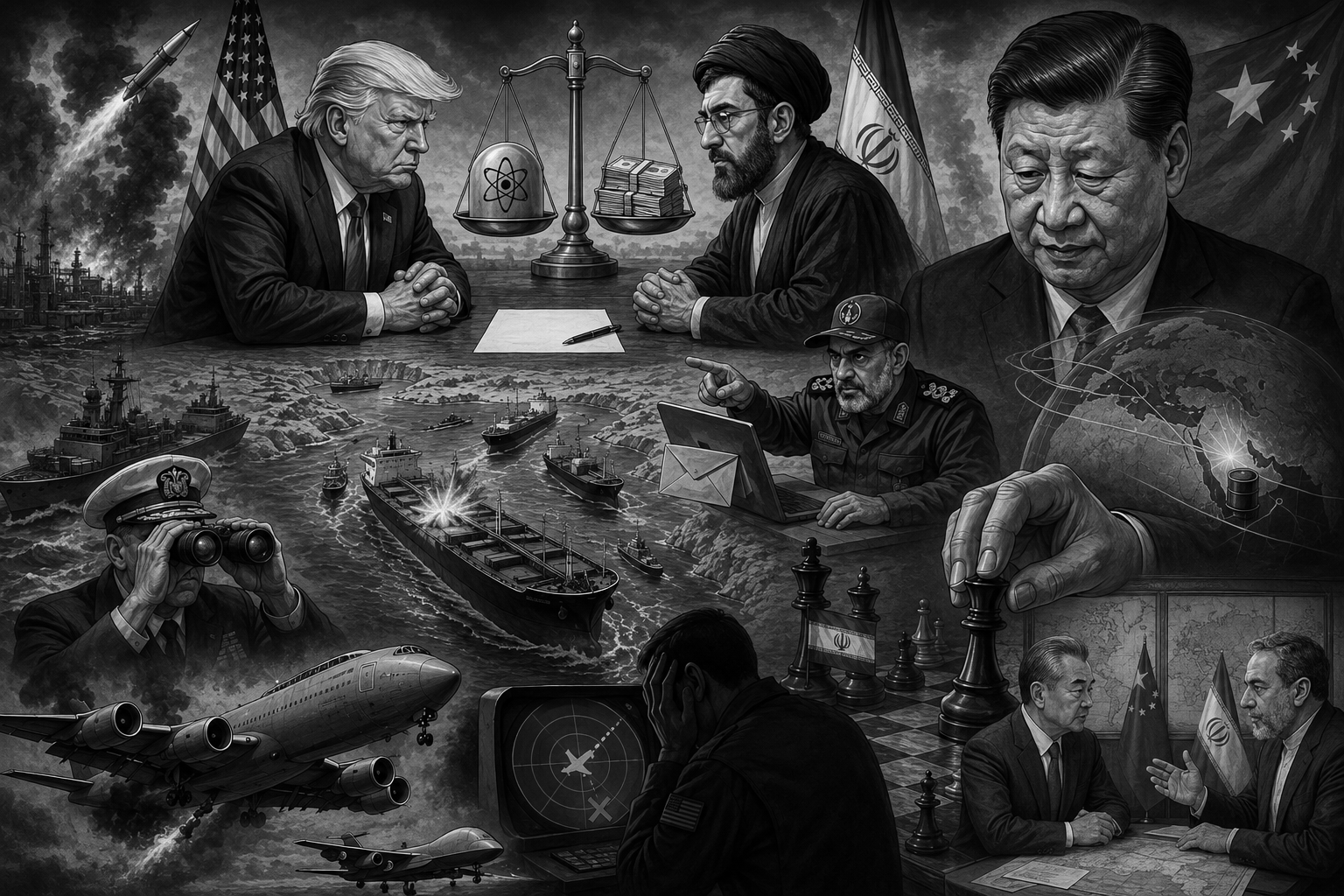
Is the Iran War Finally Over? Trump Signals End to Epic Fury
After nearly nine weeks of conflict , signals of a possible diplomatic breakthrough are beginning to emerge, cautiously, tentatively, and with enormous caveats.
President Donald Trump has declared that Operation Epic Fury is effectively over, boldly stating that Iran has already " waved the white flag " and should " cry uncle ", but Washington's guns will only fall permanently silent if Tehran agrees to freeze its nuclear programme and reopen the Strait of Hormuz within the next 48 hours. "If this were a fight, they would stop it," Trump said, leaving no doubt that America's patience has a hard deadline and that a far more ferocious military response is already locked and loaded if Iran blinks.
Reports now indicate that the United States and Iran may be converging on a one-page framework memo , not a final agreement, but a foundational document that would set the rules for future negotiations leading to a comprehensive deal . The terms reportedly under discussion are significant. Iran would commit to a moratorium on nuclear enrichment , freezing its uranium enrichment program. The duration remains a sticking point, Iran initially proposed five years , Washington demanded twenty , and the current range being negotiated sits somewhere between 12 and 15 years . In return, the United States would lift crippling sanctions and release billions in frozen Iranian funds . Both sides would also commit to reopening the Strait of Hormuz , and Iran would formally pledge to never build a nuclear weapon .
The Iranian response on key points is expected within 48 hours. If Tehran refuses, President Trump has warned that American strikes will resume at a far greater intensity than anything witnessed so far. The pressure is unmistakable and so is the urgency.
Iran, meanwhile, has introduced a new and provocative mechanism: the Persian Gulf Strait Authority . Under this body, every commercial vessel wishing to transit Hormuz must now seek Tehran's prior approval , coordinate movements with the Iranian military , and follow instructions delivered by email. The US Navy has also been warned against operating in the strait . Before Trump paused his "Project Freedom" escort mission , a bold initiative that was announced and then suspended within 48 hours , reportedly following a request from Pakistan, only two ships had safely crossed the waterway. A cargo vessel was struck by an unknown projectile , and the UAE came under attack for two consecutive days , even as Iran denied involvement.
Israeli Prime Minister Benjamin Netanyahu is reportedly engaged in high-level consultations with US officials to better understand the emerging memorandum. Nothing has been signed. The world does not wait for signatures.
While diplomats talk, soldiers operate and sometimes, they disappear. A deeply unsettling incident has added another layer of tension to this already volatile crisis. A US Air Force KC-135 Stratotanker , a massive, irreplaceable aerial refueling aircraft capable of carrying nearly 90,000 kilograms of fuel was spotted circling above the Persian Gulf before transmitting a 7700 emergency code , a signal recognized worldwide as a declaration of serious in-flight distress. Moments later, the aircraft vanished from public radar entirely.
The tanker had reportedly taken off from a US air base in the United Arab Emirates and was operating near the Strait of Hormuz before turning toward Qatar and disappearing from tracking systems. No wreckage has been found. No official explanation has followed. The US military has not confirmed a crash , and no hostile action has been officially acknowledged. But the silence itself is deafening.
This is not an isolated incident. Just weeks prior, in mid-April , the US Navy confirmed the loss of an MQ-4C Triton surveillance drone , worth over $240 million , in the same waters, after it too transmitted a 7700 emergency code . In March , a KC-135 was destroyed in Iraq , killing six crew members , with Iran-backed armed groups claiming responsibility.
The pattern is alarming. Analysts estimate that between $2.3 and $2.8 billion worth of US military equipment may have been destroyed since the conflict began, aircraft, drones, radar systems, and surveillance assets. These tankers are enormous, slow-moving, and filled with fuel, making them high-value but dangerously vulnerable targets . The full picture of American losses may be far more costly than Washington has publicly acknowledged.
Behind the battlefield and the negotiating table, a third power is positioning itself with characteristic precision. Chinese Foreign Minister Wang Yi met his Iranian counterpart Abbas Araghchi in Beijing , marking Araghchi's first China visit since the war began . The timing is telling, these talks come just days before US President Donald Trump is set to travel to Beijing for high-stakes talks with President Xi Jinping on May 14th .
Beijing's public posture has been one of measured restraint. China has called for de-escalation , backed diplomatic engagement , and even supported Pakistani-led mediation efforts . It has declared that " a complete cessation of hostilities is imperative " and expressed support for Iran in "safeguarding its national sovereignty." Diplomatically elegant, but strategically shrewd.
The deeper question is whether China is acting as a genuine peace broker or a calculated opportunist . Reports suggest that Chinese firms may have continued supplying Iran with dual-use technologies throughout the conflict, drone components, industrial materials, and satellite-linked capabilities that could meaningfully enhance Iran's surveillance and military planning . If true, Beijing may have quietly strengthened Tehran's wartime capabilities while publicly calling for peace.
The strategic logic is clear. More than half of China's seaborne oil imports pass through Hormuz. Any disruption threatens Chinese energy security directly. But it also hands Xi Jinping a powerful bargaining chip with Washington, China's economic leverage over Tehran could be deployed as diplomatic currency, exchanged for concessions on trade, technology, or Taiwan. Secretary of State Marco Rubio has already publicly urged Beijing to use its influence over Iran, noting that keeping Hormuz open is in China's own interest . Beijing has largely resisted directly backing Washington's approach .
The fundamental question hanging over next week's summit is whether China is more interested in resolving this conflict or exploiting it .