
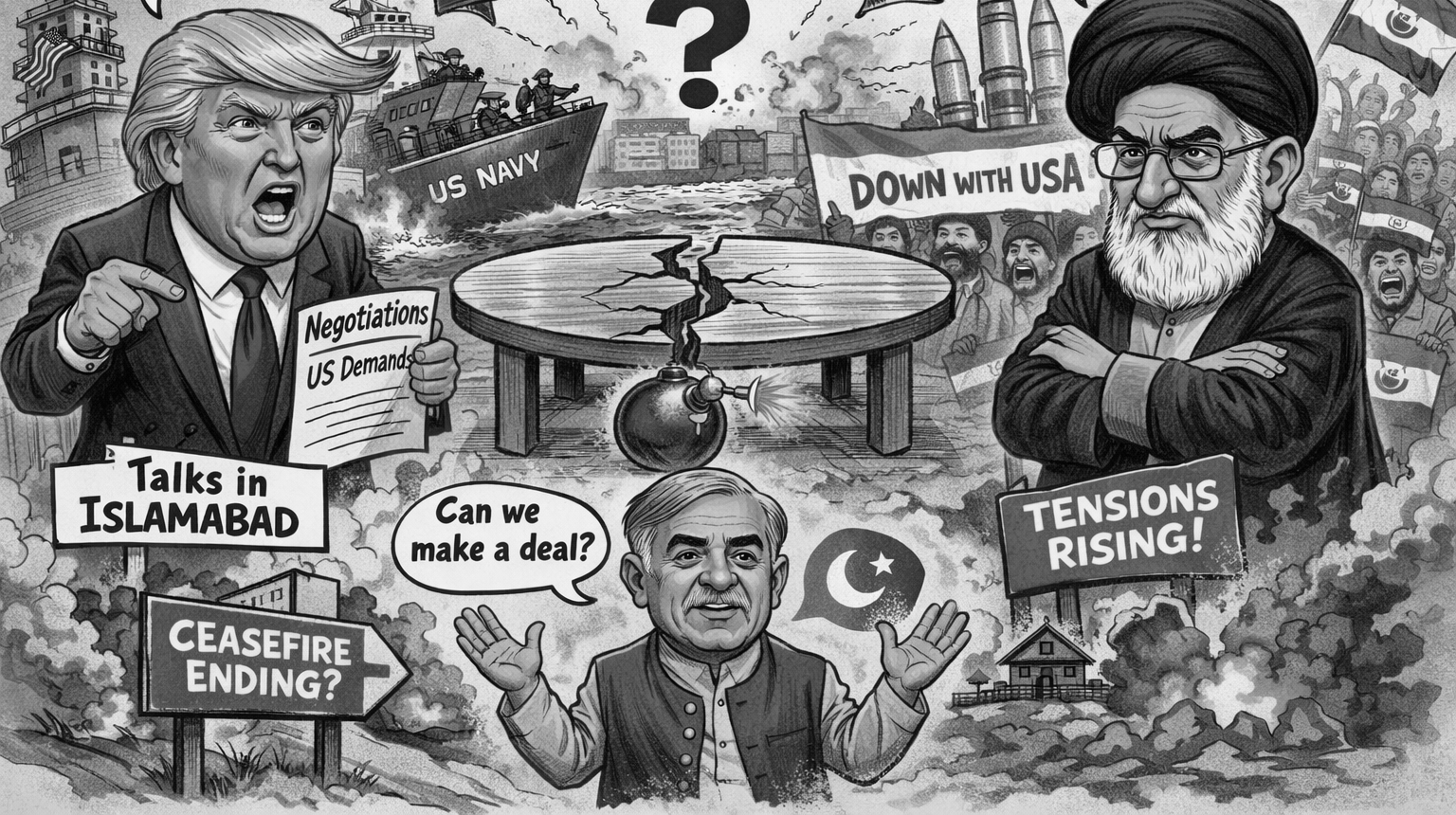
Is Diplomacy Already Dead? Iran Says No to a Second Round of Talks
It is week eight of the crisis in West Asia and still, there are no clear signs of this conflict ending, at least not anytime soon. Instead, tonight a new question has taken center stage: Will the next round of peace talks even happen?
The United States seized an Iranian-flagged ship . New threats were exchanged, fresh uncertainty has clouded hopes of peace .
Donald Trump says US negotiators are heading to Pakistan. His team is expected to arrive in Islamabad, with talks expected to take place, the very same day the fragile two-week truce between the United States and Iran is due to expire. But Tehran says it has no plan to attend those talks . Iran's position could not be clearer: "As of now, as I am speaking to you, we have no plan for the next round of negotiations. No decision has been taken in this regard." No confirmation. No date accepted. Iran also says Washington is still insisting on what it calls "unreasonable and unrealistic positions." From Tehran's point of view, there is no basis yet for a second round and honestly, the reason is not hard to see. Tehran's message to Washington is pointed and direct: "We truly do not see any serious signs of resolve on the part of the United States. On the contrary, there are repeated and numerous indications that no seriousness exists in the US when it comes to advancing diplomacy in its real conventional sense, rather than diplomacy that means issuing dictates."
Iran is clearly furious . Angry over the US naval blockade of Iranian ports . Angry over continued threats from Washington . And angry over the weekend seizure of an Iranian-flagged vessel . Tehran has called the seizure a "clear violation of the ceasefire" : "We were confronted with their actions in the Strait of Hormuz, including what they have termed a naval blockade. In just the past hours, you witnessed that an attack was carried out on an Iranian commercial vessel. All of these are considered clear violations of the ceasefire." Trump, for his part, says the ship tried to break the American blockade . He claims a US destroyer fired on the vessel, damaged its engine room , and US Marines then took control of it. Iran has warned of retaliation .
Even as military tensions rise, Trump is keeping the pressure on and Trump is reportedly even willing to meet Iran's top leadership, but only if a deal is struck. At the same time, he has chosen to maintain pressure , and this is shaping the mood inside Iran in significant ways.
Pro-government rallies were held in Tehran. Several participants said they support diplomacy, but do not trust Washington . Others said the war had actually given Iran new leverage . Any Iranian team going for talks now also faces enormous domestic pressure , and that political calculation is very much still playing out in Tehran.
Even as Tehran hesitates, preparations are already underway in Pakistan's capital . Security has been beefed up across Islamabad. Key roads have been closed and checkpoints deployed. Banners describing the process as "a step towards peace and stability" have appeared across the city. Pakistani mediation efforts are also continuing in earnest. Prime Minister Shehbaz Sharif has spoken to Iranian President Masoud Pezeshkian, with both sides discussing the latest regional developments . Pakistan's army chief is also believed to have spoken directly to Donald Trump, telling him that the US blockade of Iranian ports is a key obstacle to a second round of talks. Trump is said to have indicated he would consider this point .
But even as those efforts continue, there is fresh confusion on the American side . A White House official said US Vice President JD Vance would lead the American delegation , with Steve Witkoff and Jared Kushner also expected to be part of the team. Trump then said yesterday that Vance would not go , only to apparently make a U-turn on that as well . So even the composition of the US team remains unclear and that matters, because the first round of talks in Islamabad already ended without a breakthrough . The meeting lasted about 21 hours , but there was no deal and no agreed way forward. Round two was always going to be difficult.
The fundamental gaps have not closed . Washington wants curbs on Iran's nuclear program. It wants action on Iran's enriched uranium stockpile and it wants open shipping through the Strait of Hormuz . Tehran, meanwhile, wants sanctions relief first . It wants the US blockade removed. And it says its civilian nuclear rights are non-negotiable . This gap is only widening.
Diplomacy is still alive, at least for now . But it is no longer moving smoothly. The ceasefire is close to expiry . The talks still have not been confirmed. Iran has not committed to attending . The United States is still using threats as leverage . And the seafront remains deeply tense . Can the two sides even return to the same room?