
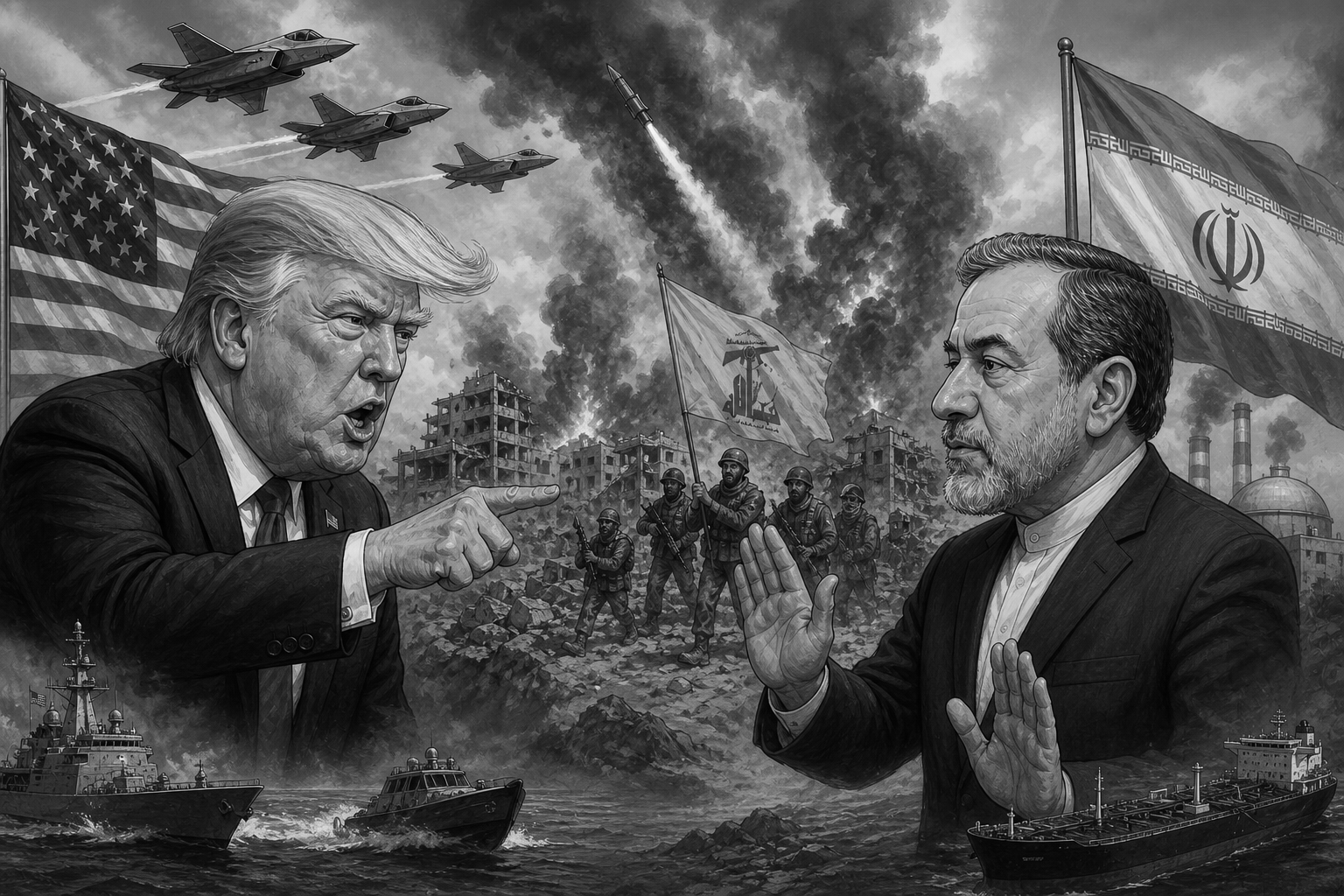
Iran Says US Deal ‘Impossible’ as Trump Floats Possibility of Fresh Strikes
The fighting on land has not paused for diplomacy. Israel carried out strikes across southern Lebanon, its military saying it hit approximately 70 military structures and 50 Hezbollah infrastructure sites across several areas, with several killed. Local media also reported alleged use of white phosphorus around Seriane and Taybeh in Marjayoun, munitions banned in civilian areas under international humanitarian law. Hezbollah struck back with artillery and kamikaze drones targeting Israeli troop concentrations in Bint Jbeil and the Marjayoun district. A Hezbollah lawmaker warned the group can thwart Lebanon-Israel normalisation talks, accepting Israel's withdrawal if it comes, but reserving the right to resist if occupation continues.
President Trump's position this week has been a study in contradictions. He described Tehran as eager for a settlement, a country so "decimated" it was desperate to talk, while simultaneously posting on Truth Social that Iran had not yet paid a big enough price for what they have done to Humanity, and the World, over the last 47 years. When asked whether fresh strikes were possible, he replied: "If they do something bad, there is a possibility it could happen." He also said he would like to eliminate the remaining 15% of Iran's missile-making capability, a demand Tehran has flatly rejected, having ruled out any limits on its missile programme or its support for regional allies.
Iran's response came in the form of a sweeping 14-point peace proposal delivered to Pakistan and passed toward Washington. Iran's foreign minister said Tehran was ready to engage diplomatically if Washington dropped "excessive demands, threatening rhetoric, and provocative actions." Trump said he was reviewing the proposal but made clear he was not satisfied, and the IRGC announced it remains on full standby for a return to hostilities.
At sea, Iran's fury has been equally pointed. Former IRGC commander Mohsen Rezaee called US naval forces " pirates " and threatened to turn Hormuz into a graveyard of American aircraft carriers. US Treasury Secretary Scott Bessent fired back, insisting the blockade is working and that Iran isn't getting much money from its attempts to put tolls on ships traversing the strait. Yet the blockade is not airtight. An Iranian Very Large Crude Carrier carrying more than 1.9 million barrels of crude oil evaded the US naval blockade and reached the Asia-Pacific region. The vessel named HUGE , carrying cargo worth nearly $220 million , went dark on tracking systems in March and navigated via Southeast Asian routes, embarrassing Washington's claim of total maritime control.
Two contrasting maritime moments illustrated the human stakes. A UK bulk carrier reported being attacked by multiple small craft off the Iranian coast west of Sirik, with all crew safe. Meanwhile, India secured a quiet diplomatic victory: MT Sarv Shakti , carrying 46,313 metric tonnes of LPG with 18 Indian crew members aboard, safely crossed the Strait of Hormuz and is expected to arrive at Visakhapatnam on May 13. Iran announced that a strike-hit facility at Isfahan University of Technology will be converted into a war museum , a defiant act of memorialisation as US-Israeli strikes have damaged at least 30 universities, 56 heritage sites, and 55 libraries across the country. The Trump administration, meanwhile, fast-tracked more than $8.6 billion in arms sales to Israel, Qatar, the UAE and Kuwait, including air-defense systems, Patriot missiles, and laser-guided rockets, bypassing Congressional approval under an emergency certification.
Israel separately approved a multibillion-dollar purchase of F-35 and F-15IA fighter jets from Lockheed Martin and Boeing , with Netanyahu declaring that Israeli pilots stand ready to reach anywhere in Iranian airspace. Gold and silver markets are expected to remain range-bound as long as the US-Iran standoff holds without decisive movement in either direction. India's leather and footwear industry has separately sought duty exemptions on critical inputs, citing supply chain disruptions from the conflict.
Iran's Revolutionary Guards have framed Washington's predicament with a sharp rhetorical edge: the United States, they say, faces a choice between an "impossible" military operation and a "bad deal" that falls short of its stated goals. It is partly propaganda, but it reflects a real strategic reality.