
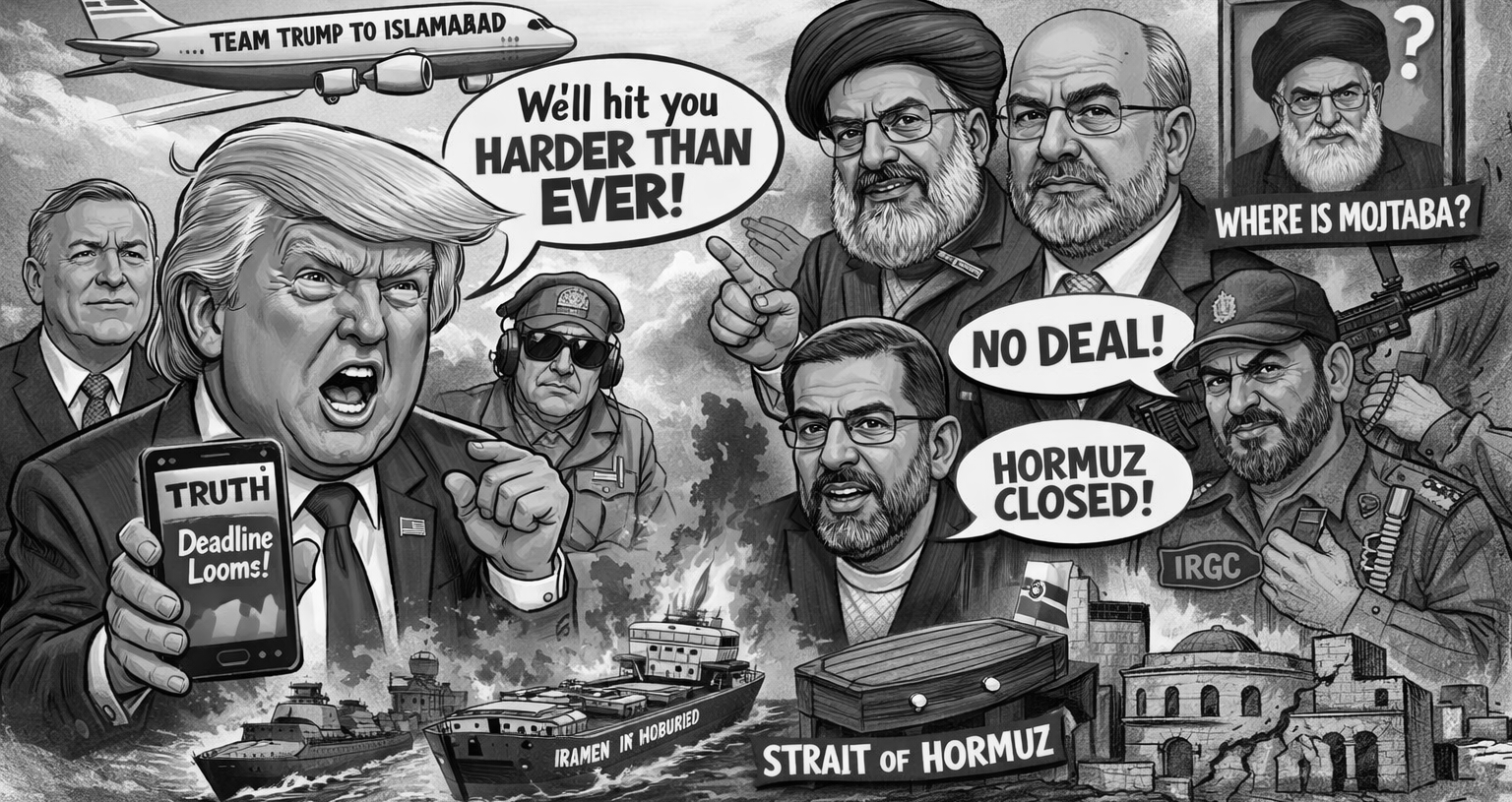
Iran Says No to Second Round as Trump's Team Flies to Islamabad With a Deadline
As the April 21–22 ceasefire deadline draws uncomfortably close, the diplomatic architecture between Washington and Tehran is showing every sign of strain, with Iran rejecting key American terms, Trump issuing fresh threats on social media, the Strait of Hormuz once again under Iran's tight grip, and a country whose own internal structure is fracturing at the seams . Yet, against all odds, Team Trump is preparing to fly back to Islamabad, Pakistan, for a second round of talks set for Tuesday, perhaps the last real window before the guns resume.
Trump, as he has done throughout this war, took to Truth Social on Sunday to raise the stakes dramatically. "We're preparing to hit them harder than any country has ever been hit before because you cannot let them have a nuclear weapon," he declared, adding: "I hope they take it because if they don't, the United States is going to knock out every single power plant, and every single bridge, in Iran." Iran, for its part, has largely avoided matching Trump's inflammatory rhetoric, but on the ground and at sea, its actions have spoken just as loudly.
Iranian Deputy Foreign Minister Saeed Khatibzadeh, speaking on the sidelines of a diplomacy forum in Turkey on Saturday, made Tehran's position plain: "No enriched material is going to be shipped to the United States. This is a non-starter." This directly contradicted Trump, who had claimed just the previous day that Iran had agreed to hand over its enriched uranium stockpile. American negotiators had proposed a 20-year suspension of Iranian uranium enrichment at the first round of talks in Islamabad, which Iranian negotiators countered with a five-year suspension, a counter the US flatly rejected. Iran's chief negotiator and Parliament Speaker Mohammad Bagher Ghalibaf said the US had "ultimately failed to gain the trust" of his delegation.
The Strait of Hormuz remains the other festering wound. Iran announced it would close the strait again on Saturday, citing what it called "repeated breaches of trust" as the US maintained its naval blockade on Iranian ports. This came just 24 hours after Iranian Foreign Minister Abbas Araghchi had declared the strait "fully open". Trump claimed on Sunday that 34 ships passed through the Strait of Hormuz, calling it "by far the highest number since this foolish closure began." Maritime data firm Kpler, however, reported only 14 ships transited the strait that day.
The India dimension of the Hormuz crisis, which broke into sharp focus on Saturday, drew a rare and firm diplomatic response from New Delhi. India's Ministry of External Affairs called in Iranian Ambassador Mohammad Fathali for a meeting with Foreign Secretary Vikram Misri, conveying "deep concern" over a shooting incident involving two Indian-flagged ships in the Strait of Hormuz. One of the vessels, the Sanmar Herald , an Indian-flagged Very Large Crude Carrier carrying nearly 2 million barrels of Iraqi crude, came under direct fire, while both ships were forced to turn back westward. Audio of the dramatic exchange captured the crew pleading: "You gave me clearance to go... you are firing now!" Iran had previously extended preferential passage to Indian vessels, making the firing a stinging reversal that New Delhi could not overlook.
Beneath all of this external brinkmanship lies a deeper, more troubling story: Iran does not speak with one voice, and increasingly, it may not speak with any clear voice at all. With former Supreme Leader Ali Khamenei killed in the February 28 strikes, and the whereabouts of his successor Mojtaba Khamenei unconfirmed, the IRGC has found what analysts describe as a golden opportunity to consolidate its grip over statecraft. The IRGC now operates through a military council of senior officers making daily decisions, and has established a strict security cordon around Mojtaba Khamenei, restricting access to government reports and blocking communication between the Supreme Leader and the political leadership, including President Pezeshkian.
According to sources close to the presidential office, Pezeshkian confronted IRGC leadership directly, accusing commanders of acting unilaterally and driving escalation through attacks on regional countries' infrastructure, warning that Iran's economy "would not be able to withstand a prolonged war for much longer" and that "full economic collapse was inevitable." The IRGC, for its part, has blamed the government for the crisis, accusing it of failing to implement structural reforms that prevented the conflict in the first place.
Adding a layer of almost surreal symbolism to Iran's predicament: Ali Khamenei has still not been buried. Iranian officials are wary of possible Israeli airstrikes on a public gathering, concerned about nationalist counter-protests, and also face the awkward challenge of explaining why Mojtaba Khamenei has not appeared in public since taking over. The contrast with 1989 is difficult for authorities to ignore, when Khamenei's predecessor Ayatollah Khomeini died, millions poured into the streets over several days. The absence of anything remotely similar now is being used by critics as evidence of a system that no longer trusts its own people. As one analyst bluntly put it: "Simply put, the regime is too afraid and too weak to roll the dice."
The ceasefire expires within days. Trump officials have indicated they are not keen to resume the war, particularly as it has led to rising prices for Americans and is broadly unpopular with the public. Iran, too, is exhausted, but its fractured command structure means that even a willing negotiator in Tehran may not be able to deliver a deal that the IRGC will honour.