
Iran Fires on Indian Tanker and Shuts Hormuz Again Within 24 Hours
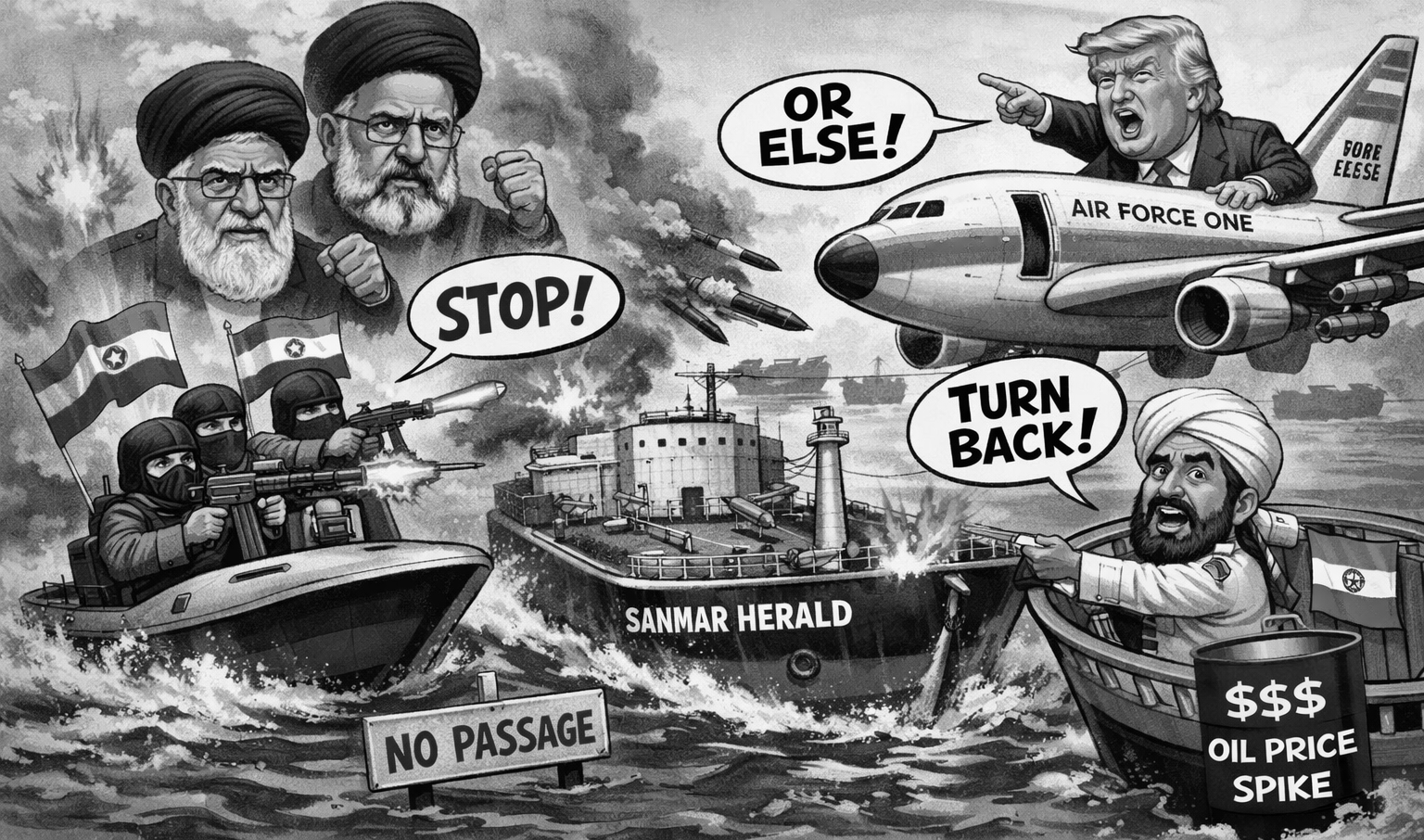
The Strait of Hormuz woke up to gunfire on Saturday. Two Iranian Revolutionary Guard gunboats opened fire on a tanker attempting to transit the Strait of Hormuz, forcing vessels to turn around and sending a brutal, unambiguous message that the brief window of passage, declared open just the day before, had slammed shut again. The vessels were forced to turn around in the strait, including an Indian-flagged super tanker , after they were fired on by Iran. The VLCC Sanmar Herald , an Indian-flagged super tanker, came under fire from two Iranian gunboats despite having received prior clearance to pass. The British military's Maritime Trade Operations centre confirmed the incident, reporting the tanker and crew as safe, though without identifying the vessel's destination.
Iran's message was blunt: the ceasefire, as far as Tehran was concerned, had already been broken and not by them. Iran's joint military command declared that "control of the Strait of Hormuz has returned to its previous state," warning it would continue to block transit as long as the US blockade of Iranian ports remained in effect. Ebrahim Azizi, head of the Iranian parliament's National Security Commission, said the strait was "returning to the status quo", meaning ships would once again require Iranian naval authorisation and toll payment before being permitted to pass. Tehran's position was clear: Washington fired the first shot against the ceasefire the moment it imposed a naval blockade on Iranian ports and shipping, and Iran's re-closure of the strait was not a provocation but a response.
US forces had by then already sent 21 ships back to Iran since the blockade began Monday, according to US Central Command. The two sides were, in effect, each strangling the other's maritime lifeline while simultaneously insisting it was the other who had broken faith.
Into this already volatile atmosphere stepped Donald Trump , who had told reporters the day before that Iran was having "very good conversations" with the United States, but in the same breath, accused Tehran of acting "a little cute, as they have for 47 years," making clear Washington would not allow Iran to "blackmail us."
Then came the words that hung over every diplomatic back-channel for the rest of the day. Asked by a reporter whether he would extend the ceasefire if no deal was reached by Wednesday when it expires, Trump was unsparing. "I don't know. Maybe I won't extend it, but the blockade is going to remain. But maybe I won't extend it, so you have a blockade, and unfortunately we'll have to start dropping bombs again ," he said. He added a cryptic note of optimism, "We had some pretty good news 20 minutes ago," he said, declining to elaborate.
Trump's wider claims about what Iran had already conceded only deepened the fury in Tehran. He said Iran and the US would jointly dig up enriched uranium buried under the rubble of bombed nuclear sites and hand it to Washington, and that Iran had agreed to stop all enrichment on its soil. Iran's foreign ministry fired back that transferring uranium "has not been an option," calling enriched uranium "as sacred to us as Iranian soil" that would "not be transferred anywhere under any circumstances." Trump also stated that Iran would not receive billions of dollars of its own frozen assets held abroad, and that the Israel-Lebanon ceasefire was entirely separate from the Iran negotiations.
Iran's Parliament Speaker Mohammad Bagher Ghalibaf , who led the Iranian delegation at the Islamabad talks, responded with controlled rage. "With these lies, they did not win the war, and they certainly will not get anywhere in negotiations either," he posted on X.
The fractures spread quickly inside Iran's own political establishment. Foreign Minister Abbas Araghchi had only the day before tweeted that the Strait was "declared completely open for the remaining period of ceasefire", a statement that triggered an immediate firestorm from IRGC-affiliated media and state television hosts who demanded instant clarification, pointing out that the tweet was written in English and therefore plainly not aimed at the Iranian public, who remain cut off from X after seven weeks of state-imposed internet shutdown. The Fars news agency, affiliated with the IRGC, declared that "Iranian society was plunged into a haze of confusion."
On the ground in Tehran, the emotional register was not confusion but grief sharpened into anger. On local messaging apps and state-run comment sections, citizens wrote with raw bitterness: "After all these years of sanctions and war and costs imposed on the people, if you are to give up the uranium and the strait, then why did you play with the people's livelihoods and the blood of the martyrs for so long?"
The markets registered everything in real time. The Iranian rial, priced at 1.46 million to the US dollar in the morning, shot back up to 1.51 million the moment the IRGC's re-closure of the strait was announced. Oil prices, which had eased the day before on hopes of an open strait, reversed course.
US officials indicated Monday was the earliest a second round of negotiations could realistically convene in Islamabad. Elsewhere, France and the UK convened around 40 nations in Paris for the Strait of Hormuz Maritime Freedom of Navigation Initiative, notably without the United States at the table.