
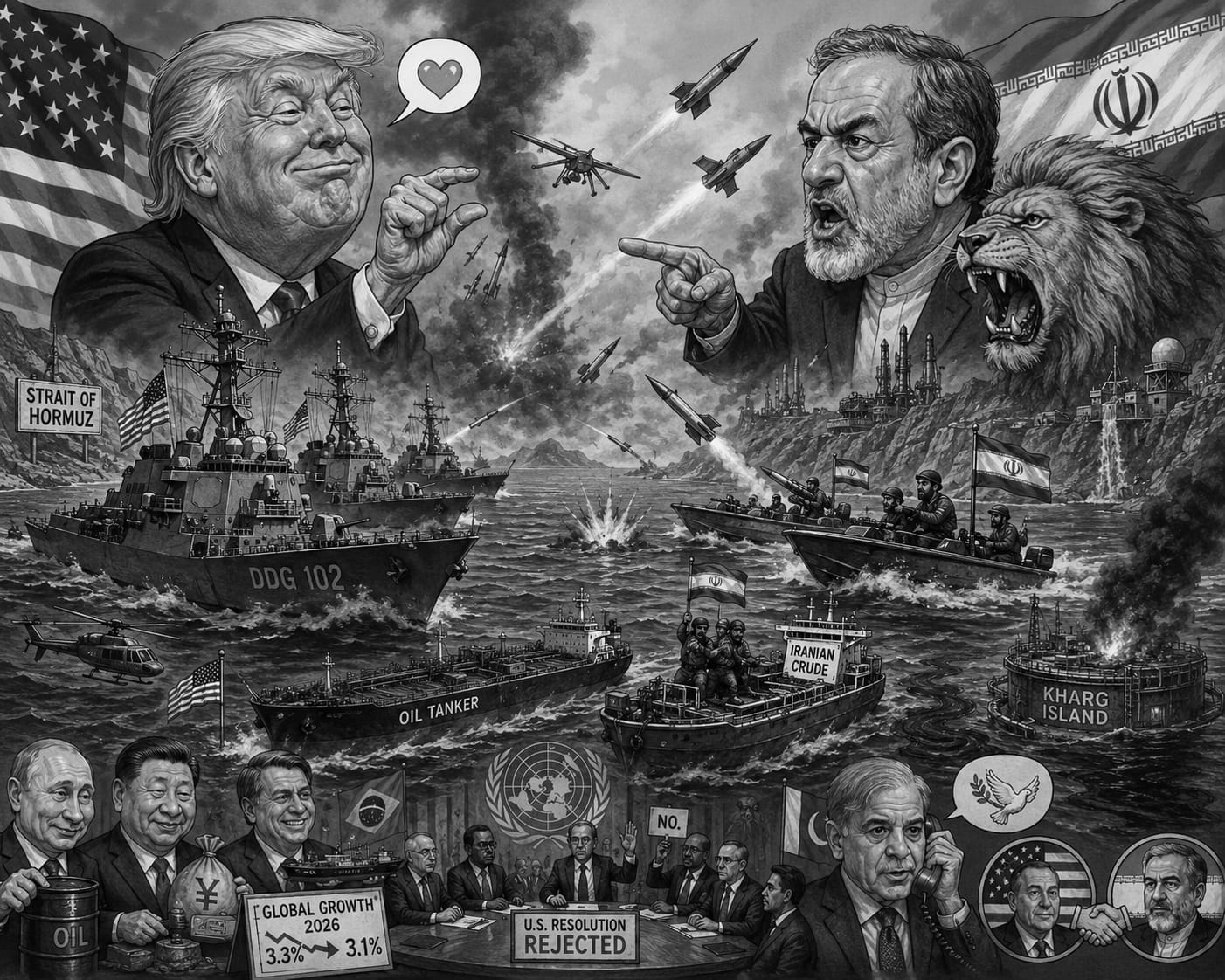
Iran Attacks Three U.S. Warships in Hormuz, Trump Says Ceasefire Still Stands, Calls It a Love Tap
The ceasefire between the United States and Iran is hanging by a thread. What was once cautiously described as a fragile but functioning truce has erupted once again into open hostility, as both nations traded missiles, drones, and fire in the Strait of Hormuz on Thursday night, raising a question the world can no longer afford to ignore: is this a temporary flare-up, or the slow, grinding collapse of a peace that was never truly stable?
US and Iranian forces clashed overnight near the Strait of Hormuz, in an escalation that threatens to further fracture the fragile ceasefire as both sides continue to discuss a permanent end to the war. According to US Central Command , three American guided-missile destroyers were transiting the strait when Iran launched a coordinated barrage of ballistic missiles, anti-ship cruise missiles, drones, and fast boats at them. The US Navy said it intercepted the attacks and returned fire in self-defense, with no American assets damaged.
US forces subsequently targeted Iranian military facilities responsible for the attacks, striking multiple locations including Bandar Abbas and Qeshm Island . Iran's armed forces spokesperson, however, claimed US airstrikes hit civilian areas along the coasts of Qeshm Island, Bandar Khamir, and Sirik - a charge Washington has not acknowledged.
Tehran tells a sharply different story. Iran's Islamic Revolutionary Guard Corps (IRGC) claimed it retaliated against US destroyers east of the strait and south of Chabahar port , insisting it caused significant damage and that three US warships retreated rapidly. The overnight attacks wounded 10 Iranian sailors , with five others still missing.
In the latest blow to the shaky ceasefire, the US military fired upon and disabled two Iranian-flagged oil tankers that were attempting to breach America's naval blockade of Iranian ports. The United Arab Emirates also said it responded to another Iranian missile barrage on Friday , marking the third time it has had to intercept Iranian fire since the ceasefire began on April 8.
Iran has not taken the UAE's involvement lightly. Tehran stated that if Abu Dhabi's role in the recent hostilities is confirmed , the country will "pay the price." The UAE, for its part, confirmed its air defenses successfully engaged Iranian missiles and drones. Satellite images reviewed by the Associated Press also appear to show an oil slick in the Persian Gulf near Kharg Island, Iran's primary crude export terminal, a grim visual reminder of the conflict's reach.
Additionally, Iran has seized a US-sanctioned oil tanker carrying Iranian crude near the Sea of Oman, citing attempts to disrupt its oil exports. China confirmed a separate attack on a tanker carrying its oil in the same waters, a development that threatens to pull yet another global power into the vortex.
President Donald Trump has sought to project calm in the face of growing alarm. He described the overnight US strikes as a " love tap ," insisting the ceasefire "is going" and remains in effect. In the same breath, however, he threatened to strike Iran "a lot more violently" if its leadership does not agree to a proposed peace deal.
Iran's Foreign Minister Abbas Araghchi was in no mood for conciliation. He condemned the US strikes as a "reckless military adventure," stating that every time a diplomatic solution is within reach, Washington reaches for its weapons instead. "Iranians never bow to pressure," he declared. Iran's foreign ministry spokesperson went further, comparing Iran to an angry lion , calling the country a superpower, and issuing a stark warning: "If you see the lion's fangs protruding, do not imagine the lion is smiling."
Behind the competing narratives lies a dangerous discrepancy between rhetoric and reality. A confidential CIA assessment, cited by the Washington Post, paints a picture starkly at odds with the White House's victory narrative. Iran still retains nearly 70% of its pre-war missile stockpile and approximately 75% of its mobile missile launchers remain intact , a far cry from the 18-19% the President publicly claimed. Iran has also managed to reopen most of its underground storage facilities and resume weapons assembly.
The CIA further assessed that Iran can survive Washington's naval blockade for 90 to 120 days, possibly longer , thanks to a sophisticated shadow war economy built on hidden oil tanker networks, shell companies, Chinese Yuan barter deals, and black market currency channels that have operated for decades under sanctions. A 52-percentage-point gap between presidential claims and intelligence findings is not a rounding error, it is a strategic miscalculation of the highest order.
The IMF has downgraded global growth for 2026 from 3.3% to 3.1%, attributing the cut directly to the conflict. Europe, heavily dependent on imported energy, is absorbing far deeper economic pain than the United States, which remains a net energy exporter.
Meanwhile, geopolitical actors are maneuvering for advantage. Russia's oil revenues hit a six-month high in April as crude prices surged. Brazil has emerged as Asia's emergency oil supplier. And Wall Street's major banks, Goldman Sachs, JP Morgan, Morgan Stanley have posted record first-quarter gains, feasting on volatility.
Pakistani Prime Minister Shehbaz Sharif said his country has been in contact with the US and Iran "day and night" in an effort to extend the ceasefire and broker a peace deal. The proposed framework on the table remains: Iran freezes nuclear enrichment and pledges never to pursue a nuclear weapon; the US lifts sanctions. Tehran says it has not yet decided.
At the UN Security Council , the US pushed a resolution demanding Iran halt its attacks and cease the mining of the strait. Iran rejected it outright, calling the resolution a cover for America's "illegal maritime blockade."