
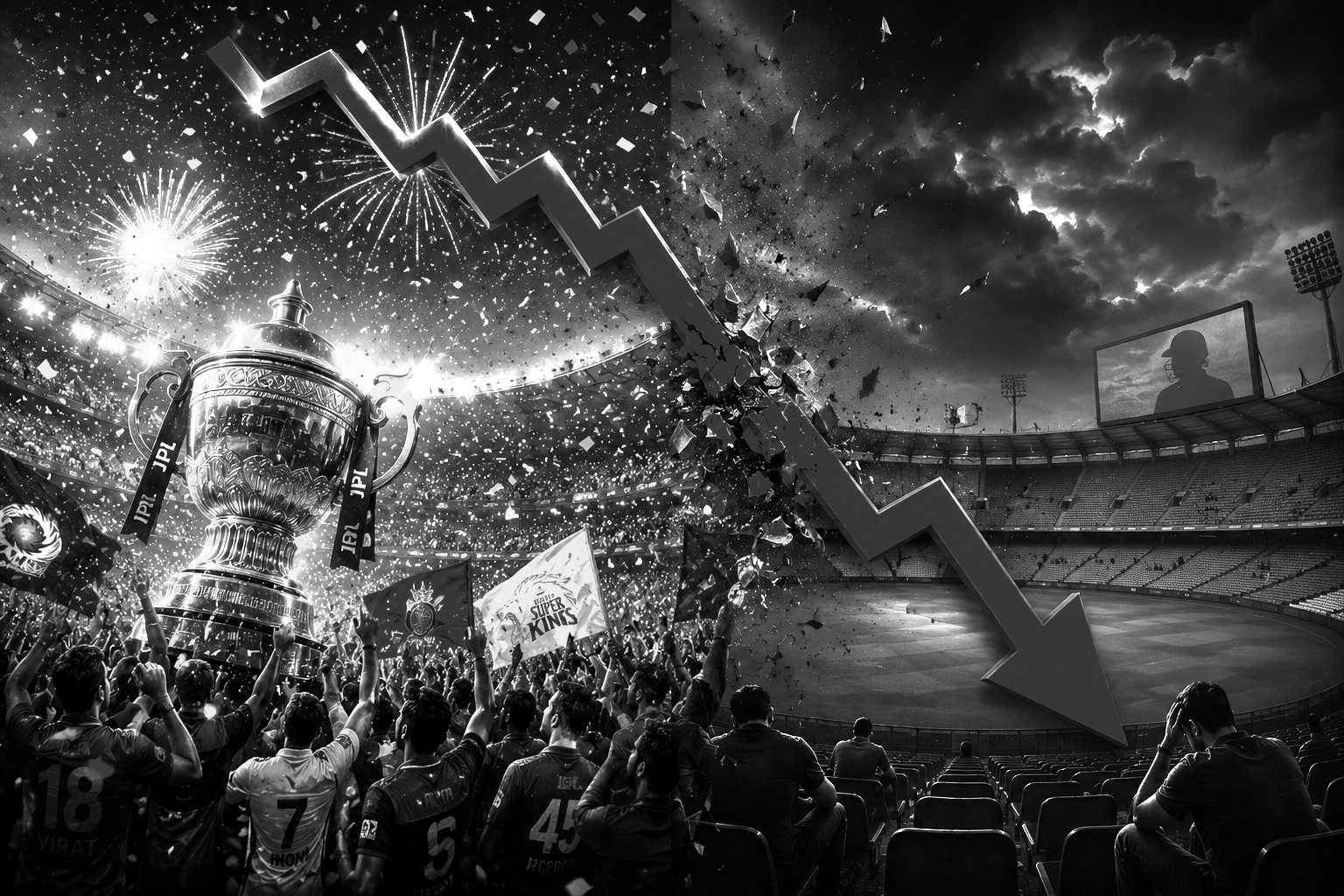
IPL 2026 Was Supposed to Break Records. Instead It Lost 10 Crore Viewers.
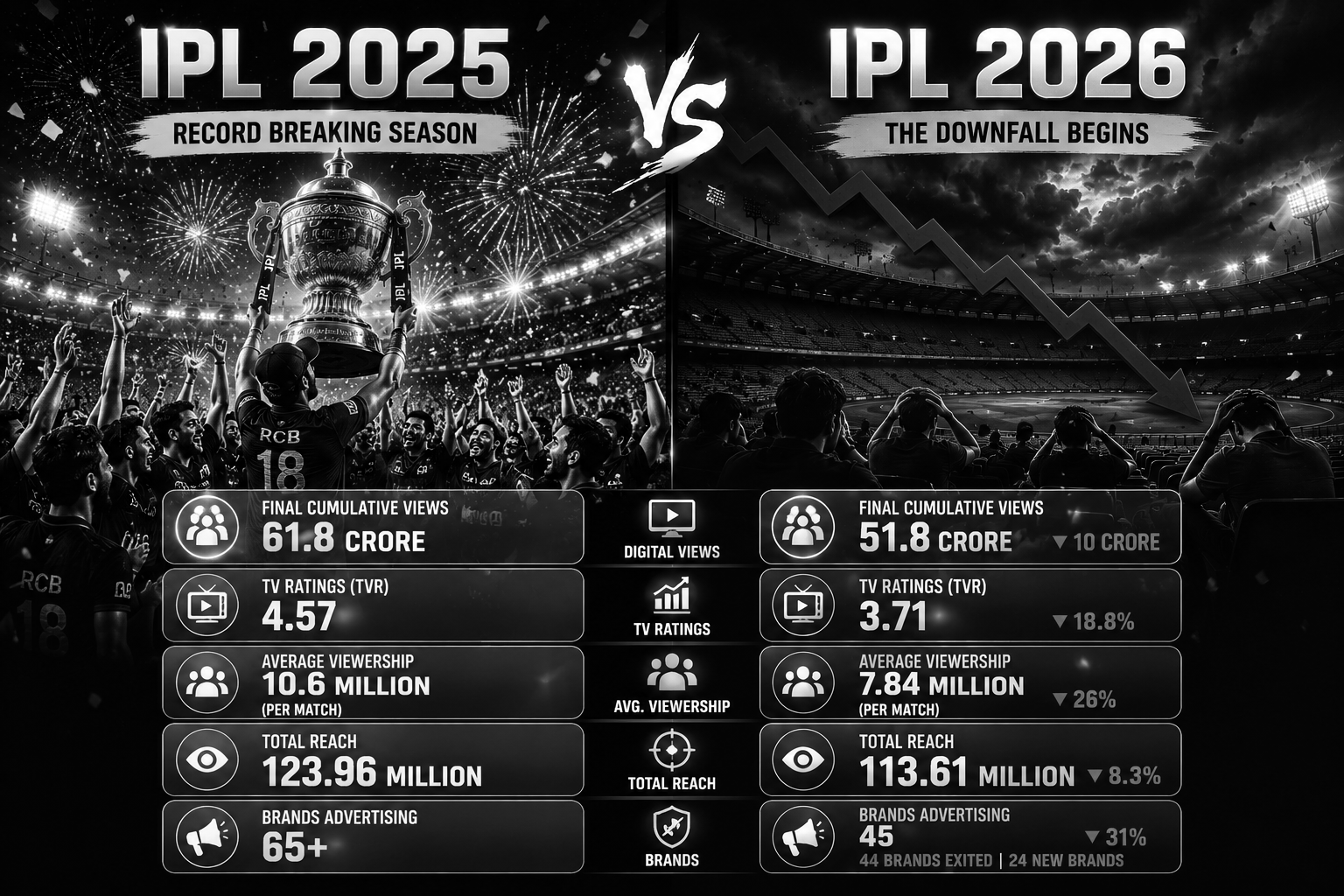
Last year, when Royal Challengers Bengaluru finally lifted the IPL trophy after 18 years of heartbreak , the television and streaming numbers shattered every record in Indian cricket history. The 2025 final between RCB and Punjab Kings amassed a combined 31.7 billion minutes of watch time, with JioHotstar recording 89.2 crore video views and a world-record peak of 5.5 crore concurrent users . The digital viewership hit 61.8 crore cumulative views . It was the kind of number that made broadcasters and advertisers believe the IPL's ceiling was still nowhere in sight.
Twelve months later, the ceiling has arrived, hard.
The IPL 2026 final between the same RCB and Gujarat Titans drew 51.8 crore cumulative views on JioHotstar. That is not a small number in isolation, but against the backdrop of 61.8 crore the year before, it represents a drop of roughly 10 crore viewers for the single biggest match of the season. A final that was supposed to build on history's most-watched cricket match instead retreated from it significantly. And this wasn't just a final problem, it was the story of the entire tournament. TV ratings across IPL 2026 fell by 18.8% , dropping from a TVR of 4.57 in 2025 to just 3.71 this year, while average viewership collapsed by 26% , from 1.06 crore viewers per match to 78.4 lakh. Total reach for the tournament also dropped by 8.3% , from 12.39 crore viewers in 2025 to 11.36 crore in 2026.
The question everyone in Indian cricket media is asking is: why? The two finalists this year, RCB and GT, are not exactly the country's most universally beloved teams. RCB, for all their passionate fanbase, are a polarising side . Having won the title in 2025, a large segment of neutral viewers who tuned in last year specifically to witness that historic, long-denied moment had no similar emotional reason to return. The underdog story was gone. Gujarat Titans, meanwhile, have never quite managed to ignite a pan-India frenzy the way a CSK , MI , or even KKR final appearance would. A rematch of a final pairing that lacked the emotional stakes of the previous year was always going to struggle.
The timing didn't help either. IPL 2026 kicked off just two weeks after the T20 World Cup 2026 concluded, which brought with it a wave of T20 fatigue at exactly the wrong moment. Compounding that, the Indian government's shutdown of betting and fantasy apps following IPL 2025 shook the entire industry, with a measurable section of viewership lost because of it. Fantasy gaming had quietly become one of the IPL's most powerful engagement engines, keeping millions glued to matches they might otherwise have switched off after the result seemed settled.
The advertising market felt it just as sharply, the number of brands advertising during the tournament dropped by 31% , from over 65 brands in 2025 to just 45 in 2026, with 44 brands exiting the IPL entirely while only 24 new ones came in.
The deeper concern is structural. With 10 teams and a gruelling 70-match league stage , the IPL has transformed from a must-watch event into a marathon of endurance, where every match no longer feels like a step toward something significant. When 220 is a routine first-innings score and six-hitting happens on auto-pilot, the spectacle loses its shock value. Familiarity, it turns out, breeds not contempt but indifference.
The IPL remains the most watched cricket league on the planet . But for the first time in years, its viewership trajectory is pointing downward, and a finale that drew 10 crore fewer viewers than the one before it is a hard number to explain away.