
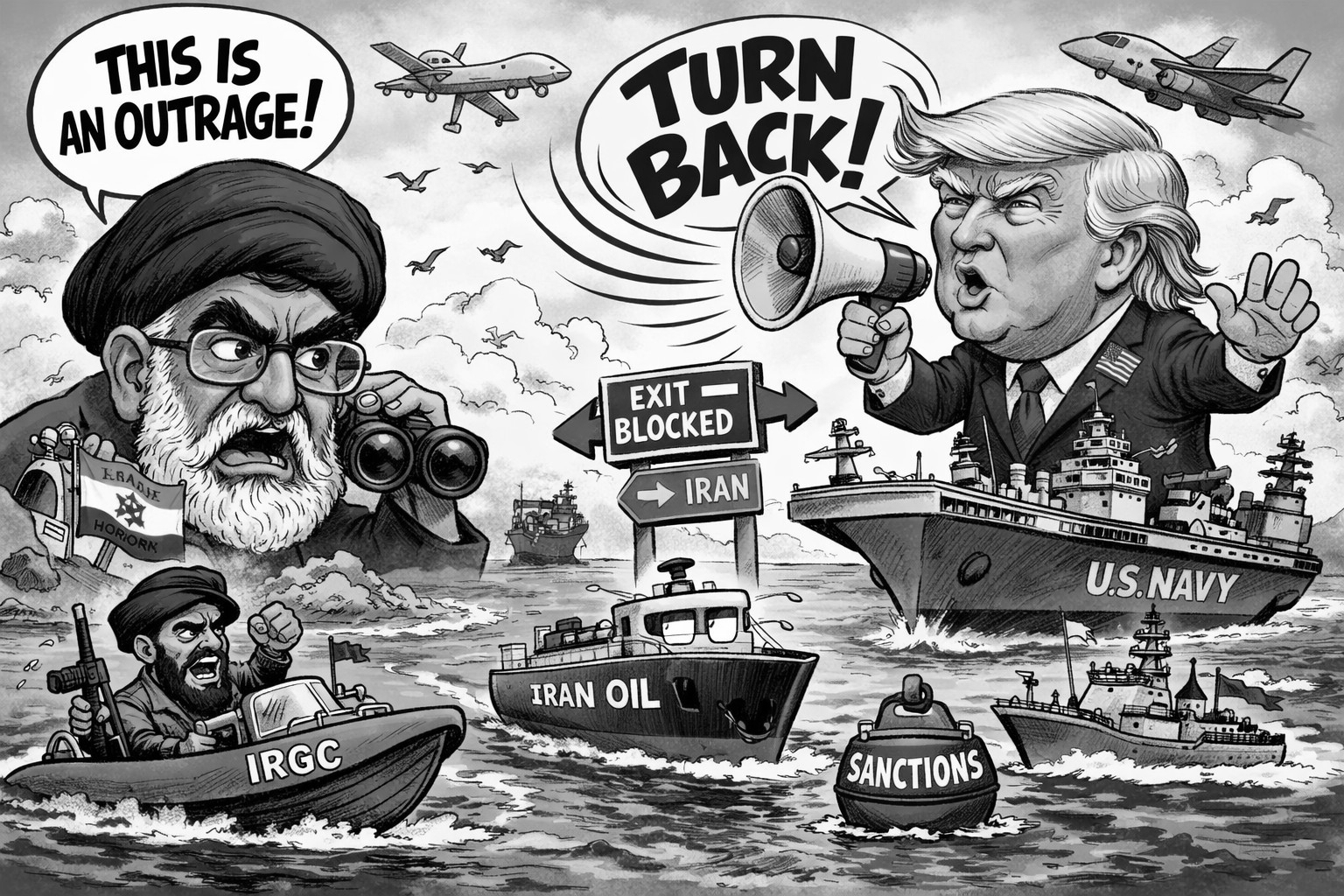
Invisible Blockade: US Forces Turn Back Sanctioned Tankers Near Iranian Waters
The strategic waters around the Strait of Hormuz have entered a new and uncertain phase after the United States under President Donald Trump imposed a sweeping maritime pressure campaign targeting Iranian trade, a move designed to choke Iran’s oil-driven economy without formally shutting down one of the world’s most critical shipping routes . In the days since the announcement, multiple vessels linked to Iranian ports have been intercepted and forced to reverse course , exposing a carefully crafted strategy that exploits legal grey areas in international maritime law.
Despite widespread fears that Washington would block the Strait of Hormuz entirely , US officials clarified that the blockade technically targets only ships entering or leaving Iranian ports , not vessels transiting the strait toward other destinations. This distinction has allowed the United States to claim it is protecting global freedom of navigation while simultaneously isolating Iran economically . According to US military statements, at least eight vessels attempting to move cargo tied to Iranian ports were contacted by American naval units over radio and ordered to turn back , with every ship complying without confrontation.
Among the most closely watched incidents was a sanctioned tanker that attempted to exit the Gulf before abruptly reversing course , underscoring the effectiveness of the interception strategy.
What makes the operation unusual is where the United States is enforcing it . Rather than clustering warships directly inside the narrow strait, a move that could provoke Iranian retaliation, American forces appear to be operating further east, stretching surveillance and interception lines across the Gulf of Oman and parts of the Arabian Sea . Using satellite tracking, drones and maritime monitoring systems , US forces reportedly identify vessels leaving Iranian ports and wait until they approach open ocean routes before warning them to turn back .
The military footprint supporting this strategy is significant. More than a dozen US naval vessels, aircraft and thousands of troops are now deployed across West Asian waters , forming what officials describe as a monitoring “net” around Iran’s maritime trade routes.
At the same time, around a dozen commercial ships are believed to be stalled or delayed by the new restrictions , caught in a growing maritime stand-off whose precise locations remain unclear due to limited tracking data.
Iran, meanwhile, continues to hold geographic leverage over the northern side of the Strait of Hormuz , controlling a chain of strategic points from Bandar Abbas through Larak Island to Qeshm Island . Patrol boats operated by the Islamic Revolutionary Guard Corps (IRGC) frequently operate along this coastline, allowing Tehran to monitor traffic entering and leaving the strait and shadow vessels if necessary .
Yet Iran has so far chosen not to fully shut the strait , a decision shaped by economic reality. A complete closure would disrupt global shipments of oil, food, medicine and fuel, harming Iran’s own partners and regional trade flows as well as its adversaries . Instead, Tehran appears to be exercising selective pressure , allowing some ships through while delaying, questioning or warning others , signalling that it still retains escalation options.
The stakes are enormous. Before the conflict escalated earlier this year, roughly one-fifth of the world’s oil and liquefied natural gas shipments moved through the Strait of Hormuz each day , making it one of the most strategically sensitive waterways on the planet.
With shipping already slowing and insurance costs rising, global economic institutions are beginning to sound alarms. The International Monetary Fund has warned that prolonged disruptions in energy flows could push the world economy closer to recession , especially as energy prices ripple through supply chains already strained by conflict.
Diplomatic efforts are still continuing in parallel with the military pressure. Officials say a second round of indirect peace talks between the United States and Iran is being discussed , following earlier negotiations that failed to produce a breakthrough. For now, however, the unfolding maritime standoff shows no sign of easing, as Washington attempts to squeeze Iran’s economy while carefully avoiding a full shutdown of global oil traffic .