
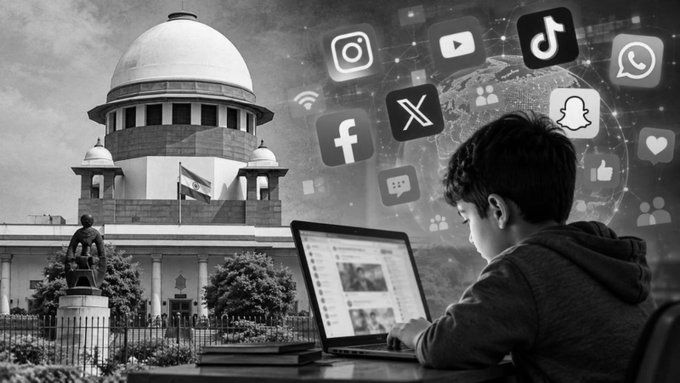
Internet Access Is a Fundamental Right for Children Too: Supreme Court
The Supreme Court has held that access to and use of the internet is a fundamental right for every individual, including children, stressing that protecting young people from online dangers cannot mean shutting them out of the digital world.
A Bench of Justices J.B. Pardiwala and K. Vinod Chandran linked the right to Article 21, which guarantees life and personal liberty, and Article 19(1)(a), which protects freedom of speech and expression. The Court made clear that children enjoy these constitutional protections regardless of their age.
The ruling came during proceedings concerning the circulation of child sexual exploitation and abuse material on social media and other online platforms. The Court was examining whether digital platforms and authorities were doing enough to identify, report and remove such material.
The Bench cautioned that blanket restrictions on children's internet access could push young users towards unregulated platforms and discourage victims of online abuse from seeking help. The internet, it noted, is an important source of education, information, communication and social connection, particularly for children in remote areas and those with special needs.
The Court suggested safeguards including parental guidance and consent, child-mode accounts, private-by-default profiles, restrictions on contact from unknown adults and stronger moderation of age-inappropriate content. Restrictions on inherently harmful services, including adult-content websites, may still be imposed.
The Bench also called for stronger action against online child abuse, including a national database of digital fingerprints and URLs to help identify and remove abusive material. The Centre has been asked to develop guidelines and standard operating procedures, strengthen complaint mechanisms and consider changes to relevant information technology laws and rules. The Court also called for digital safety education in schools, parental awareness programmes and counselling for victims.
The issue is also relevant as Karnataka has proposed a social media ban for children below 16, while Andhra Pradesh has proposed restrictions for children below 13.
The Union government must submit a progress affidavit before the next hearing on December 10, 2026.
The ruling underscores the need to protect children from online abuse without denying them their fundamental rights to learn, communicate and express themselves.