
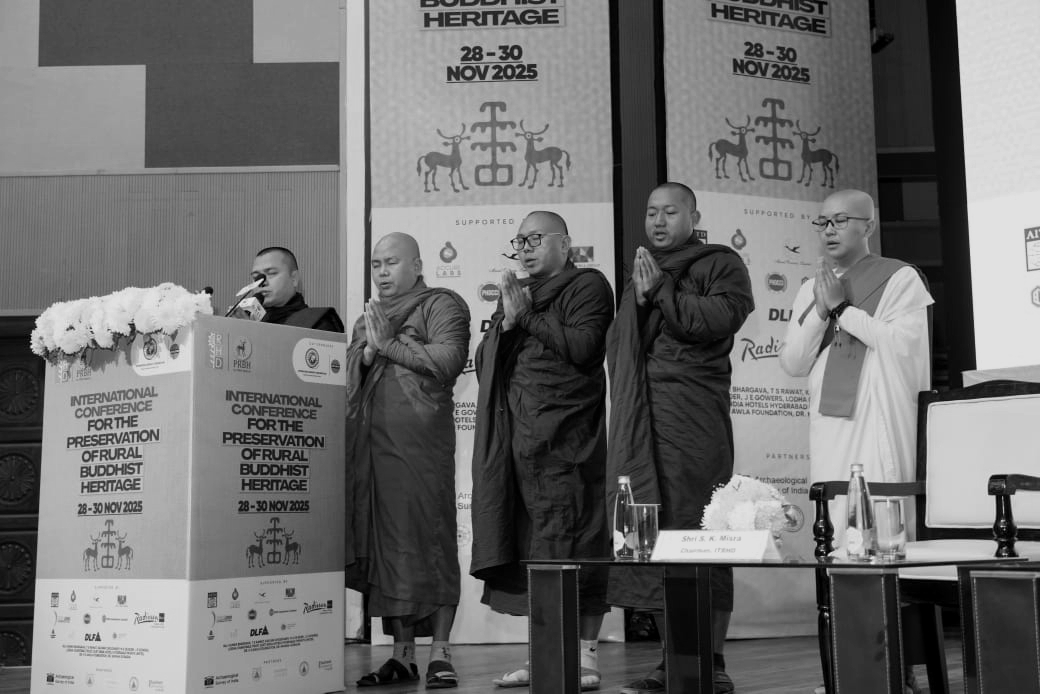
International conference sets action agenda for protecting fragile rural Buddhist sites
The International Conference on the Preservation of Rural Buddhist Heritage concluded in New Delhi on November 30 with the adoption of the Delhi Declaration, a comprehensive framework aimed at protecting and revitalising India’s widespread but often overlooked rural Buddhist heritage. Organised by the Indian Trust for Rural Heritage and Development (ITRHD), the three-day event at the Dr. Ambedkar International Centre brought together Indian and international scholars, conservation experts, architects, administrators and policymakers for extensive discussions on building a more systematic, community-driven approach to heritage preservation.
One of the most significant developments to emerge from the conference is a proposal to establish a National Academy for Rural Heritage Conservation and Development Training at Nagarjunakonda in Andhra Pradesh. The state government, under Chief Minister N. Chandrababu Naidu, has allotted five acres of land for the project, paving the way for what is expected to be India’s first dedicated institution focused on professional training, coordinated conservation planning and community capacity-building for rural Buddhist heritage. The academy is intended to address longstanding gaps in skilled manpower and integrated planning, and to support a national framework for preserving heritage in rural landscapes.
ITRHD Chairman S. K. Misra said the Delhi Declaration will guide future work and called for annual reviews to ensure that the recommendations translate into measurable outcomes rather than remaining theoretical. The final day of the conference marked a shift from broad conceptual discussions to concrete, action-oriented strategies. Speakers emphasised the role of digital tools in documentation, the importance of empowering local communities as custodians of heritage, the need for education-driven outreach, and approaches to sustainable tourism that safeguard fragile and archaeologically sensitive sites. Many participants highlighted that rural Buddhist heritage, while archaeological in form, remains a living cultural resource intertwined with identity, livelihoods and regional development.
Harvard University’s Dr. Prajapati Trivedi underscored the need for a shared and clearly defined understanding of success to ensure long-term coordination among institutions. Conservation architect Prof. A. G. K. Menon noted persistent gaps between agencies and argued that heritage protection and development should not be treated as competing priorities, adding that India’s overall progress must be evaluated through the condition of its villages as much as its urban centres. International delegates also welcomed India’s initiative, with Dr. Victoria Demenova of Ural Federal University describing the event as unusually comprehensive and suggesting that its outcomes could influence global thinking on heritage management, particularly in rural regions where culture and community are closely linked.
The conference organiser, the Indian Trust for Rural Heritage and Development (ITRHD), is a national non-profit organisation founded in 2010 by senior civil servants, conservation specialists and development practitioners led by S. K. Misra. Its mission is to integrate heritage conservation with rural development by protecting built, natural and cultural heritage while improving local livelihoods. The organisation focuses on documenting and conserving rural heritage, promoting community-led stewardship, enabling sustainable tourism models, supporting policy development and forming partnerships with international universities, cultural organisations and government bodies. Its work includes restoration projects, skill development programmes, awareness campaigns and capacity-building initiatives in heritage-rich rural areas.
With the adoption of the Delhi Declaration and a concrete plan to set up a national academy at Nagarjunakonda, organisers say India is better positioned to develop a coherent long-term strategy for safeguarding its rural Buddhist legacy. They emphasise that the combined focus on professional training, community participation, inter-agency coordination and international engagement will strengthen conservation outcomes while enhancing rural development and cultural diplomacy.