

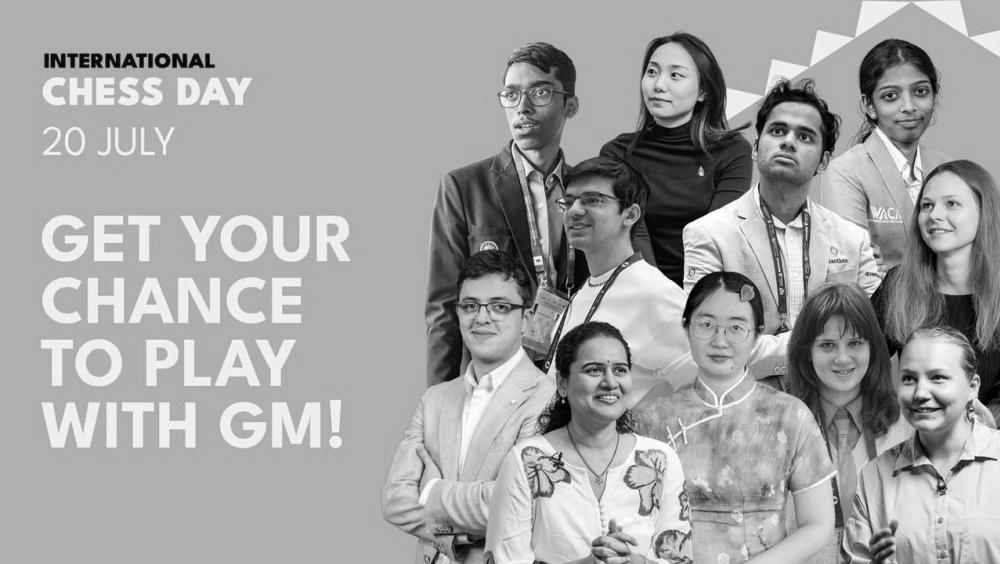
International Chess Day 2026: The Timeless Game That Continues to Unite the World
Every year on July 20 , millions of people across the globe celebrate International Chess Day , honoring a game that has fascinated minds for more than fifteen centuries. What began as a strategic board game in ancient India has evolved into one of the world's most popular intellectual sports, played by people of all ages, backgrounds, and nationalities. Today, chess is far more than a competitive pursuit; it is a symbol of education, critical thinking, creativity, discipline, and international friendship.
International Chess Day commemorates the founding of FIDE (Fédération Internationale des Échecs) , the world governing body for chess, on July 20, 1924 , in Paris. The observance was first proposed by UNESCO in 1966 and gained even greater significance when the United Nations General Assembly officially recognized July 20 as World Chess Day in 2019 . The UN acknowledged chess as a powerful tool for promoting dialogue, mutual respect, inclusion, fairness, and cooperation among people and nations.
The game's journey began in ancient India, where historians believe it originated as Chaturanga during the Gupta Empire around the sixth century. Chaturanga represented the four divisions of an army and laid the foundation for modern chess. The game later spread to Persia, where it became known as Shatranj, before traveling across the Arab world and Europe. Over centuries, the rules gradually evolved into the modern version played today. This remarkable journey from ancient India to every corner of the globe is one of the reasons chess is often described as a universal language.
The significance of International Chess Day extends beyond celebrating a board game. Around the world, schools, universities, clubs, federations, and community organizations organize tournaments, exhibitions, workshops, simultaneous displays, online competitions, and educational programs. These activities aim to introduce new players to chess while highlighting its educational and social benefits. For International Chess Day 2026 , FIDE has adopted the theme "Celebrate, Create and Make a Difference," encouraging people to use chess as a platform for community engagement, learning, and positive social impact.
One of the reasons chess has endured for centuries is its unique ability to develop essential life skills. The game teaches players how to think critically, evaluate alternatives, anticipate consequences, solve problems, and make decisions under pressure. Chess also strengthens concentration, memory, creativity, patience, and emotional resilience. These benefits have led many educational institutions around the world to incorporate chess into learning programs. Educators often view the game as an effective tool for improving cognitive development, analytical thinking, and academic performance among students.
While many people associate chess with traditional over-the-board competition, the modern game exists in several formats designed to suit different playing styles and audiences. Classical chess remains the most prestigious format and is used in World Championship events. Players receive long time controls, allowing for deep calculation and strategic planning. Rapid chess offers shorter time controls, usually between ten and sixty minutes per player, creating a balance between careful analysis and quick decision-making. Blitz chess , one of the most popular formats today, typically gives players between three and ten minutes each, resulting in fast-paced and exciting encounters.
For those who enjoy even greater speed, Bullet chess allows players as little as one minute each, testing reflexes and instinctive decision-making. Armageddon chess is often used as a tie-break format and guarantees a decisive outcome because White must win while Black advances with a draw. Another increasingly popular variant is Chess960 , also known as Fischer Random Chess, where the starting positions of the major pieces are randomized. This format reduces reliance on opening preparation and encourages creativity from the very first move. Other forms include Correspondence chess , where players may take hours or days to make moves, Blindfold chess , which relies entirely on visualization and memory, and Bughouse chess , a team-based variant that introduces unique strategic possibilities.
The way chess tournaments are conducted also varies considerably. Elite invitation events often use the round-robin format , where every participant plays against every other participant. Large open tournaments typically employ the Swiss system , which pairs players with opponents who have similar scores after each round. Major international competitions such as the World Cup frequently use a knockout format , where players are eliminated after losing matches. Team events, including the prestigious Chess Olympiad , bring together national teams from around the world, while league competitions allow clubs and organizations to compete over an entire season. In recent years, online championships have expanded rapidly, enabling players from different continents to compete without leaving their homes.
Chess history is filled with legendary figures who transformed the game and inspired generations of players. Among the earliest great champions was Wilhelm Steinitz , recognized as the first official World Chess Champion. José Raúl Capablanca of Cuba became famous for his natural talent and exceptional endgame mastery. Alexander Alekhine brought dynamic attacking ideas that influenced modern chess theory, while Mikhail Tal , known as the "Magician from Riga," captivated audiences with imaginative sacrifices and brilliant combinations.
Few players have left a larger mark on chess than Bobby Fischer , whose rise to the World Championship in 1972 helped popularize the game worldwide. Fischer's contributions extended beyond competition, as many of his ideas influenced modern chess formats and preparation methods. Anatoly Karpov later dominated the chess world through remarkable consistency and positional understanding, while Garry Kasparov elevated the game to new heights with his aggressive style, deep preparation, and sustained excellence. Kasparov is widely regarded as one of the greatest chess players in history.
For India, no name is more significant than Viswanathan Anand . By becoming India's first World Chess Champion, Anand inspired a generation of young players and triggered a chess revolution across the country. His achievements transformed chess from a niche pursuit into a mainstream sport and encouraged thousands of children to take up the game. Many of India's current stars have openly acknowledged Anand as their inspiration.
The modern era of chess continues to be shaped by extraordinary talent. Magnus Carlsen , the Norwegian superstar and former World Champion, is considered by many experts to be among the greatest players ever. His dominance across classical, rapid, and blitz formats has set new standards in professional chess. At the same time, a new generation of grandmasters is redefining the competitive landscape.
India's rise has been particularly remarkable. D Gukesh , who became the youngest undisputed World Chess Champion in history, represents the country's growing influence on the global stage. Alongside him, players such as R Praggnanandhaa , Arjun Erigaisi , Koneru Humpy , R Vaishali , and Divya Deshmukh continue to achieve impressive results in international competition. Beyond India, leading contemporary stars include Hikaru Nakamura , Fabiano Caruana , Nodirbek Abdusattorov , Wei Yi , Javokhir Sindarov , and Anish Giri . Their performances, combined with the popularity of online streaming and digital content, have helped chess reach new audiences worldwide.
India's transformation into a chess powerhouse is one of the most significant developments in the modern history of the sport. Building on the foundation laid by Anand, the country has invested heavily in youth development, coaching infrastructure, and grassroots programs. The results have been extraordinary. Indian players are now regular contenders in world championships, elite tournaments, and international team events. A landmark achievement came at the 2024 Chess Olympiad , where India captured both the Open and Women's team titles, demonstrating the depth and strength of its chess ecosystem.
The numbers associated with chess are equally fascinating. The game is played on a board containing 64 squares and begins with 32 pieces , sixteen for each side. Researchers estimate that there are more possible chess positions than atoms in the observable universe, highlighting the game's immense complexity. More than 2,000 recognized chess variants exist worldwide, and hundreds of millions of people know how to play the game. The growth of online platforms has further expanded participation, making it easier than ever for players to compete, learn, and connect with opponents around the world.
International Chess Day also serves as a reminder of chess's unique ability to bring people together. Unlike many activities, chess requires no common language. A player from India can sit across the board from a player from Norway, Uzbekistan, China, or the United States and communicate entirely through moves. This universal nature has allowed chess to flourish across cultures and generations, creating friendships and fostering mutual understanding.
As the world celebrates International Chess Day 2026 , the game's enduring appeal remains stronger than ever. From its origins in ancient India to modern online platforms connecting millions of players, chess continues to evolve while preserving the qualities that have made it timeless. It remains a game of imagination and discipline, competition and learning, tradition and innovation. More importantly, it stands as a reminder that a simple board of sixty-four squares can inspire excellence, bridge cultures, and unite people across the globe through a shared passion for strategy and intellectual challenge.