
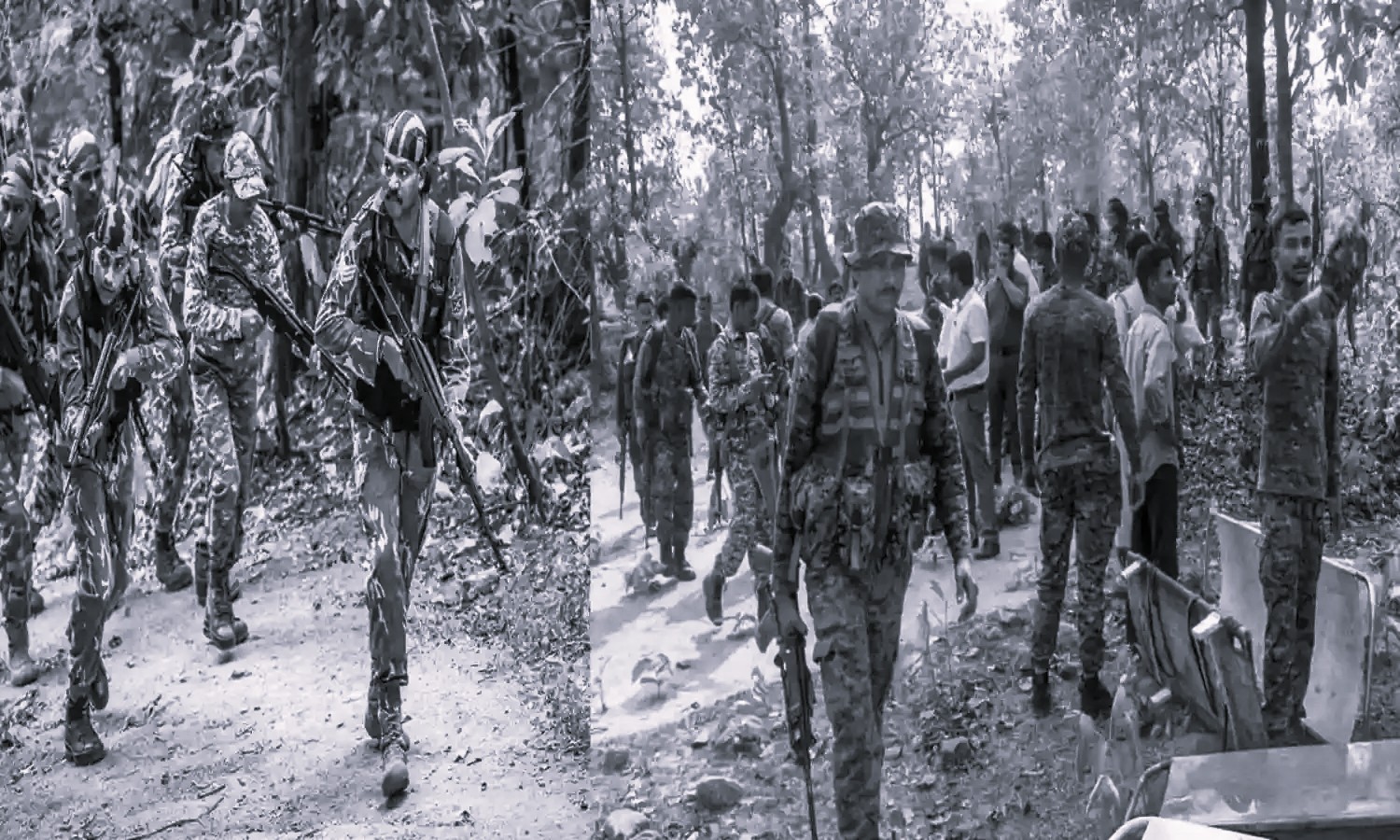
Inside Operation Kagar, the Biggest Offensive Against Maoist Insurgency
India’s decades-long battle against Maoist insurgency appears to be entering a decisive phase with the launch of Operation Kagar , a large-scale security campaign aimed at dismantling the remaining Maoist network in central India. Initiated toward the end of 2024 , the operation is now being aggressively carried out across the forested border regions of Chhattisgarh, Telangana, Maharashtra and Odisha , areas long considered the heartland of Maoist activity.
The word “Kagar,” meaning the final edge or brink , symbolically reflects the objective of the campaign to push the Maoist movement toward its last phase. Unlike earlier anti-Naxal operations, this initiative combines massive security deployment, intelligence coordination and development programmes in an attempt to eliminate insurgent influence permanently.
A Conflict Rooted in Decades of Insurgency
The Maoist movement has operated in India for several decades, expanding significantly in the 1980s across forest regions of central India . Over time, areas such as Bastar in Chhattisgarh, Gadchiroli in Maharashtra, forest belts along the Telangana border, and Odisha’s Malkangiri district evolved into major operational zones for insurgents.
These regions collectively became known as the Red Corridor , where Maoist groups built armed squads, established training camps and launched attacks against security forces. However, in recent years, the government intensified both counter-insurgency measures and infrastructure development , creating the conditions for a coordinated offensive such as Operation Kagar .
Union Home Ministry Leading the Campaign
The Union Home Ministry is spearheading the operation with a focus on strengthening internal security and weakening Maoist influence across multiple states. Officials say Union Home Minister Amit Shah has been closely monitoring the progress of the campaign through regular review meetings and coordination with state governments.
According to security officials, the Centre has set an ambitious target of significantly curbing Maoist activities by 2026. To achieve this, authorities have expanded security deployments, established new forward operating camps and increased the use of advanced surveillance technologies, including drones and satellite-based intelligence.
The strategy, however, extends beyond security operations. The government has also accelerated development initiatives in remote tribal areas , including road connectivity, mobile communication networks, schools and healthcare facilities. Authorities believe these efforts will reduce local support for insurgents while strengthening trust in government institutions.
Dandakaranya: The Core Battleground
Much of Operation Kagar is concentrated in the Dandakaranya forest region , a vast expanse connecting the borders of Chhattisgarh, Telangana, Maharashtra and Odisha . For years, this rugged terrain has served as the operational hub for Maoist leadership and guerrilla squads.
Security forces have intensified large-scale combing operations in districts such as Bastar, Sukma, Bijapur and Dantewada , where Maoist units have traditionally operated. The operations aim to identify insurgent hideouts, dismantle camps and neutralize armed formations deep within the forests.
Multiple security units are involved in the campaign, including the CRPF (Central Reserve Police Force), CoBRA commandos, District Reserve Guard (DRG), Bastar Fighters and specialized state police units . Equipped with modern weapons, drones and satellite surveillance , these forces are conducting sustained patrols and intelligence-based strikes.
Series of Major Encounters
The intensified operations have resulted in a series of significant encounters over the past two years. Security agencies report that hundreds of Maoist cadres were killed in operations during 2025 , including several senior leaders from the organization’s central and zonal committees .
In districts such as Bijapur and Sukma , security forces also uncovered arms depots, training facilities and underground bunkers used by insurgents. Hidden tunnels and fortified positions, including structures discovered in areas like Karregutta , highlighted the extent of Maoist infrastructure within the forests.
Elimination of Top Maoist Leaders
One of the biggest blows to the insurgency came on May 21, 2025 , when Maoist General Secretary Nambala Keshava Rao, also known as Basavaraju , was killed during a massive operation in the Abujhmad forests near the Narayanpur–Bijapur border in Chhattisgarh .
The joint operation by central forces, DRG and STF lasted for more than 50 hours , resulting in the deaths of 27 Maoists . Basavaraju, who carried a ₹1.5 crore bounty , was considered one of the most influential leaders in the Maoist hierarchy and played a crucial role in planning operations across the Dandakaranya region .
Just weeks later, on June 5, 2025 , another key Maoist figure, Central Committee member Narasimha Chalam alias Sudhakar , was killed during an encounter in the forests of Indravati National Park in Bijapur district . Security forces recovered an AK-47 rifle and other weapons from the site. Sudhakar was known for his role in ideological training within the Maoist movement .
Further operations in July 2025 led to the death of PLGA platoon commander Rahul Punem alias Lachhu along with five other Maoists in the Abujhmad forests of Narayanpur district .
In another major development, Central Committee leaders Raju Dada (Katta Ramachandra Reddy) and Kosa Dada (Kadari Satyanarayana Reddy) were killed in an encounter. Both leaders carried ₹40 lakh rewards and were considered influential strategists within the Maoist structure.
Security forces also reported operations targeting Hidma , a senior Maoist commander accused of orchestrating several deadly attacks in the region.
Surrenders on the Rise
The sustained pressure created by Operation Kagar has also led to a significant rise in Maoist surrenders . In Chhattisgarh alone, hundreds of insurgents have surrendered over the past year , choosing to return to civilian life.
Among those who recently surrendered are Mallojula Venugopal Rao, Koyyada Sambayya (Azad), Appasi Narayana (Ramesh), Muchaki Somada (Erra) and Badise Deva .
In early March 2026 , around 130 Maoists surrendered before Telangana Chief Minister Revanth Reddy , including several PLGA members and commanders .
Security officials believe the loss of senior leadership combined with rising surrenders has disrupted the Maoist command structure , forcing remaining cadres to operate in smaller guerrilla units rather than organized formations.
Rehabilitation and Development Push
Government rehabilitation programmes have played a significant role in encouraging insurgents to surrender. Those who give up arms are offered financial assistance, housing support, vocational training and opportunities for government employment .
At the same time, the government has accelerated development projects in tribal regions , including road construction, electricity supply, mobile connectivity, schools and healthcare services . Officials say these initiatives are gradually reducing Maoist influence in villages and strengthening public confidence in governance.
Aiming for a Decisive Break by 2026
Security agencies have set March 31, 2026 as a key milestone in the campaign, hoping to significantly weaken the Maoist network by that time. The focus remains on dismantling the last remaining insurgent bases in the Dandakaranya forests .
Experts caution that some armed groups may still remain hidden in remote areas, meaning complete eradication could take longer. Nevertheless, Operation Kagar is widely regarded as the most comprehensive strategy launched against Maoist insurgency in India .
With senior leaders eliminated, increasing surrenders and shrinking operational capacity , analysts say the insurgency is facing one of its most challenging phases. If the current momentum continues, the long-troubled forest regions of central India could finally see greater stability, peace and development in the years ahead.