
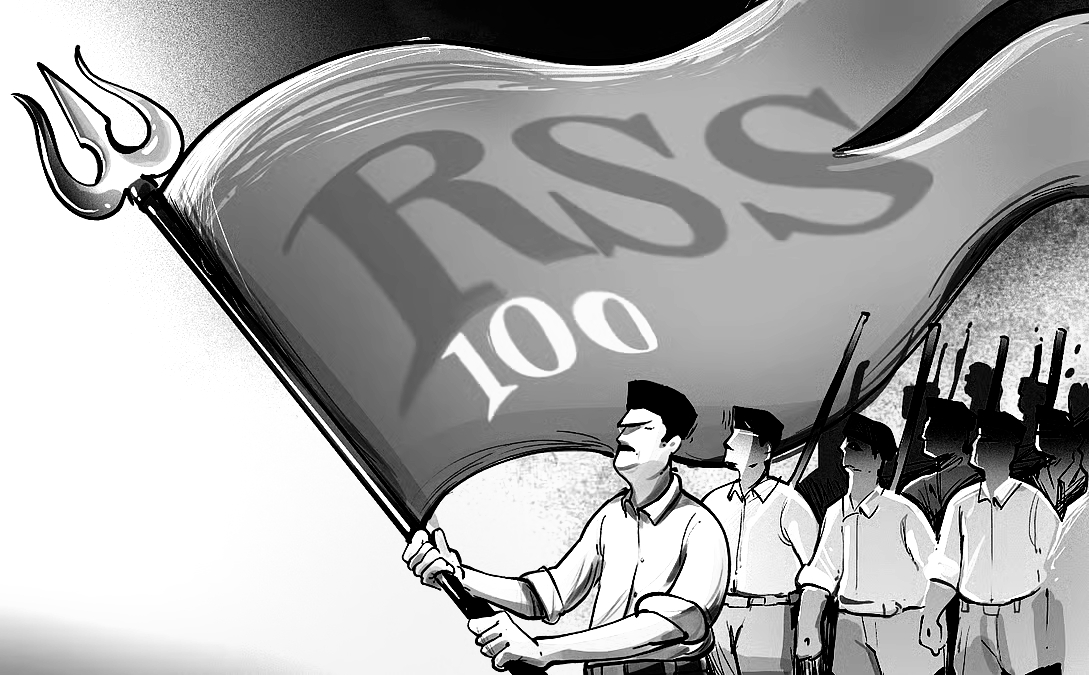
Inside Mohan Bhagwat’s era: How he shaped 100 years of RSS
Mohan Bhagwat, the sixth sarsanghchalak (chief) of the Rashtriya Swayamsevak Sangh (RSS), has led the organization through one of its most consequential stretches. Appointed in March 2009, he inherited an organisation with deep historical roots and an expansive social footprint. Under Bhagwat’s stewardship the RSS has doubled down on two linked projects, broadening the Sangh’s social presence (schools, relief work, community outreach), while sharpening political influence through indirect networks and public messaging. The result is an RSS that looks and feels different from the one Hedgewar founded in 1925,more visible, more networked, and far more influential in public life.
Mohan Bhagwat was born in 1950 into a family active in the Sangh, his father was an RSS worker. Trained as a veterinarian, Bhagwat became a full-time RSS pracharak and rose through organisational ranks to become sarsanghchalak in 2009. He is, by training and temperament, a cadre,first leader: he talks often about culture, service and nation building, but he also understands modern media and public relations, a useful mix for steering an old institution into contemporary politics.
One hundred years, many chapters: The RSS began in Nagpur in 1925 with K. B. Hedgewar, its original aim was to organise Hindu society around cultural nationalism and social discipline. Over a century, the Sangh evolved from a small volunteer shakha movement into an umbrella ecosystem, a family of organisations (the Sangh Parivar) that includes educational networks, service groups and political parties. That long arc explains why the RSS can now speak at once to village shakhas and national policy debates; it didn’t happen overnight, but grew through deliberate institution building.
The social architecture, schools, relief and reach: One of the clearest measures of the RSS’s reach is education, Vidya Bharati, the Sangh’s education wing, runs a vast network of schools that reaches millions of children across India. These schools are a daily touchpoint for cultural training, language and value,education, and they function as both social service and a softpower incubator for the Sangh’s worldview. The scale matters, thousands of schools, millions of students, this is influenced by the slow, patient method of schooling.
Beyond classrooms, the Sangh’s service arms have become prominent in crisis response. In the 2020 COVID,19 shutdowns, RSS volunteer networks mobilised masks, food kits, shelters and assistance for migrants at scale, official counts reported millions of meals and millions of items distributed across thousands of locations. These relief efforts are real, visible, and emotionally powerful for ordinary citizens; they change how the Sangh is seen on the ground, irrespective of high politics.
Political influence without direct politics: The RSS officially remains a non party movement, yet its ideas and personnel filter into politics through the Sangh Parivar, the most visible arm of which is the BJP. That relationship is not a simple chain of command, but a long standing pipeline, the Sangh trains cadres, develops leaders, and provides social legitimacy, political parties convert some of that social capital into votes and policy. In Bhagwat’s era that pipeline has continued to function, sometimes quietly, sometimes in plain view, producing an ecosystem where cultural messaging and electoral politics are closely aligned. Critics and analysts argue this has sharpened polarisation, supporters contend it has given India a coherent cultural voice. Both claims reflect reality, the Sangh’s organizational depth makes it a distinct force in India’s political life.
Examples that illustrate a century of change
• Education and identity, Vidya Bharati classrooms teach local languages and Indian civilizational narratives, alumni often populate local civic institutions or join Sangh activities. This explains how cultural ideas percolate into ordinary civic life over generations.
• Disaster relief to public trust, During COVID,19, volunteers running relief kitchens, arranging shelter and assisting migrants translated into goodwill for the Sangh in regions where state response was slow. These are practical acts that shift public perception.
• Public outreach and media, Bhagwat’s public speeches, invitations to presidential functions, and efforts to speak in conciliatory language in some forums are steps to rebrand the Sangh as mainstream and socially responsible. Yet critics see these gestures as tactical, generous rhetoric that coexists with narrower ideological aims.
The controversies, the reality check: The Sangh’s critics point to a long record of communal tensions and episodes where fringe elements linked to Sangh networks were accused of or involved in anti,minority violence. Historians and journalists have documented episodes where nationalist mobilisation had violent or exclusionary consequences, those critiques remain a central part of the RSS debate. At the same time, defenders counter that the Sangh’s vast social work should not be reduced to its critics’ worst examples. This duality, social welfare on the ground, contested public politics at the top, is the defining tension of Bhagwat’s era.
Bhagwat’s attempts at recalibration: Under Bhagwat, the RSS has attempted gestures of outreach, paying lip service to harmony, inviting dialogues, and emphasising “service” in public messaging. At times he has publicly spoken of inclusivity and cultural unity, at other times, critics have denounced these words as insufficient. The pattern is a classic organisational strategy, broadening the unit of appeal (education, relief, culture) while continuing to press core ideological goals through cadre work. That mix has made the Sangh resilient and adaptable, and harder to summarise in a single sentence.
What the evidence suggests,
• Institutional depth is the Sangh’s real asset, The RSS does not rely on flash,in pan campaigns, it builds schools, runs shakhas, trains volunteers. That slow institutional work creates durable influence.
• Soft power translates into political power over time. When an organization feeds children, educates them and provides civic leadership, it shapes the next generation’s worldview. That makes the Sangh’s influence intergenerational and structural rather than merely rhetorical.
• Public messaging and optics matter, but so do grassroots choices, Bhagwat’s conciliatory line in some speeches enlarges the Sangh’s audience, grassroots training keeps the movement coherent. Both are necessary for long,term political strategy.
• Contestation will not disappear, The Sangh’s social work does not erase the history of controversy, instead, it complicates it. For many citizens the Sangh is a relief and school, for others it is a political threat. That division is the political reality Bhagwat must govern.
Looking ahead, Mohan Bhagwat’s impact will b e seen in whether the RSS’s schools and service work create lasting cultural influence and civic engagement. Equally, it will depend on how the organisation balances its social welfare image with the political effects of its ideology, shaping India’s public life for decades.
Mohan Bhagwat’s era is neither saintly makeover nor pure hardening of old lines. It is a complex, hybrid evolution, an organisation that still studies its founder’s lessons but has adapted modern management, schooling and relief methods. It remains a powerful social machine with political aftereffects, a hundred,year old organisation learning to play the contemporary game. Understanding it requires three lenses at once, historical roots, organizational capacity, and political consequences. Read through those lenses, and the figure of Mohan Bhagwat emerges as the custodian of a project that intends to be both cultural and political, social and strategic.