
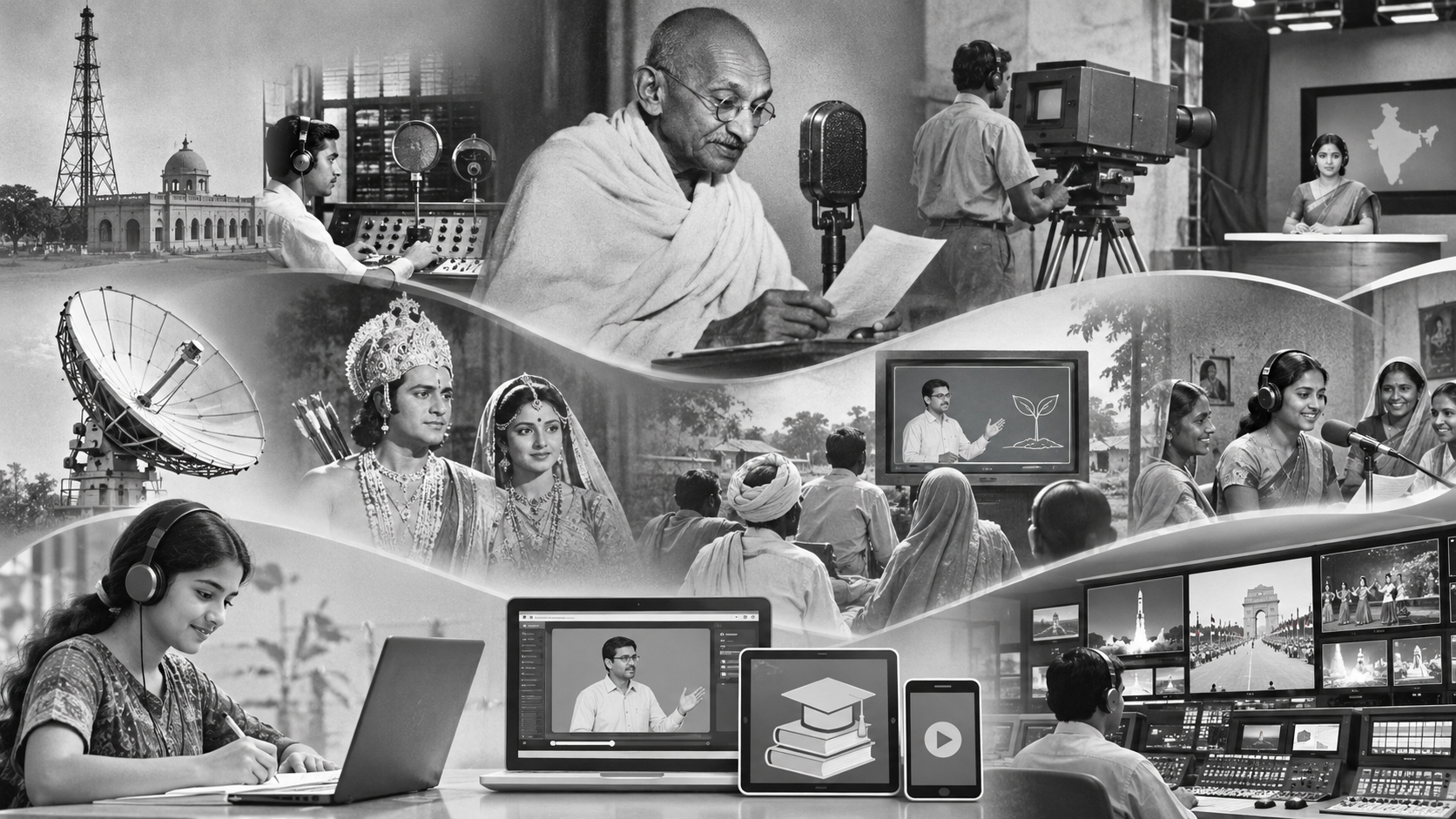
Informing, Educating and Connecting: The Legacy of India's Public Broadcasting
Long before smartphones, social media and digital streaming transformed information consumption, radio served as one of India's most important connections with the outside world. It carried news across geographical boundaries, connected communities and brought essential information into households. For a newly independent nation confronting the challenges of rebuilding itself, broadcasting became more than a communication facility, emerging as an instrument of nation-building, education and public awareness. Nearly a century later, India's public broadcasting system has evolved from a handful of radio stations into an extensive network spanning radio, television, community broadcasting and digital platforms.
The Beginning of India's Broadcasting Journey
India's broadcasting journey began in the early 1920s. The Radio Club of Bombay conducted the country's first radio broadcast in June 1923, followed by similar initiatives in Calcutta and Madras. A major milestone came on July 23, 1927, when the Indian Broadcasting Company (IBC) inaugurated its Bombay station, followed by its Calcutta station. The date is commemorated as National Broadcasting Day.
After the IBC went into liquidation in 1930, the government established the Indian State Broadcasting Service. It was renamed All India Radio (AIR) in 1936, creating the foundation for an organised national broadcasting network. The Central News Organisation was established in 1937, strengthening its news operations, while its External Services began in 1939. The name Akashvani, meaning 'voice from the sky', was adopted in 1956.
Gandhi's Historic Broadcast and Public Service Broadcasting Day
One of the most significant moments in broadcasting history occurred on November 12, 1947, when Mahatma Gandhi addressed thousands of Partition-displaced people staying in Kurukshetra through an All India Radio broadcast from New Delhi. Delivered at 3 PM on the occasion of Deepawali, his message offered hope and solidarity to people facing displacement and uncertainty. The broadcast demonstrated radio's ability to connect people during a national crisis. The occasion is commemorated as Public Service Broadcasting Day, an annual observance introduced in 2001. It is distinct from National Broadcasting Day, celebrated on July 23.
From Six Stations to a Nationwide Network
At Independence, All India Radio operated just six stations and 18 transmitters, covering approximately 2.5 per cent of India's geographical area and 11 per cent of its population. The subsequent expansion of stations, transmitters and regional services transformed radio into a nationwide communication network. Programmes such as the National Programme of Music, National Programme of Talks and Vividh Bharati, launched in 1957, diversified its content. Radio became an integral part of everyday life through news bulletins, music, dramas, agricultural advisories and regional programming. Today, Akashvani broadcasts in 23 languages and 182 dialects, reflecting India's linguistic diversity.
Television Enters Indian Homes
A new chapter began on September 15, 1959, when Doordarshan started experimental television broadcasting in New Delhi with assistance from UNESCO. Initially operating with a modest studio and transmitter, the service offered educational and public-awareness programmes. Regular television broadcasting began in 1965, and the network gradually expanded to other cities. Doordarshan was separated from All India Radio on April 1, 1976, becoming an independent department under the Ministry of Information and Broadcasting. The introduction of colour television on August 15, 1982, marked another major technological milestone, transforming the Indian viewing experience.
Satellite Technology and Television's Developmental Role
Broadcasting increasingly became an instrument of rural development and education. The Satellite Instructional Television Experiment (SITE), conducted between August 1975 and July 1976, used the American ATS-6 satellite to deliver educational programmes to approximately 2,400 villages across six states. Its content covered agriculture, health, education and community development. Another important initiative, Krishi Darshan, introduced in 1967, used television to communicate scientific farming practices and agricultural information to rural households. These programmes demonstrated how broadcasting could overcome geographical barriers and extend developmental information to underserved communities.
Doordarshan's Cultural and Social Influence
During the 1980s, Doordarshan became a household name through news bulletins, documentaries, educational programmes and entertainment serials. Hum Log, Ramayan and Mahabharat became landmark television productions, attracting audiences across the country while reflecting social and cultural themes. National events, Republic Day celebrations, Independence Day broadcasts and major sporting competitions also brought millions of viewers together. Regional programming further promoted local languages, literature, music and traditions, establishing television as an important part of India's cultural landscape.
Prasar Bharati: Strengthening Public Broadcasting
The Prasar Bharati Act was enacted in 1990 and came into force on September 15, 1997, establishing an autonomous statutory broadcasting corporation. It brought All India Radio and Doordarshan under a common institutional framework. Under Section 12 of the Act, Prasar Bharati is mandated to inform, educate and entertain citizens while ensuring balanced broadcasting development. Its responsibilities include national integration, literacy, agricultural development, public awareness, scientific advancement and adequate representation of India's linguistic and cultural diversity. The legislation also emphasises communication with women, children, minorities, tribal communities, persons with disabilities and people in remote regions.
From Radio Classrooms to Digital Universities
India's educational broadcasting mission has expanded from radio lessons and televised classrooms to interactive digital learning. A major initiative is SWAYAM (Study Webs of Active-Learning for Young Aspiring Minds), developed by the Ministry of Education with IIT Madras as its technical partner. The platform provides online courses from school education to postgraduate studies, covering engineering, science, management and humanities. Its four-part learning structure includes video lectures, reading materials, self-assessment tests and discussion forums. Most course content is free, while certification requires registration for designated examinations. Under applicable UGC regulations, universities may allow students to earn up to 40 per cent of programme courses in a semester through SWAYAM. By January 2026, the platform had recorded more than 5.80 crore cumulative enrolments, over 4,400 unique courses and approximately 52.88 lakh certifications.
The government introduced SWAYAM Plus in February 2024, with IIT Madras as the implementing institution, to connect education with employment. It offers industry-oriented programmes, professional training and opportunities for internships and skill development in areas such as information technology, manufacturing, management and emerging technologies. Meanwhile, SWAYAM Prabha, launched in 2017, uses satellite technology to provide 24-hour educational programming through 48 DTH channels. The initiative helps students in remote areas access lessons without depending entirely on internet connectivity.
Building an Inclusive Digital Learning Ecosystem
The PM eVIDYA initiative, launched in May 2020, integrated online education, television, radio and digital learning resources, particularly during the COVID-19 pandemic. Its important component, DIKSHA, launched in 2017, provides digital textbooks, video lessons, assessments and teacher-training resources. QR codes in textbooks enable students to access additional educational content using digital devices. Other initiatives, including NPTEL, developed by the IITs and IISc, extend technical and higher education, while SATHEE, developed with IIT Kanpur, provides support for competitive examination preparation. Together, these platforms demonstrate how technology can expand educational opportunities beyond conventional classrooms.
Community Radio and Grassroots Participation
Community radio has strengthened local communication by giving communities platforms to discuss agriculture, healthcare, education, livelihoods and women's empowerment. India's policy framework initially approved educational institutions in 2002 before expanding eligibility to other organisations. Community-generated programming is central to the model, with at least 50 per cent of content expected to involve community participation. Government figures recorded 578 operational community radio stations as of June 30, 2026. These stations also play an important role in disseminating local-language information during floods, cyclones and other emergencies. The Supporting Community Radio Movement scheme for 2026–31 carries an allocation of ₹50 crore, with emergency assistance of up to ₹11.50 lakh for eligible stations affected by natural disasters.
Digital Transformation and the Future
Prasar Bharati has increasingly expanded its digital presence through the NewsOnAIR application, social media and online broadcasting. PB-SHABD, launched in 2024, provides audio-visual news material to registered media organisations, supported by a network of more than 1,500 reporters, correspondents and stringers and 60 editorial desks. The launch of WAVES OTT in November 2024 marked another major development, bringing together live television, radio, video-on-demand, audio content and archival programmes. By June 2026, the platform had crossed one crore registered users and 1.4 crore downloads, offering more than 24,000 titles, over 15,000 hours of content, more than 140 television channels and over 200 radio services.
The government has also approved the Broadcasting Infrastructure and Network Development Scheme, with an outlay of ₹2,539.61 crore for 2021–26, to modernise studios, transmitters and production facilities. DD Free Dish has further expanded access to free-to-air television without recurring subscription charges.
Despite these developments, public broadcasting faces competition from private television, streaming services and social media. Misinformation, changing audience preferences, infrastructure modernisation and unequal digital access remain important challenges. Its future will depend on combining technological innovation with credibility, regional representation, cultural preservation and inclusive access.
A Voice That Continues to Connect Generations
From six radio stations at Independence to an extensive broadcasting and digital learning ecosystem, India's public broadcasting journey reflects nearly a century of technological and social transformation. Its evolution demonstrates how communication can advance education, agricultural development, cultural preservation and national integration. As Public Service Broadcasting Day is observed on November 12, the legacy of Gandhi's historic broadcast remains relevant. The platforms have changed from radio receivers and television sets to smartphones, satellite classrooms and streaming services, but the central purpose remains the same: making information, knowledge and meaningful communication accessible to every section of society.