
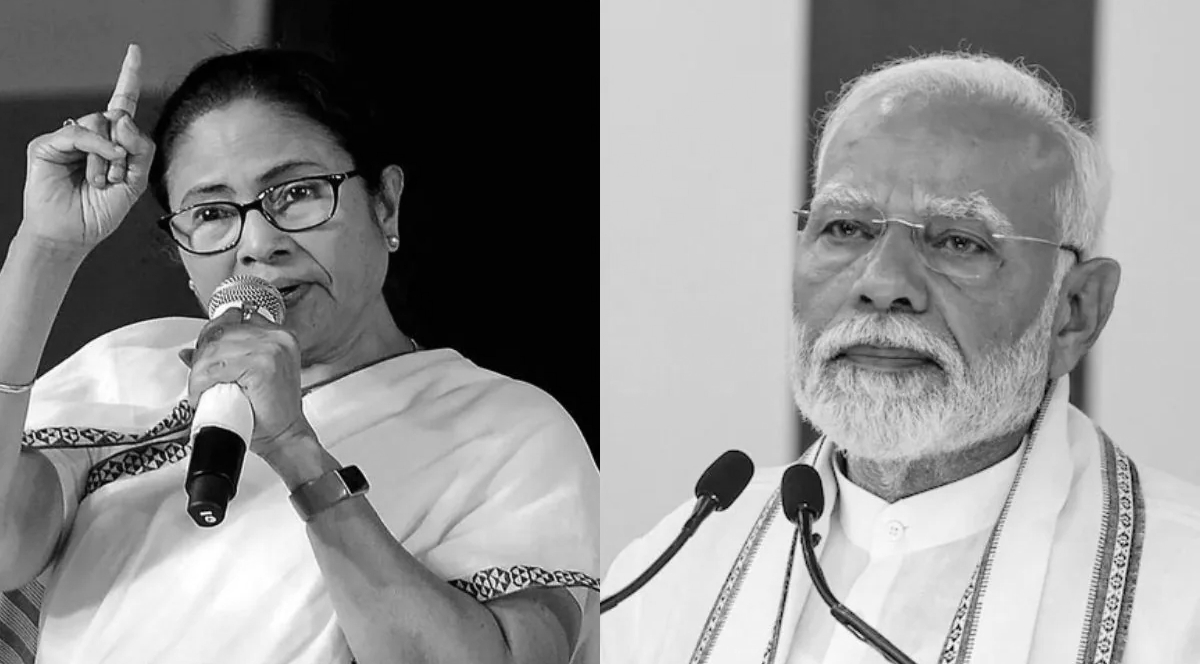
‘Infiltrators’ vs ‘Voter Deletion’: Bengal Elections See Fierce Modi - Mamata Face-Off
The political contest in West Bengal has intensified into a high-stakes battle over citizenship, democracy, and identity , with Prime Minister Narendra Modi and Chief Minister Mamata Banerjee presenting sharply contrasting narratives ahead of the assembly elections scheduled for April 23 and April 29 , with counting on May 4 .
Addressing a rally in Katwa, Modi reaffirmed that the Citizenship (Amendment) Act would be fast-tracked if the BJP comes to power in the state. Enacted in December 2019 and operationalised with rules in March 2024 , the law offers accelerated citizenship to Hindus, Sikhs, Buddhists, Jains, Parsis and Christians from Pakistan, Bangladesh and Afghanistan who entered India on or before December 31, 2014 , reducing residency requirements from 11 years to 5 years .
Government and independent estimates suggest that 30–35 lakh potential beneficiaries could qualify nationwide, with millions from the Matua and Namasudra communities in Bengal forming a crucial electoral bloc, although not all are undocumented as many already possess voter IDs and Aadhaar , complicating the citizenship narrative. Modi also sharpened his attack on illegal immigration, warning that “infiltrators” would have to leave , thereby framing the election around national security, demographic concerns, and border management with Bangladesh , effectively merging citizenship assurance with an anti-infiltration stance .
The CAA remains under intense legal scrutiny , with over 200 petitions pending before the Supreme Court of India, primarily challenging its religion-based eligibility under constitutional equality provisions. While the law is in force, its final validity is yet to be determined . At present, many refugees are protected through Long-Term Visas , allowing limited access to housing, employment, education and healthcare , as India lacks a formal refugee law. Since implementation rules were notified recently, thousands of applications have been filed , though comprehensive official data on approvals and pendency remains limited.
In a strong counterattack, Banerjee alleged that the BJP, with support from the Election Commission of India, attempted to invalidate her nomination from Bhabanipur by filing false cases, though there has been no official confirmation of any such move and her candidature remains valid and accepted . She further alleged large-scale electoral irregularities , claiming that 90 lakh voters were deleted during the Special Intensive Revision of electoral rolls and that more than 250 people died due to issues linked to the exercise, adding that of those deleted, 60 lakh were Hindus and 30 lakh Muslims , claims that remain politically contested and not independently verified .
She also accused the BJP of attempting to manipulate EVMs and capture votes through fraudulent means , framing the election as a struggle to protect democratic institutions and voter rights , while also opposing the proposed Uniform Civil Code, alleging it would undermine democratic rights and target marginalised communities , whereas the BJP positions it as a step toward legal uniformity and national integration .
The election has thus crystallised around three major fault lines citizenship versus identity , security versus democracy , and centralisation versus federalism where refugee communities such as the Matuas may view CAA as long-awaited recognition , while critics argue that the exclusion of Muslims and the rhetoric around infiltrators could create anxiety and perceived targeting , particularly in a border state like Bengal.
Banerjee’s remark questioning whether Bengalis need to constantly prove their citizenship directly challenges the BJP’s narrative by framing it as an issue of dignity and belonging, while Modi’s pitch seeks to convert citizenship into a guarantee of security and rights. Importantly, CAA remains a central law and will continue to be implemented by the Union government regardless of the Bengal election outcome, although state-level resistance could influence its execution, making the ongoing contest not merely an electoral fight but a broader clash between citizenship-driven nationalism and rights-based regional politics that is likely to shape both state and national political discourse in the coming years.