
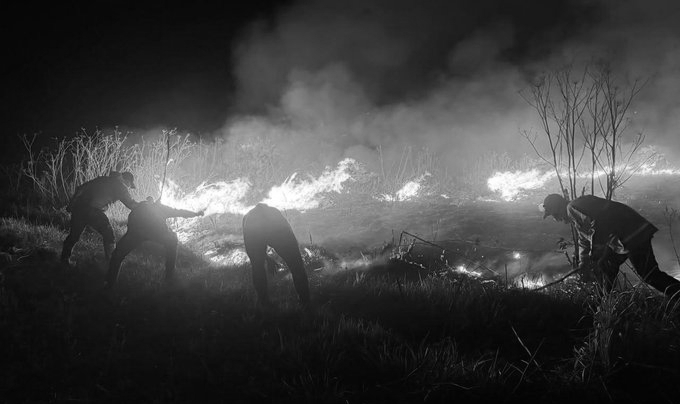
Indonesia Wildfires: Mount Bromo Blaze Nears 900 Hectares As Haze Forces School Closures
Indonesia is battling a worsening wildfire crisis as a blaze at Mount Bromo has scorched nearly 900 hectares, while fires across the country have affected more than 107,000 hectares amid a severe dry season worsened by El Nino.
Firefighters have largely contained the Mount Bromo wildfire, but crews are still fighting hot spots in four areas of Bromo Tengger Semeru National Park in East Java. The park remains closed to tourists as authorities work to prevent the flames from spreading again.
The fire has destroyed large areas of dry grassland and vegetation and threatened protected edelweiss flowers. The flames also reached the Penanjakan area, a popular viewpoint for visitors to Mount Bromo. No injuries or evacuations have been reported from the Bromo fire.
The situation is much wider than East Java. Forestry Ministry data shows that 107,465 hectares of land were hit by fires between January and June 2026, a 110 per cent increase from the same period in 2023, the last major El Nino year.
The government has identified six priority provinces for firefighting: Riau, Jambi and South Sumatra on Sumatra, and West Kalimantan, Central Kalimantan and South Kalimantan on Borneo.
Nearly 48,900 hectares of peatland have burned in these areas. Peat fires are particularly difficult to control because flames can continue burning underground. In Jambi, around 540 hectares have been affected, while thousands of firefighters are working to contain the fires.
Indonesia has stepped up its aerial response, deploying 43 helicopters and 15 fixed-wing aircraft, with more than 35 aircraft involved in water bombing and patrol operations. Authorities are also using cloud-seeding aircraft in an effort to bring rain to fire-hit areas, although the lack of suitable rain clouds has limited the operation.
The worsening fires are now affecting daily life. Dozens of schools have been closed, while schools in Pontianak have shifted classes online because of smoke and poor air quality.
The haze is also crossing Indonesia's borders. Malaysia's Sarawak state has reported unhealthy air quality, while authorities in Singapore have warned that winds could carry smoke towards the city state.
Officials have warned that August and September could be the most critical months as dry vegetation, strong winds and El Nino conditions increase the risk of fires spreading quickly.
Authorities have also pointed to human activity as a major factor, including the burning of peatland and land clearing linked to agriculture, plantations and other development.