
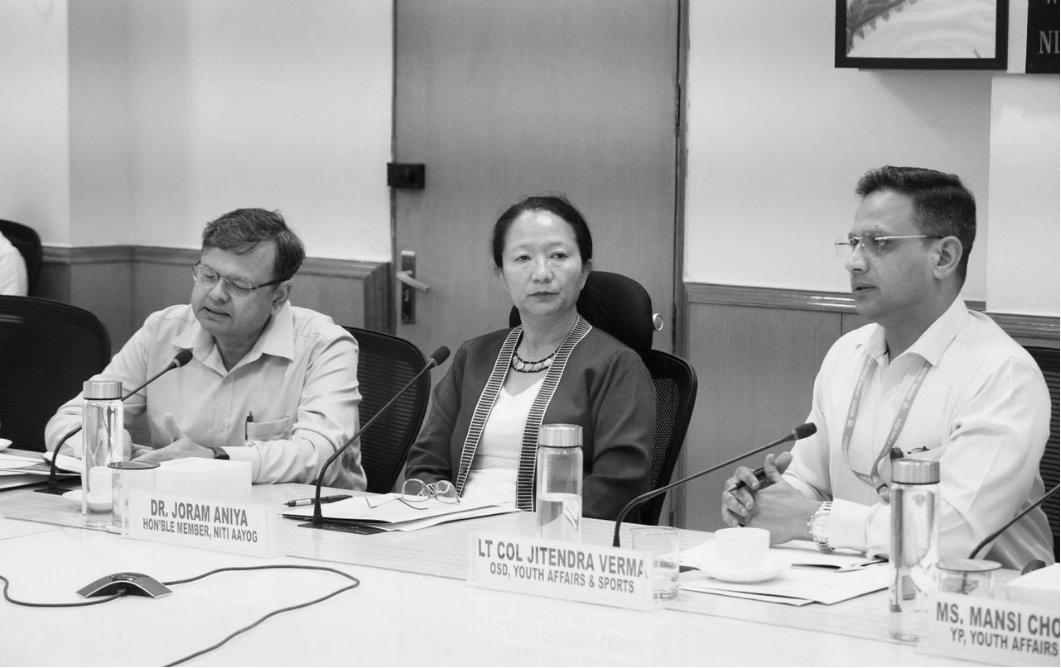
Indigenous Knowledge Can Drive Viksit Bharat 2047, Says Joram Aniya
NITI Aayog Member Dr. Joram Aniya has called for greater scientific documentation and validation of the Northeast’s indigenous knowledge systems, saying traditional practices can contribute to India’s development goals under the Viksit Bharat 2047 vision.
Dr. Aniya made the remarks while delivering a Societal Development Lecture on “Indigenous Knowledge Systems and Viksit Bharat 2047” at the BRIC-Institute of Bioresources and Sustainable Development (BRIC-IBSD) in Imphal on Monday.
She stressed the need to preserve traditional knowledge while connecting it with modern science, biotechnology and research. Rather than treating indigenous practices only as cultural heritage, she emphasised the importance of documenting and scientifically examining them so they can be strengthened and adapted for contemporary needs.
Dr. Aniya cited the Apatani agricultural system of Ziro in Arunachal Pradesh, where paddy cultivation is integrated with fish farming and crop production on field bunds. She noted that such traditional systems face challenges as younger members of communities increasingly move away from rural areas for education and employment.
She urged researchers to explore how biotechnology and modern scientific methods can help address issues such as soil and water conservation, while ensuring that scientific interventions complement rather than replace traditional practices.
Dr. Nanaocha Sharma, Director (Additional Charge), BRIC-IBSD, highlighted the institute’s efforts to connect traditional knowledge with scientific research in the Northeast, a region known for its rich biodiversity and indigenous knowledge.
During the programme, Dr. Aniya released “A Compendium on Medicinal Plants of the Family Zingiberaceae from North-East India (Volume-I)”, published by BRIC-IBSD. The volume documents medicinal plants belonging to the ginger family found in the region.
The institute is also working to promote indigenous agricultural resources. According to recent coverage of the event, BRIC-IBSD has been pursuing Geographical Indication (GI) recognition for two indigenous varieties of Manipur black rice.
Dr. Aniya later visited the institute’s Genome Sequencing Facility, underlining the connection between biodiversity, indigenous knowledge and modern biological research.
Dr. R.K. Radhesana Devi and Dr. R.K. Tombisana Singh of the Manipur Planning Department were among the dignitaries present at the programme.