
Indigenous Fighter With Foreign Engine: India Opens Race for 5th Gen Fighter Jet
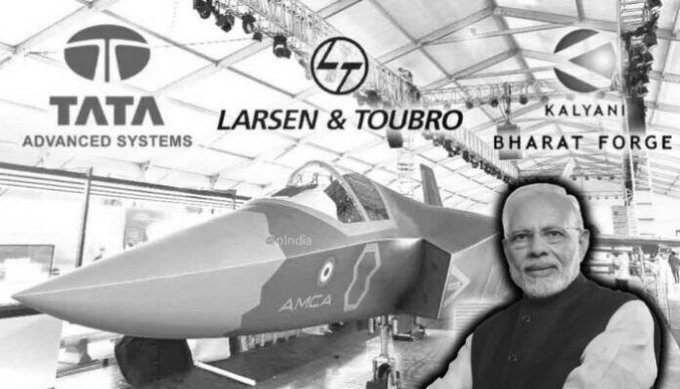
India has fired the starting gun on what could be its most consequential aerospace endeavour in decades. The Defence Ministry has issued a Request for Proposal (RFP) to three private sector contenders for the Advanced Medium Combat Aircraft (AMCA), the country's proposed fifth generation stealth fighter , formally launching a competition that will shape the Indian Air Force's combat capability well into the mid 21st century.
The RFP has been issued to Tata Advanced Systems , the L&T-BEL–Dynamatic consortium , and the Bharat Forge-BEML-Data Patterns consortium, a lineup that signals a decisive shift in how India builds its most sensitive military platforms. HAL was reportedly disqualified during the financial assessment phase, with officials expressing concern over the state owned firm's operational bandwidth. Its current order backlog is said to be nearly eight times its annual revenue, while engine supply bottlenecks have already pushed Tejas Mk1A deliveries into mid 2026.
The winning private partner will be responsible for building five prototypes at a new greenfield manufacturing facility in Puttaparthi, Andhra Pradesh , spread over 650 acres. The total outlay for the programme is estimated at around ₹15,000 crore . On May 15, Defence Minister Rajnath Singh and Andhra Pradesh Chief Minister N. Chandrababu Naidu laid the foundation stone for the Core Integration and Flight Testing Centre at Puttaparthi, being built at a cost of nearly ₹2,000 crore .
The Aeronautical Development Agency (ADA) has laid out a 10 year development roadmap, with the first prototype rollout planned for late 2026 or early 2027, first flight in 2028, certification by 2032, and induction by 2034. The Indian Air Force plans seven squadrons of the AMCA, with series production expected to commence around 2035.
Yet the programme’s grandest ambition runs headlong into a stubborn contradiction. Initial prototypes and early production variants will be powered by American GE F414 engines , with future versions expected to transition to a customised 120 kN class powerplant being explored through international cooperation, including discussions with France’s Safran . Meanwhile, while HAL will manufacture FADEC hardware under the engine deal, the proprietary software will remain under GE’s control, a reminder that true self reliance in propulsion remains elusive.
India’s Kaveri engine programme , running for over three decades, has yet to power a single operational sortie.
If successfully developed and inducted, the AMCA would place India in a small group of countries, currently including the United States, China, and Russia , capable of designing and producing fifth generation combat aircraft domestically. That is an extraordinary ambition. Whether the country builds the engine to match it will determine whether this is genuine strategic independence or an impressively assembled dependence wearing an Indian label.