
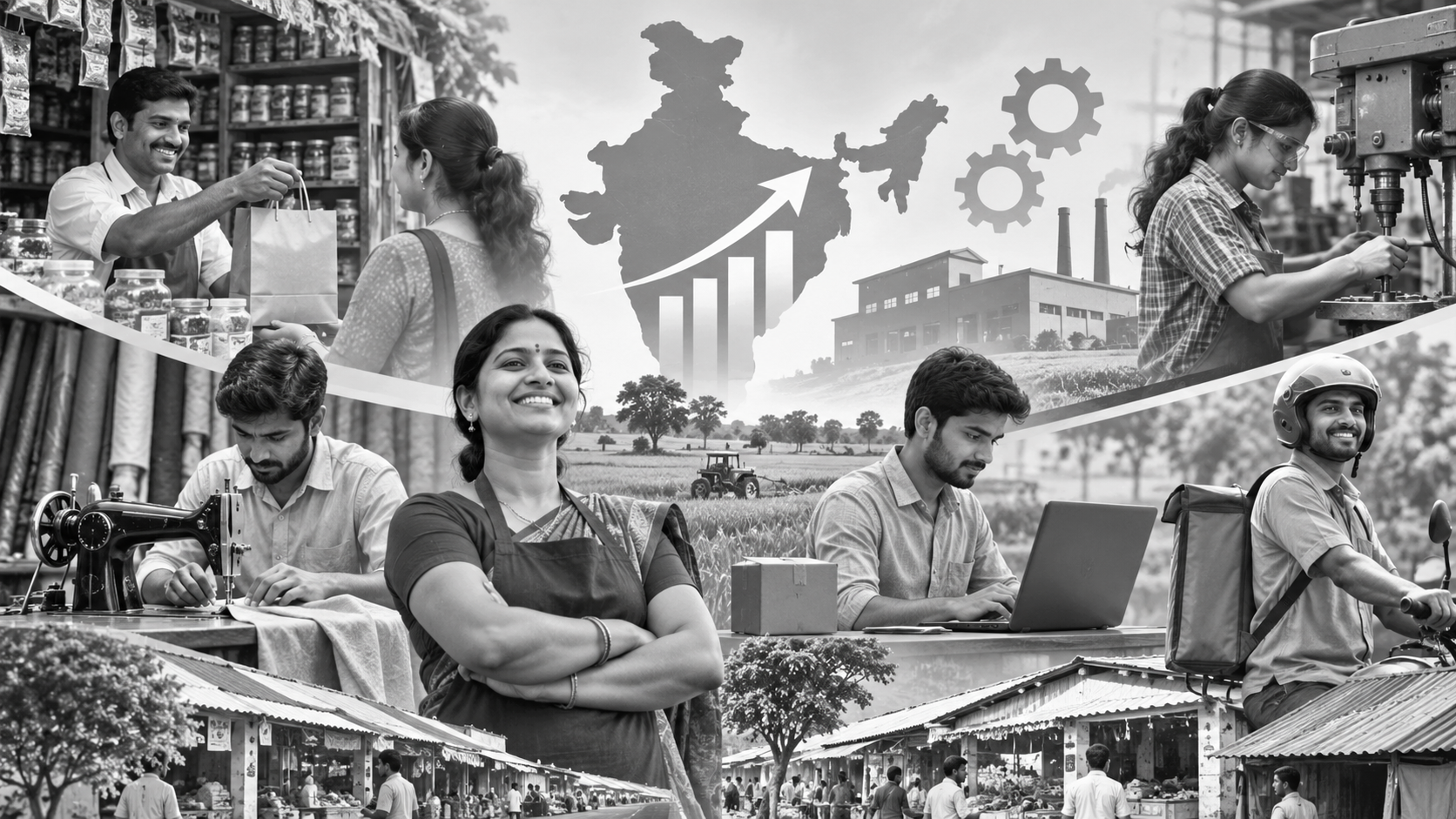
India's Unincorporated Sector Records 18.8% Growth, Employment Rises
India's unincorporated non-agricultural sector recorded strong growth during July–September 2026, with the number of establishments increasing 18.81% year-on-year to 9.47 crore and employment rising 16.86% to 15.03 crore. The expansion highlights the growing contribution of small businesses to employment generation, entrepreneurship and economic activity across the country. According to the latest Quarterly Bulletin of Unincorporated Sector Enterprises (QBUSE), released by the National Statistics Office (NSO) under the Ministry of Statistics and Programme Implementation (MoSPI) on November 23, the Other Services segment emerged as a major growth driver, while women's participation, internet usage and enterprise registration also improved. The findings underline the importance of India's grassroots business ecosystem in supporting livelihoods, strengthening domestic markets and advancing inclusive economic development.
Small Enterprises Form the Backbone of India's Grassroots Economy
India's unincorporated sector comprises a wide range of small businesses, including neighbourhood retailers, independent manufacturers, transport operators, repair workshops, food establishments and personal service providers. These enterprises operate outside the corporate framework and include proprietorships, partnerships, cooperatives, societies and trusts engaged in manufacturing, trade and other services, excluding construction. Although individual establishments generally function on a smaller scale, their combined contribution to employment, production and local markets makes them an important part of the economy.
To assess this segment, the NSO introduced the Annual Survey of Unincorporated Sector Enterprises (ASUSE) in 2021–22. The quarterly bulletin, introduced in 2025, provides more frequent estimates of establishment numbers, employment and business activity. While the annual survey offers a wider assessment of the sector's performance, quarterly estimates help identify emerging trends and changes in business conditions.
Services Lead Expansion as Establishments and Employment Increase
The number of unincorporated establishments rose from 7.97 crore in July–September 2025 to 9.47 crore in the corresponding quarter of 2026. Urban establishments recorded growth of 22.05%, compared with 16.05% in rural areas. Employment increased to 15.03 crore, while the number of hired workers also registered an increase of approximately 5% over the year.
Among the major segments, Other Services recorded the strongest expansion, with establishments increasing by 29% and employment growing 33%. Trade establishments rose by 11.70%, accompanied by an 8.36% increase in employment. Manufacturing establishments expanded by 10.55%, while employment in the segment increased by 3.52%. Retail trade, repair and maintenance services, land transport, personal services and the manufacture of wearing apparel were among the industrial categories recording the highest establishment growth. The figures point to the increasing role of services in creating employment and supporting small-business activity.
Nearly Rs 20 Lakh Crore in GVA Highlights Economic Contribution
The sector's economic contribution is also reflected in the annual ASUSE 2025 findings. The number of establishments increased from 7.34 crore in ASUSE 2023–24 to 7.92 crore in 2025, registering growth of 7.97%. Employment rose by 6.18%, adding more than 74.52 lakh workers during the period.
Gross Value Added (GVA) increased by 10.87% at current prices to approximately Rs 19.93 lakh crore. Trade recorded the highest GVA growth at 16.77%, followed by manufacturing at 8.52% and Other Services at 7.36%. Other Services contributed 42% of the sector's GVA, while trade accounted for 37% and manufacturing 21%. GVA per worker increased by 4.54% to Rs 1,56,539, while GVA per establishment reached Rs 2,52,699. Average emoluments per hired worker also increased by 3.88% to Rs 1,46,550. These annual figures complement the latest quarterly estimates by illustrating the sector's broader contribution to economic value creation.
MSMEs Strengthen Manufacturing and Domestic Supply Chains
The wider MSME ecosystem plays a significant role in India's economic structure. According to the Economic Survey 2025–26, MSMEs contribute approximately 31.1% of the country's GDP, 35.4% of manufacturing output and 48.58% of exports. The broader segment comprises more than 7.47 crore enterprises employing over 32.82 crore people. These figures cover the wider MSME sector and should not be confused with estimates specifically relating to unincorporated establishments.
Smaller enterprises support larger industries through ancillary manufacturing, component production, transportation, distribution and specialised services. Their growth can strengthen domestic supply chains, expand market access and create opportunities beyond major industrial centres. This makes them important to India's efforts to increase manufacturing capacity, encourage entrepreneurship and deepen participation in domestic and international markets.
Rural Employment and Women's Participation Drive Inclusive Growth
The latest quarterly findings indicate that employment opportunities are expanding in both rural and urban areas. Rural employment increased by 17.52%, marginally higher than the 16.30% growth recorded in urban areas. Small enterprises can diversify rural household incomes beyond agriculture by creating opportunities in manufacturing, retail, transport and local services.
Women's participation also improved, with women accounting for more than 31% of total employment in the unincorporated sector, compared with 28.70% in the corresponding quarter of 2025. Separately, ASUSE 2025 found that women-owned proprietary establishments represented 26.93% of such businesses, up from 26.17% in the previous survey round. More than 60% of female proprietors operated establishments in manufacturing. These trends highlight the role of small businesses in expanding women's employment and entrepreneurship.
Digital Adoption and Formalisation Transform Business Operations
Technology is increasingly influencing how small businesses operate and connect with customers. Nearly 84% of establishments covered by the latest quarterly survey reported using the internet for entrepreneurial purposes, while around 80% adopted cashless transaction methods. Digital payments, online banking and internet-based business activities can improve transaction convenience, record-keeping and access to wider markets.
Formalisation also recorded progress, with 43.28% of establishments reporting some form of registration, an increase of more than six percentage points over the corresponding quarter of 2025. Government initiatives such as the Udyam Registration Portal and Udyam Assist Platform seek to bring eligible micro-enterprises into the formal system and improve their access to institutional support. However, the quarterly registration estimate and broader government registration figures measure different indicators and should be treated separately.
Credit and Market Access Remain Critical for Enterprise Growth
Access to affordable finance remains essential for small businesses seeking to expand operations, purchase equipment and create jobs. The Pradhan Mantri MUDRA Yojana provides collateral-free institutional loans to eligible micro-enterprises. By March 27, 2026, the scheme had recorded more than 57.79 crore loans involving cumulative disbursements of Rs 40.07 lakh crore. The Credit Guarantee Fund Trust for Micro and Small Enterprises had approved cumulative guarantee coverage of Rs 13.67 lakh crore by March 2026, supporting eligible lending without conventional collateral requirements.
Market access initiatives also help smaller businesses reach institutional buyers. The Trade Receivables Discounting System (TReDS) enables eligible MSME suppliers to obtain early payment by discounting invoices, with transactions reaching Rs 3.47 lakh crore in FY2025–26. Meanwhile, the Government e-Marketplace had more than 1.37 lakh buyer organisations and nearly 25 lakh sellers and service providers as of August 2026, with cumulative procurement exceeding Rs 20 lakh crore.
Reliable Data Supports India's Long-Term Development Priorities
The July–September 2026 QBUSE survey covered 6,002 First Stage Units, comprising 2,411 rural villages and 3,591 urban blocks. It surveyed 1,80,025 establishments, including 77,038 rural and 1,02,987 urban units. Data were collected through oral enquiries using tablets and Computer Assisted Personal Interviewing (CAPI), following a multi-stage stratified sampling framework.
The 2026 survey adopted the National Industrial Classification (NIC) 2025, replacing NIC 2008. Certain motor vehicle and motorcycle repair and maintenance activities previously classified under trade were shifted to Other Services, which should be considered when interpreting sectoral growth. The NSO has also cautioned that quarterly estimates use a smaller sample than annual surveys and are subject to sampling variability and short-term fluctuations. QBUSE excludes construction and incorporated businesses and should not be treated as a measure of the entire economy.
As India works towards its Viksit Bharat 2047 vision, the expansion of smaller enterprises will remain important for employment, entrepreneurship, rural development and domestic manufacturing. Sustaining this growth will require improved access to finance, skills, technology and markets, alongside higher productivity and better-quality employment. Turning the expansion of establishments into stronger and more competitive businesses will be crucial to strengthening India's grassroots economy.