
India’s Strides Toward ‘Waste-to-Wealth’
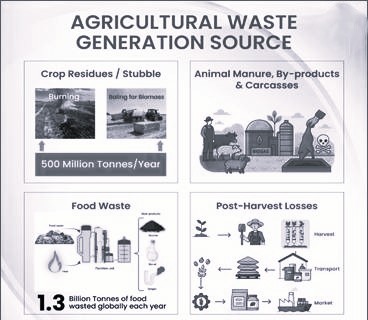
In an agrarian nation like India, the rising production of waste is no longer being viewed merely as an environmental challenge but as a significant economic opportunity. Every year, India generates approximately 350 million tonnes of agricultural waste, crop residues, and livestock waste. The core objective of the "Circular Economy" is to view this not as garbage but as a precious resource to be recovered and repurposed. Innovative government schemes such as GOBARdhan, Crop Waste Management, and the Agriculture Infrastructure Fund are sparking a new revolution in rural landscapes. By reducing the pollution caused by stubble burning and converting waste into biogas, electricity, and organic fertilizers, these initiatives protect the environment while providing farmers with additional income and employment opportunities. This is not just waste management; it is a powerful journey toward self-reliance and sustainable development.
From Environmental Challenge to Economic Opportunity
India is primarily an agricultural nation. While this sector feeds billions, it also generates waste on a massive scale. In the past, this waste was considered a burden; today, thanks to technology and proactive government policies, it is being transformed into 'gold.' The 350 million tonnes of annual agricultural waste are now the raw materials fueling the nation’s energy and economic needs. Proper management of this waste reduces pollution and creates wealth on a grand scale.
The primary waste products in India include straw, husk, and residues from crops like paddy, wheat, and sugarcane. Burning these residues in the fields releases toxic gases such as carbon monoxide and methane into the atmosphere. This causes severe pollution in cities like Delhi during the winter months. Furthermore, burning kills beneficial soil microorganisms, rendering the land infertile. Overcoming this challenge is the immediate task before the nation.
The Circular Economy: A New Revolution
A circular economy moves away from the "take-make-dispose" model toward "reduce, reuse, and recycle." It is built on the 6R principle: Reduce, Reuse, Recycle, Refurbish, Recover, and Repair. In nature, nothing is wasted; the excretion of one organism becomes the food for another. Applying this to agriculture, crop waste becomes fertilizer that nourishes the next harvest. It is estimated that by 2050, this sector will have a market value of $2 trillion in India.
GOBARdhan: An Energy Revolution in Villages
The "Galvanizing Organic Bio-Agro Resources Dhan" (GOBARdhan) scheme was launched by the Government of India on April 30, 2018, as part of the Swachh Bharat Mission (Gramin) Phase-2. It was first piloted in the Karnal district of Haryana. The primary goal is to collect cattle dung and agricultural waste to produce biogas and organic manure, keeping villages clean while increasing farmer income. This has paved the way for self-sufficiency in the energy sector by addressing the shortage of cooking gas in rural areas.
Currently, the scheme is achieving remarkable growth nationwide. Statistics show it has expanded to 51.4% of districts in the country, with approximately 979 biogas plants successfully operational. The 'Unified GOBARdhan Portal' launched in 2023 has increased transparency. A major milestone was the establishment of Asia's largest municipal waste-based Bio-CNG plant in Indore, Madhya Pradesh. The government is now aiming to set up 500 new 'Waste-to-Wealth' plants. This strengthens the rural economy, reduces dependence on chemical fertilizers, and lowers cultivation costs by providing high-quality organic slurry.
Crop Waste Management and Technological Solutions
The government has allocated substantial funds (approximately ₹3,926 crore) to prevent stubble burning. In states like Punjab and Haryana, 'Custom Hiring Centers' provide farmers with modern machinery. These machines either incorporate the straw back into the soil or extract it for industrial use, significantly enhancing soil fertility.
Biochar: A Miracle for Soil Health
Biochar is produced by heating food and crop waste in an oxygen-deprived environment. While wasted food in homes and markets releases methane, a potent greenhouse gas, it can be converted into useful substances like biochar.
Biochar is a charcoal-like substance that, when mixed with soil, increases its water retention capacity. It helps mitigate global warming by sequestering carbon in the ground. "Engineered Biochar" is now even making it possible to remove toxins from the soil.
Agriculture Infrastructure Fund (AIF)
The AIF plays a pivotal role with a fund of ₹15,000 crore to create infrastructure in the agricultural sector. The establishment of cold storages, grading units, and processing centers helps prevent post-harvest losses. This allows farmers to store their produce longer and sell when prices are favorable. By 2025, thousands of projects have been successfully completed under this fund.
Beyond crops, livestock waste is also turning into wealth. Scientific processing of animal carcasses (bones, horns) and waste management in animal husbandry are creating industrial products and animal feed, improving sanitation and providing extra income to farmers.
Creating "Waste-to-Wealth" in Andhra Pradesh
Chief Minister N. Chandrababu Naidu has modernized the 'Clean Andhra Pradesh' program, directing the Municipal Department to generate income from waste. Significant emphasis is placed on segregating urban waste to produce electricity and organic fertilizers.
As the Minister for Environment, Pawan Kalyan is implementing strict regulations for the management of hazardous waste from industries. The government has decided to set up state-of-the-art 'Recycling Parks' in cities like Visakhapatnam to protect the environment while creating jobs for the youth.
In his capacity as the Minister for Panchayat Raj, Pawan Kalyan is integrating central schemes like GOBARdhan with state programs to improve rural sanitation. Plans are underway to revive rural solid waste management centers to produce biogas from dung and crop residue. Under his 'Vision 2047,' Chandrababu Naidu is promoting the circular economy by formulating a new water policy to reuse treated wastewater from treatment plants for industries and irrigation.
Key Projects in AP
Guntur (Naidupalem):
Andhra Pradesh’s first waste-to-energy plant was established here in collaboration with Jindal Urban Waste Management. This plant processes 1,200 tonnes of municipal solid waste daily to produce 15 MW of electricity, serving Guntur, Vijayawada, and eight surrounding municipalities.
Rajamahendravaram (Dhawaleswaram):
A major plant segregates wet and dry waste, converting wet waste into high-quality organic fertilizer for local farmers.
Prakasam (Kanigiri):
The current coalition government is expanding this model. In partnership with Reliance Bio-Energy, a massive Compressed Biogas (CBG) plant is being established here, set to be one of the largest in Asia.
"Waste-to-Wealth" in Telangana
The movement has gained significant momentum in Hyderabad and its surrounding areas.
Jawaharnagar Waste-to-Energy Plant:
This is the most critical project in Telangana, located in the Medchal district. It is one of the largest in South India, currently processing thousands of tonnes of city waste to generate 24 MW of power, with plans to expand to 48 MW. It is the primary resource for scientifically disposing of the 7,000 tonnes of garbage Hyderabad generates daily.
Rural Biogas and Siddipet Model:
Through GOBARdhan, rural areas are converting cattle dung into fuel. Compressed Biogas plants are being set up in places like Bibinagar through private partnerships. Siddipet has emerged as a national role model through its "Swachha Badi" (Clean School), educating the public on waste management and generating municipal income through compost.
Dry Waste Management:
Municipalities in Warangal, Karimnagar, and Nizamabad have established units to sell plastic and glass, providing livelihoods for workers.
Water Management and Jal Shakti Mission
Preventing water waste in agriculture is a vital component of the circular economy. Treating sewage from industries and households for reuse in irrigation reduces pressure on groundwater. Schemes like 'Har Ghar Jal' enhance rural water security while protecting the resources necessary for agriculture.
Agricultural waste management is not merely an environmental issue; it is a stepping stone to India’s economic self-reliance. This approach promises the creation of 10 million new jobs, a reduction in fuel imports, and healthier soils. If the government, farmers, and startups work in coordination, India will emerge as a global role model in 'Circular Agriculture.'