
India’s Robot Revolution and the Human Cost of Progress
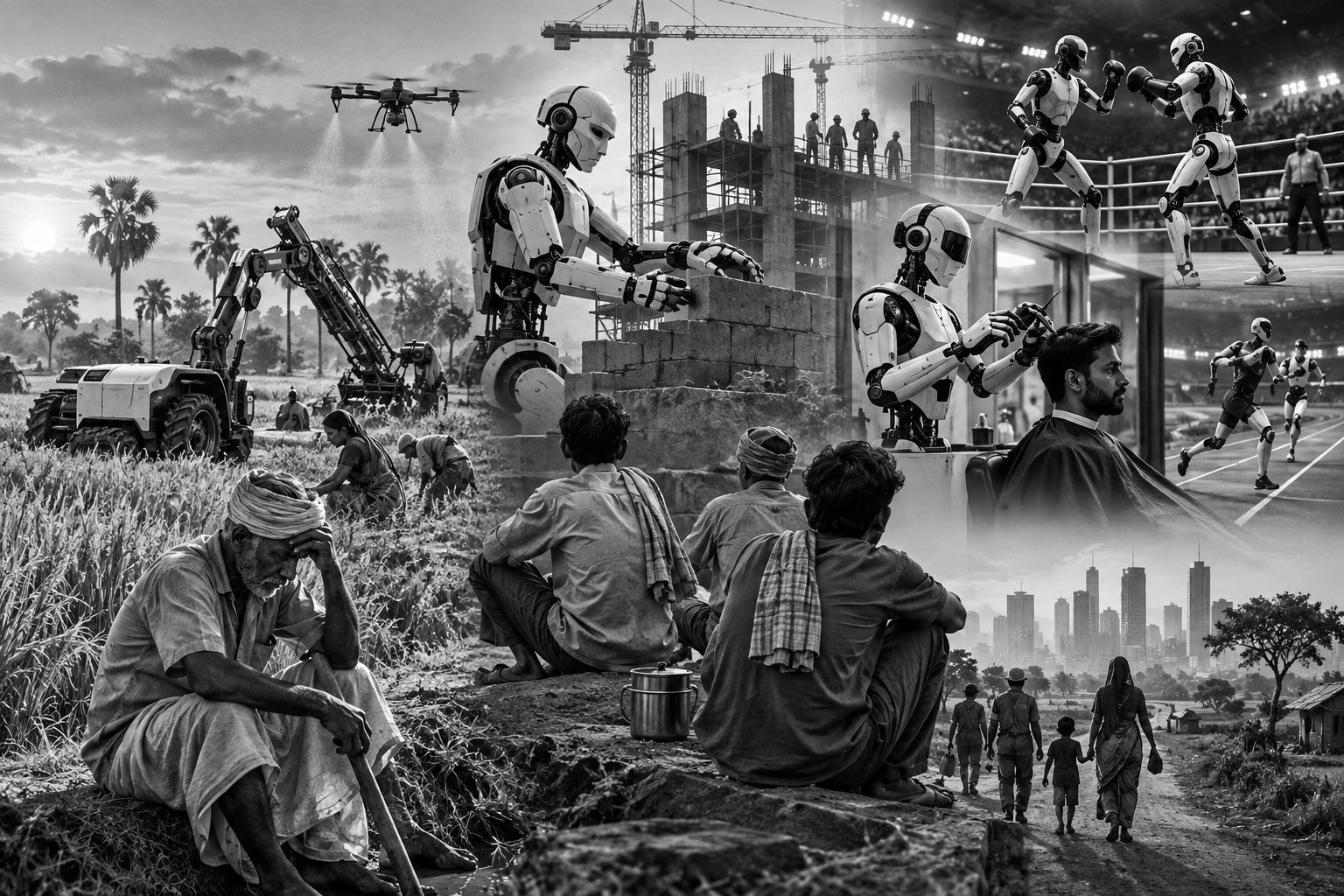
From construction sites and farms to barber shops and boxing rings, machines are learning to perform tasks once reserved for humans. India’s technology revolution may improve productivity, but it also raises a difficult question: what happens to the millions whose livelihoods depend on physical work?
A robot does not ask for a salary. It does not demand a weekly holiday, fall sick, ask for overtime or send money home to its family. It simply works. That may sound like the perfect employee from an accountant’s perspective. For the worker standing next to it, however, the joke may not be quite as funny. The inauguration of a ₹3.30-crore robotics laboratory at IIT Madras, established with CSR support from Bechtel India, offers a glimpse into how quickly robotics is moving from laboratories towards practical applications in construction and infrastructure. The facility is expected to support research, prototype development, patents, industry demonstrations and training. The technological possibilities are impressive. Yet they also raise a larger question: when machines become capable of doing more human work, who prepares the humans for the transition?
From AI Anxiety to Robot Anxiety
For several years, the anxiety surrounding artificial intelligence has largely belonged to office workers. Programmers wondered whether AI would write code, writers wondered whether machines would produce content and designers questioned whether algorithms would replace creative work. Robotics takes that anxiety out of the office and onto the factory floor, construction site and farm. A machine does not need to understand Shakespeare to replace a repetitive task; it simply needs to perform that task faster, more accurately and at a lower cost. Suddenly, the automation debate is no longer only about people sitting behind computers. It is about people carrying bricks, harvesting crops, welding steel, painting buildings, sorting goods and performing other physically demanding jobs.
The Robot Has Entered the Playground Too
Machines are increasingly moving beyond workplaces and into spaces traditionally associated with human physical ability. In 2026, humanoid robots competed in events including running, football, boxing, martial arts and weightlifting at the World Humanoid Robot Games in Beijing. There is something almost comical about the progression. Humans built robots, taught them to walk, taught them to run and then put them inside a boxing ring. But beneath the spectacle lies serious technological development. Such competitions test balance, coordination, movement, reaction and recovery—capabilities that could eventually have practical applications in factories, homes, warehouses and other environments. Even skilled personal services are entering the conversation, with videos circulating of barbers and other professionals demonstrating physical movements that could potentially be captured as training data for robotic systems. We are increasingly moving from teaching humans to operate machines to teaching machines how humans perform tasks.
The Village Is Where the Question Gets Serious
The consequences become much more significant when automation reaches rural India. Official employment data show that agriculture remains central to rural livelihoods, accounting for 57.2% of rural employment in 2025, while self-employment accounted for 62.4% of rural employment. This means rural employment is not simply a collection of individual jobs; it is an interconnected economic system. A farm labourer earns wages, spends that money at a local shop, pays for transport, buys household necessities and supports family members. The shopkeeper then pays suppliers, while local businesses depend on the spending generated by workers. If automation removes a source of income, the consequences can therefore travel beyond the individual worker. Labour income is also local purchasing power, and removing it can weaken the economic ecosystem surrounding a job.
What Happens When the Farm Gets a Robot?
Agriculture is already moving towards greater automation. Indian agricultural technology projects are exploring AI-powered spraying, precision farming, weeding, harvesting and crop monitoring. Agricultural robots can potentially reduce chemical exposure, address labour shortages, improve precision and increase productivity. For farmers, the attraction is obvious. A machine can work for long periods, perform repetitive tasks and potentially reduce production costs. But the other side of the equation is more uncomfortable. If a machine performs a task that previously provided wages to several agricultural workers, where does that income come from? A farmer may benefit from lower costs, while the technology company benefits from selling the machine and consumers eventually benefit from greater efficiency. But what happens to the labourer whose seasonal income disappears?
India Has Seen Mechanisation Before
India has experienced labour-saving technologies before. Tractors replaced large amounts of animal power, harvesters reduced manual harvesting in some regions and mechanised equipment transformed grain processing. Such changes often improved productivity and reduced physically exhausting work. Robotics, however, could take mechanisation further by combining machines with sensors, computer vision, artificial intelligence and autonomous decision-making. The objective should not be to prevent technological progress. That would neither be realistic nor desirable. The real challenge is ensuring that technological progress does not become synonymous with economic exclusion. A productivity revolution becomes socially dangerous when productivity rises while people's ability to earn falls.
The Construction Worker Faces the Same Question
Construction provides another important example. According to the 2025 Periodic Labour Force Survey, 78.4% of male workers in construction were classified as casual labour, highlighting the sector's dependence on workers whose employment can be relatively insecure. Robotics could make construction safer, faster and more precise while reducing exposure to hazardous physical tasks. Yet many workers currently performing those tasks cannot simply become robotics engineers overnight. The future may therefore not be about robots versus workers but about robots working alongside highly trained workers while those without access to training become increasingly vulnerable. The technological divide could become an employment divide.
Who Owns the Robot?
Another question deserves greater attention: who owns the machine? Imagine a village cooperative purchasing a harvesting robot and allowing farmers to share its services. Young people could be trained to operate and maintain it, creating new technical employment while reducing physical labour. Now imagine the same technology being controlled entirely by a large company, with farmers dependent on its services and most of the productivity gains flowing elsewhere. The technology is identical, but the economic outcome is not. Ownership, access, financing and skills will determine who benefits from automation. Technology does not automatically distribute prosperity; institutions and economic structures do.
The Danger of a “Smart Village” Without Jobs
There is an amusing but uncomfortable vision of the future village: smart irrigation, autonomous tractors, AI crop advisers, robotic harvesters, drones, automated warehouses and digital marketplaces. Everything is connected. Everything is efficient. Everything is intelligent. And then comes the inconvenient question: where are the villagers? India could theoretically create technologically advanced rural communities while leaving sections of their population economically vulnerable. The country cannot simply assume that workers displaced from agriculture or construction will automatically move into manufacturing, services or technology. New jobs may emerge, but they will require different skills, locations and forms of education.
But Robots Can Also Help Rural India
The answer cannot be to preserve every manual job simply because automation threatens it. If a robot can perform dangerous agricultural work, reduce pesticide exposure, climb coconut trees or handle physically exhausting tasks, there can be genuine social benefits. Automation can also help address labour shortages and improve productivity. The question is therefore not whether India should use robots. It is whether India can introduce them in a way that allows workers to share in the gains. Technology should ideally remove dangerous work while creating opportunities for people to move into better-paid, safer and more skilled roles.
The Worker Must Move With the Machine
That transition will require serious investment in skills. Telling a displaced agricultural worker to “learn technology” is not enough. Training requires money, time, infrastructure and access to actual employment. Workers will need opportunities to move from manual operations into machine operation, maintenance, supervision, logistics, precision agriculture and other emerging occupations. The goal should be to ensure that the worker is not simply pushed away when the machine arrives but is given the opportunity to move with the machine. Otherwise, automation could create a strange contradiction: increasingly sophisticated technology operating alongside increasingly insecure workers.
The Robot Does Not Have a Family to Feed
A robot does not worry about school fees, medical bills, rent, loans or a bad harvest. It does not migrate hundreds of kilometres looking for work or stand outside a contractor's office waiting to be hired. The machine sees a task; the human sees a livelihood. That distinction should remain at the centre of India's automation debate. The IIT Madras robotics laboratory may eventually help create machines capable of making construction safer, faster and more productive. That is precisely why investment in workers must accompany investment in machines. India may soon build smart cities, automated farms and robotic factories. Robots may even run races and enter boxing rings for entertainment. But the real test of technological progress will not be how much work a machine can perform. It will be whether the humans whose work is transformed by that machine can still find a meaningful place in the economy. The robot may be ready for the future. The real question is whether the worker is being prepared for it.