
India's Research Revolution: Bridging the Gap Between Discovery and Development
Rising research investments and international partnerships offer India new opportunities, but translating scientific discoveries into affordable technologies, stronger industries and solutions to development challenges remains the real test.
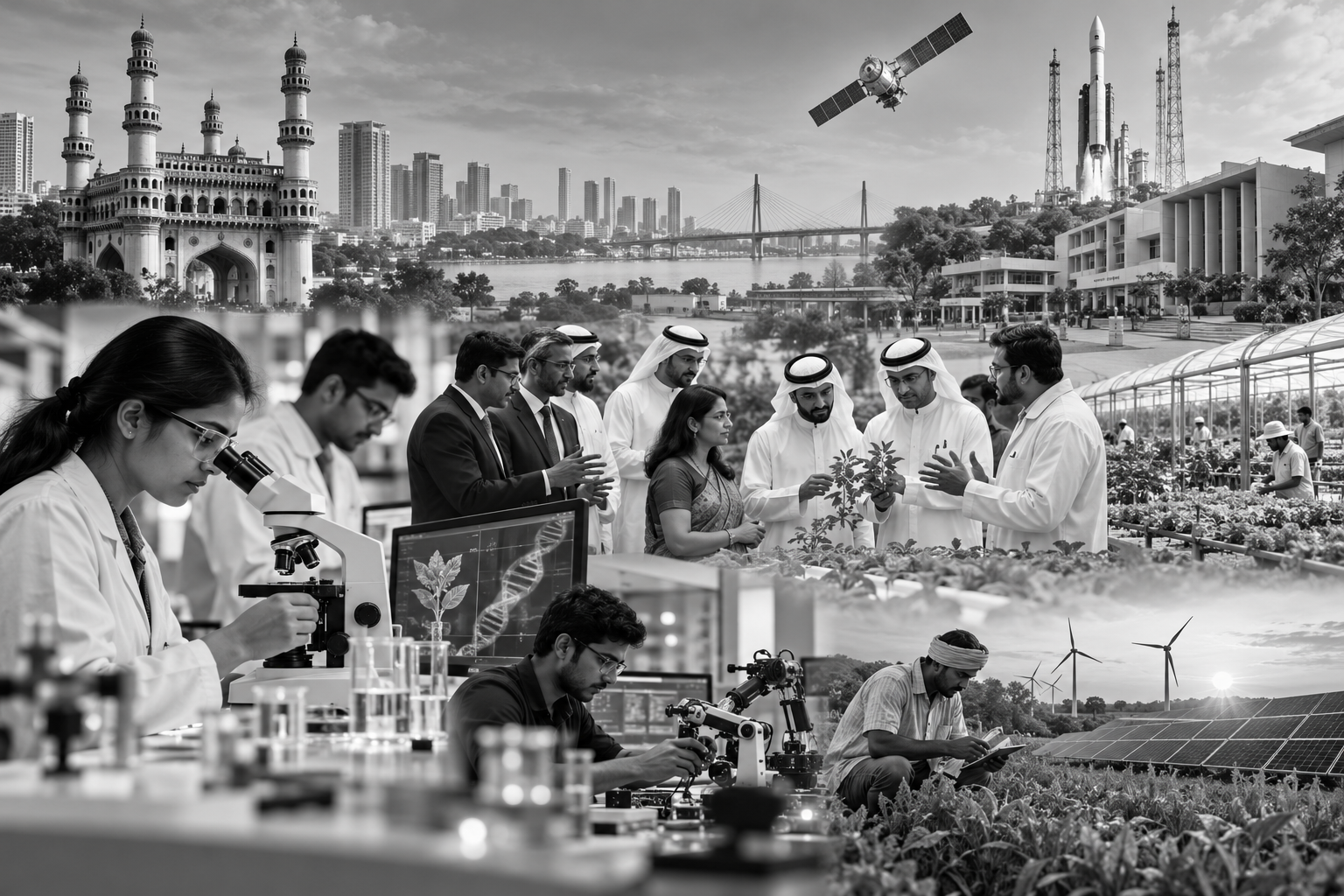
The UAE delegation's visit to Anurag University in Hyderabad on October 13 has highlighted a question extending far beyond a single institution: Can India transform its expanding research capabilities into an innovation ecosystem that delivers tangible benefits to society? As part of the second phase of the UAE–India Leaders Program, the delegation explored the university's agricultural campus, farming practices, agricultural machinery, biofertiliser and biopesticide production units, mushroom cultivation and sericulture facilities. The university also showcased its wider academic and research ecosystem, including AWS- and ISRO-related facilities, to representatives from agriculture, food security, energy, sustainability and technology organisations.
The delegation included representatives from Silal Group, Agthia, ADNOC, Borouge, Fertil, the Abu Dhabi Agriculture and Food Safety Authority and the Environment Agency – Abu Dhabi. The engagement provided an opportunity to explore knowledge exchange, training, faculty engagement and student exposure between India and the UAE. Its wider significance lies in how such interactions could connect Indian research institutions with international expertise to address challenges ranging from agricultural productivity to emerging technologies.
India's Research Ambitions and the Funding Gap
India's research investment has increased considerably, but its share of national economic output remains relatively modest. According to the Department of Science and Technology's Research and Development Statistics 2025–26, India's gross expenditure on research and development (GERD) rose from approximately ₹1.33 lakh crore in 2019–20 to ₹2.45 lakh crore in 2023–24. However, R&D expenditure accounted for just 0.84% of GDP in 2023–24.
Government-sector spending reached approximately ₹1.18 lakh crore in 2023–24, while private-sector expenditure rose to around ₹1.27 lakh crore. The figures indicate growing private participation, although sustained industry investment remains essential for developing technologies that require years of testing before commercialisation.
India ranked 38th in the World Intellectual Property Organization's Global Innovation Index 2025, reflecting progress across several measures of innovation. Nevertheless, research spending and international rankings cannot alone establish whether discoveries are becoming successful products or improving people's lives.
Government Push to Strengthen Research
The government has introduced initiatives to improve funding, widen institutional participation and encourage industry-led innovation. The Anusandhan National Research Foundation (ANRF), operationalised in 2024, seeks to strengthen research across universities and encourage collaboration among academia, industry and government.
Its Partnerships for Accelerated Innovation and Research (PAIR) programme follows a hub-and-spoke model, connecting established research institutions with universities that need to strengthen their research capabilities.
Another major initiative is the ₹1 lakh crore Research, Development and Innovation (RDI) scheme, approved in July 2025 for a six-year period. It aims to encourage private-sector investment in high-impact research, particularly in artificial intelligence, robotics, quantum technologies, space, biotechnology, pharmaceuticals, medical devices and energy transition.
These initiatives could help expand India's research base, but their success will depend on implementation, timely funding, access to laboratories and the ability to sustain projects over several years.
Where India Needs Research Most
Agriculture and food security offer one of the clearest examples of how research can address immediate development needs. Climate-resilient seeds, efficient irrigation, improved soil health, affordable biological inputs and better storage systems are essential to improving productivity and reducing agricultural losses. The Indian Council of Agricultural Research, the Indian Agricultural Research Institute and state agricultural universities contribute to research in crop improvement, dryland farming and sustainable agricultural practices.
The challenge is to ensure that innovations work under field conditions, remain affordable for small farmers and produce measurable benefits. Anurag University's work involving biofertilisers, biopesticides and cultivation practices fits into this broader research agenda, although the outcomes of any proposed international collaboration would need to be independently established.
Clean energy, healthcare and water management are equally important. Research into battery storage, low-carbon materials and smart grids can support India's energy transition. The Indian Council of Medical Research, medical institutions and biotechnology organisations contribute to work on diagnostics, vaccines, medical devices and drug-resistant infections. Meanwhile, the National Institute of Hydrology, the Indian Institute of Tropical Meteorology and CSIR–National Environmental Engineering Research Institute address challenges involving water resources, climate and pollution.
Advanced technologies, including artificial intelligence, semiconductors, robotics and high-performance computing, will also shape India's competitiveness. Research institutions such as the Indian Institutes of Technology, the Indian Institute of Science and the Centre for Development of Advanced Computing are important contributors. Greater domestic expertise and stronger connections between research laboratories and manufacturers will be necessary to turn discoveries into commercially viable technologies.
International Partnerships: Beyond Academic Exchanges
Foreign collaboration can give Indian universities access to specialised expertise, modern equipment, funding and international research networks. It can also create opportunities for student exchanges, joint publications, faculty development and technology transfer.
The India–UAE partnership provides a relevant example. During UAE President Sheikh Mohamed bin Zayed Al Nahyan's visit to India in January 2026, both countries reaffirmed cooperation in food security, sustainable agriculture, space, artificial intelligence and emerging technologies.
The countries also welcomed a proposed collaboration involving India's C-DAC and UAE company G42 to establish a supercomputing cluster in India. The initiative is intended to support research and applications across public and private sectors. Cooperation in food safety and agricultural trade also reflects shared interests in resilient supply chains and sustainable sourcing.
However, an international visit or memorandum of understanding is only a starting point. Meaningful partnerships require clear research objectives, committed funding, intellectual property arrangements and opportunities for researchers to work together. Joint projects, trained researchers, validated technologies and commercial applications provide stronger evidence of success than announcements alone.
The Obstacles Between Discovery and Development
Despite progress, India's research ecosystem faces administrative delays, funding constraints, uneven infrastructure and challenges in retaining skilled researchers. In April 2026, NITI Aayog released reports on the ease of conducting R&D in India, drawing on consultations with more than 400 institutional leaders and insights from over 850 scientists and researchers.
The findings highlighted barriers affecting research institutions, including funding and procurement processes, regulatory burdens and difficulties in translating research into practical applications.
Technology transfer remains a critical concern. A scientific paper or laboratory prototype does not automatically become a usable product. Discoveries often require further testing, intellectual property support, pilot production and industry investment. Research evaluation should therefore consider not only publications and patents but also affordability, productivity gains, employment and measurable social benefits.
Hyderabad's Opportunity
Hyderabad's research and industrial ecosystem spans pharmaceuticals, biotechnology, information technology, engineering and agricultural sciences. This creates opportunities for universities, public research organisations and businesses to develop solutions through multidisciplinary collaboration.
Anurag University's engagement with the UAE delegation illustrates how international interactions can bring academic institutions into contact with organisations working on shared development priorities. For Telangana, research into drought-resilient crops, water-efficient agriculture, biological farm inputs and emerging technologies could offer practical regional benefits.
The next step is to establish whether such engagements produce formal research agreements, funded projects, shared facilities or sustained academic exchanges. These outcomes would help determine whether international visits translate into lasting research capacity.
India's ambition to become a global research powerhouse will depend on more than funding announcements or international exposure. It requires stronger research careers, modern laboratories, predictable financing and effective links between universities and industry. Ultimately, the success of partnerships such as the UAE–India engagement will be measured by whether scientific knowledge becomes practical innovation that strengthens institutions, improves livelihoods and delivers lasting benefits to society.