
India’s Rare Economic Cross Roads and the Long Shadow of Silent Prices
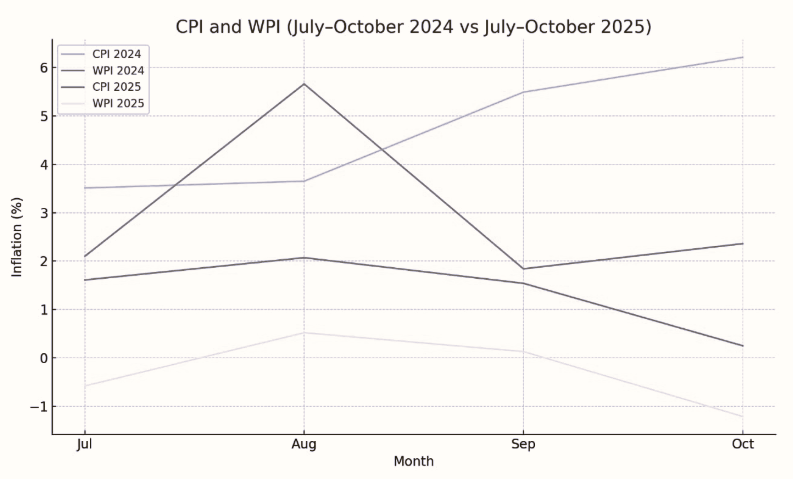
In a country long accustomed to debating rising prices at dinner tables, political rallies, and parliament sessions, the current conversation around inflation feels almost surreal. India’s latest macroeconomic data shows a dramatic collapse in both retail and wholesale inflation, a decline so pronounced that it has pushed the country into an economic zone rarely seen in its post-liberalisation history. The Consumer Price Index (CPI), the primary gauge of retail inflation, has plunged to 0.25% in October 2025, its lowest reading since the index was formalised. Simultaneously, the Wholesale Price Index (WPI), reflecting producer-level inflation, has fallen 1.21% below its level a year ago.
For a nation that watched inflation climb stubbornly through much of the last decade peaking in episodes of food crises, supply-chain disruptions, fuel price spikes, and the pandemic aftershocks the sudden drop feels like a reversal of gravity. Prices falling instead of rising sounds like welcome news, yet seasoned economists warn that unusually low inflation can be both a boon and a brewing challenge. Understanding why inflation has collapsed, and what lies behind this rare macroeconomic moment, requires a step back into the architecture of India’s economic landscape from food supply chains and global volatility to policy interventions and structural shifts in consumption.
Reasons for low inflation
India’s current inflation slump cannot be traced to a single factor. Instead, it is the outcome of a convergence of global, domestic, structural and statistical.
1. A Historic Softening of Food Prices:
Few forces shape India’s inflation trajectory as powerfully as food prices. Food constitutes nearly half the CPI basket, making any fluctuation in vegetables, cereals or pulses a nationwide event. The recent data shows an unusually sharp deflation in food categories vegetables dropping in double digits, pulses softening after two years of firm prices, and cereals stabilising after months of elevated rates.This softening comes from multiple sources: a good monsoon, strong agricultural output, uninterrupted supply chains, and improved logistics. Some states reported bumper harvests of vegetables and rice; better rural road networks facilitated quicker transport; procurement bottlenecks eased. The result was visible in mandi floors and retail aisles alike.
2. Global Commodity Prices in Retreat:
The world economy has slowed significantly. A tepid growth forecast in major economies, combined with excess inventories of metals and energy commodities, has kept global prices under pressure. Brent crude has been trading at multi-quarter lows. Base metals have seen weak demand from China. Fertilizer prices have stabilised.For India, which imports a substantial share of its energy needs and industrial inputs, this global softness directly lowers production costs. This is reflected strongly in the WPI, where fuel, minerals and manufactured goods have all registered declines.
3. Policy Nudges: GST Cuts and Targeted Interventions
The reduction in GST rates on certain essentials including household goods, packaged foods, and select consumer items has had a measurable impact on retail prices. Additionally, targeted government actions to release buffer stocks of grains and pulses helped cool prices during months of stress. The cumulative effect of these interventions is now materialising in the CPI.
4. The Powerful Base Effect
Inflation is inherently comparative: this year’s prices are measured against last year’s. Since late 2024 saw elevated prices due to supply disruptions, the year-on-year calculation now appears sharply lower. Economists note that this “optical disinflation” amplifies the real decline, pushing headline numbers to unusual lows.
5. Structural Improvements Across Supply Chains
Over the past five years, India has invested heavily in cold chains, warehouses, rural connectivity, and digital market access. While these improvements often go unnoticed in political narratives, they quietly reduce wastage, improve storage, and stabilise prices. The cumulative impact of these structural changes is now visible as smoother supply lines contribute to price stability.Together, these forces have created a phenomenon rare in India: a simultaneous decline in both retail and wholesale inflation, pointing to deep disinflationary currents across the economy.
Windfall Gains for Households
For the average Indian household, the most immediate effect is visible in the kitchen budget. Vegetables that cost ₹70 a kilogram months ago now sit at half the price. Pulses, a persistent driver of inflation in the past decade, have eased. Cooking oil prices, which soared during the pandemic, remain stable. For lower- and middle-income families, this translates into higher real purchasing power. When essentials get cheaper, real income effectively rises even if salaries remain unchanged. For millions of households navigating stagnant wage growth, this is a moment of genuine relief.Yet, beneath this comfort lies a caution: consumer behaviour can shift dramatically when people expect prices to keep falling. If households begin postponing purchases of durable goods refrigerators, electronics, vehicles, anticipation itself can reduce demand. Economies thrive on spending, and widespread postponement can cool growth.
A Mixed Bag for Business
Producers and manufacturers generally welcome lower input costs. A falling WPI implies cheaper raw materials, lower energy expenses, and better margins. The manufacturing sector which faced severe cost pressures between 2021 and 2024 now finds breathing room.But deflation has a shadow side. If output prices fall faster than input costs, revenue growth may slow. Businesses may hesitate to increase production or hire new workers. Companies dependent on rural markets like FMCG, two-wheelers, and agri-products could see demand weaken if farm incomes fall.Gross sales values may decline even if unit sales remain steady, affecting profitability and investor sentiment. Over time, falling price expectations can dampen investment intent a warning that policymakers cannot ignore.
The RBI’s Unusual Advantage and Hidden Constraints
For the Reserve Bank of India, this is the first time in years that inflation sits comfortably below the upper tolerance band. The central bank suddenly has the space to consider rate cuts without fearing a surge in inflationary pressure. Lower rates could stimulate sectors such as housing, MSMEs, agriculture, urban consumption, and infrastructure.However, the caution lies in real interest rates. When inflation is extremely low, even moderate nominal rates can feel punitive. For instance, a 6% lending rate with 0% inflation is effectively a 6% real rate high enough to disincentivise borrowing. Thus, unless the RBI adjusts policy intelligently, the benefits of low inflation may not translate into credit growth.
Effects on Different Sectors
Winners:
Manufacturing reliant on imported commodities
Export sectors benefiting from lower producer costs
Urban consumers
Companies with large input cost exposure
Government agencies procuring for infrastructure
Potential Losers:
Farmers facing low crop prices
Rural consumption-dependent industries
Retailers and wholesalers seeing shrinking margins
Sectors requiring strong demand cycles: real estate, autos, discretionary retail
Rural India, in particular, faces a complicated reality. Lower food prices may delight consumers, but they hurt producers. If farm-gate prices fall sharply, rural incomes weaken, reducing demand for essential goods. This creates a ripple effect across the economy because rural consumption drives nearly half of India’s consumer demand.
Global Context
The world has been experiencing a disinflationary wave. Europe, struggling with stagnant demand and geopolitical uncertainties, has seen inflation cooling rapidly. The United States has managed to contain inflation while avoiding recession — a rare “soft landing.” China, facing a prolonged property-market slump, is exporting disinflation through falling exports.India’s current phase aligns with this global cooling but remains unique because its disinflation is more heavily influenced by food prices and domestic supply dynamics.
A Crucial Policy Window
Periods of low inflation offer rare opportunities:
• Governments can push large capital expenditure projects without triggering price pressures.
• The RBI can recalibrate monetary policy.
• Structural reforms land, labour, logistics become easier to execute without causing inflation spikes.
• Export competitiveness improves.
But the window is narrow. If disinflation deepens into deflation, India risks falling into a slow-growth trap where investment stalls, incomes stagnate, and consumption weakens. Avoiding this outcome will require calibrated fiscal support, rural income protections, targeted subsidies, and public investment that crowds in private capital.
The Road Ahead
Inflation is likely to inch up again once base effects fade and global commodities stabilize. The goal for policymakers is not to maintain ultra-low inflation but to guide India toward a steady, predictable price environment that supports growth without burdening households.India now stands at a rare crossroads: an economy with low inflation, stable fundamentals, improving supply chains, and a chance to reset growth drivers. Whether this becomes a springboard for long-term stability or a prelude to stagnation will depend on how decisively policy is shaped in the coming months. For now, the fall in CPI and WPI is a moment of calm, a pause in the inflationary storm of the last decade. But like all moments of calm, it carries a silent warning: the opportunity must be seized before it slips away.