
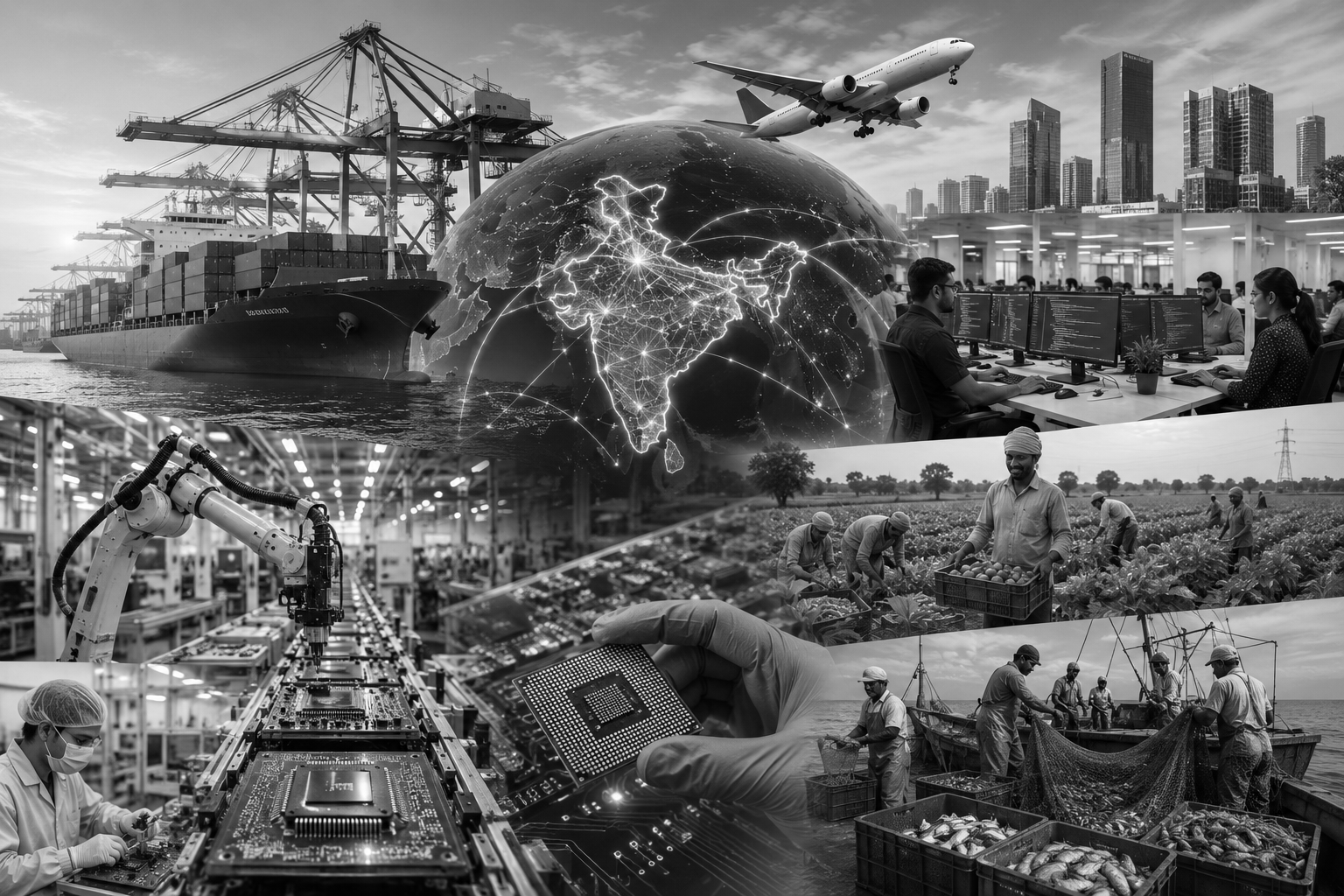
India’s Race to USD 2 Trillion Exports Runs Through Code, Chips and Global Supply Chains
India’s export ambitions are entering a defining phase. At a time when global trade is slowing, geopolitical conflicts are unsettling supply chains, and major economies are battling inflation and recessionary fears, India is attempting something unusually ambitious, transforming itself from a largely consumption-driven economy into a global export powerhouse.
The scale of that ambition was visible at the Confederation of Indian Industry Annual Summit in New Delhi, where Piyush Goyal outlined the government’s vision of taking India’s exports to USD 2 trillion over the next five to six years.
The announcement comes as India prepares to close the current financial year with a record USD 863 billion in combined goods and services exports, the highest in the country’s history. While the figure reflects strong post-pandemic momentum, it also signals a deeper structural shift underway in the Indian economy.
From Traditional Trade to High-Value Exports
For decades, India’s export profile depended heavily on traditional sectors such as textiles, gems and jewellery, agriculture and low-end manufacturing. Today, that mix is changing rapidly. The country is increasingly earning foreign exchange through software services, engineering goods, electronics manufacturing, pharmaceuticals, AI-enabled business operations and Global Capability Centres (GCCs) .
According to Shri Goyal, India has remained resilient despite global uncertainty because of strong economic fundamentals and rising international confidence in the country. He pointed out that India currently holds nearly 11 months of import cover in foreign exchange reserves , while the country’s combined trade deficit in goods and services remains lower than annual remittances flowing into India.
That resilience is especially significant given the volatile global backdrop. Over the last five years, international trade has endured the COVID-19 pandemic, the Russia-Ukraine conflict, disruptions in the Red Sea shipping corridor, rising protectionism and slowing economic growth across Europe and China. Yet India’s exports have steadily expanded from roughly USD 498 billion in FY21 to nearly USD 863 billion in FY26 .
The Post-Pandemic Boom and Structural Shift
Economists note that the first phase of growth came from the post-pandemic rebound when global demand surged sharply after lockdowns eased. Commodity prices rose, supply chains normalized and global businesses rushed to rebuild inventories.
But the second phase, the one India is entering now is fundamentally different. It is being driven less by temporary recovery and more by long-term structural transformation.
The clearest evidence of that transformation lies in India’s services sector.
India’s services exports are estimated to have crossed USD 421 billion this year, making them the single largest contributor to export growth. Software services, consulting, engineering research, financial operations, digital infrastructure management and AI-enabled solutions are now generating billions in foreign exchange earnings.
GCCs Become India’s New Export Engine
At the centre of this transformation is the explosive growth of Global Capability Centres , or GCCs. These are offshore innovation and operational hubs established by multinational corporations to manage technology, analytics, finance, engineering and research operations from India.
Shri Goyal revealed that nearly 1,800 GCCs are already operating in India, with another 500 expected in the coming years. Exports from GCCs are currently growing at 40–50 per cent annually , contributing around USD 50 billion while directly employing nearly two million people .
This rise of GCCs represents a major shift in India’s economic identity. Earlier, India was known globally as a low-cost outsourcing destination dominated by call centres and back-office services. Today, multinational companies are increasingly shifting higher-end operations such as artificial intelligence, cloud computing, engineering design, financial analytics and product development to India.
The services boom has also made India more resilient during global slowdowns. Unlike low-end manufacturing exports, software and digital services tend to remain in demand even during economic uncertainty because companies worldwide continue investing in technology upgrades, AI integration and operational efficiency.
Engineering and Electronics Lead Manufacturing Push
Alongside services, India’s manufacturing exports are also undergoing a dramatic transformation.
Engineering goods have emerged as India’s largest merchandise export segment, contributing more than USD 116 billion annually. Auto components, industrial machinery, steel products and electrical equipment are increasingly finding markets across the United States, Europe and the Middle East.
But perhaps the most striking change is visible in the electronics sector.
Over the last few years, India has become one of the world’s fastest-growing smartphone manufacturing hubs. Electronics exports, especially mobile phones, have surged following the government’s Production Linked Incentive (PLI) schemes and the global “China+1” supply-chain diversification strategy.
Global firms, including Apple and its suppliers, are expanding manufacturing operations in India as multinational corporations look to reduce excessive dependence on China. Electronics has now emerged as one of India’s fastest-growing export categories and is steadily moving into the country’s top export sectors.
The Rupee Paradox and Import Dependence
Still, India’s export ambitions face serious structural challenges.
One of the biggest paradoxes confronting policymakers is the coexistence of rising exports with a weakening rupee and strengthening US dollar. Economists explain that a weaker rupee can actually help exporters because Indian goods become cheaper in international markets, while exporters earn more rupees for every dollar received.
However, the same currency weakness also increases India’s import bill for crude oil, semiconductors, machinery and gold.
This remains a critical issue because India continues to import more goods than it exports, especially energy and advanced industrial inputs. As a result, any sharp global spike in oil prices or sustained dollar strength can widen the trade deficit and put pressure on inflation.
Can India Realistically Reach USD 2 Trillion?
Another major concern is whether India can realistically achieve the USD 2 trillion export target within the proposed timeline.
To reach that goal, India would need to sustain roughly 15 per cent annual export growth for several consecutive years. While mathematically achievable, economists warn that global uncertainties could slow the pace significantly.
If export growth moderates to around 8–10 per cent annually because of weaker global demand or geopolitical instability, India’s exports may rise to around USD 1.4–1.6 trillion instead of USD 2 trillion within the same timeframe.
Some sectors are already showing signs of vulnerability.
Traditional export industries such as textiles, gems and jewellery and low-end manufacturing are under pressure from weak Western demand, rising competition from countries like Bangladesh and Vietnam, and increasing tariff barriers in developed markets. India’s gems and jewellery exports have already fallen to multi-year lows due to weaker luxury demand and tariff-related concerns.
Rural India’s Silent Contribution
At the same time, India’s rural economy remains deeply connected to global trade.
Agriculture and processed food exports are estimated to exceed USD 50 billion annually , supporting millions of farmers and rural workers. India remains one of the world’s largest exporters of rice, spices and seafood.
Coastal states such as Andhra Pradesh have emerged as major hubs for shrimp and marine exports, while sectors like food processing, dairy, handicrafts and textiles continue generating large-scale rural employment.
Yet policymakers believe India still loses enormous value by exporting raw commodities instead of premium finished products. Much of the current policy focus is therefore shifting toward value addition, food processing, branding and higher-end manufacturing .
Moving Beyond ‘Assembled in India’
That broader shift was captured in Shri Goyal’s call for India to move from being merely “assembled in India” to becoming “designed, engineered and manufactured in India.”
The minister also urged Indian businesses to embrace artificial intelligence, robotics and quantum computing as force multipliers for growth and productivity. He emphasized that AI should not simply be used for reducing costs or manpower, but for expanding markets, improving competitiveness and building globally scalable businesses.
Equally important is India’s push for deeper global market access through Free Trade Agreements. Over the last three-and-a-half years, India has signed nine FTAs covering 38 countries, focusing largely on developed economies with strong purchasing power. According to Shri Goyal, these agreements are intended to expand exports, attract investments and integrate India more deeply into global value chains.
India’s Export Story Enters a New Era
For now, India’s export story reflects a country in transition from a commodity-heavy exporter toward a technology-driven and knowledge-intensive economy.
Whether the USD 2 trillion dream is achieved on schedule or delayed by global uncertainty, one reality is becoming increasingly clear: India’s future export growth will depend not merely on producing more, but on producing smarter, innovating faster and moving steadily up the global value chain.