
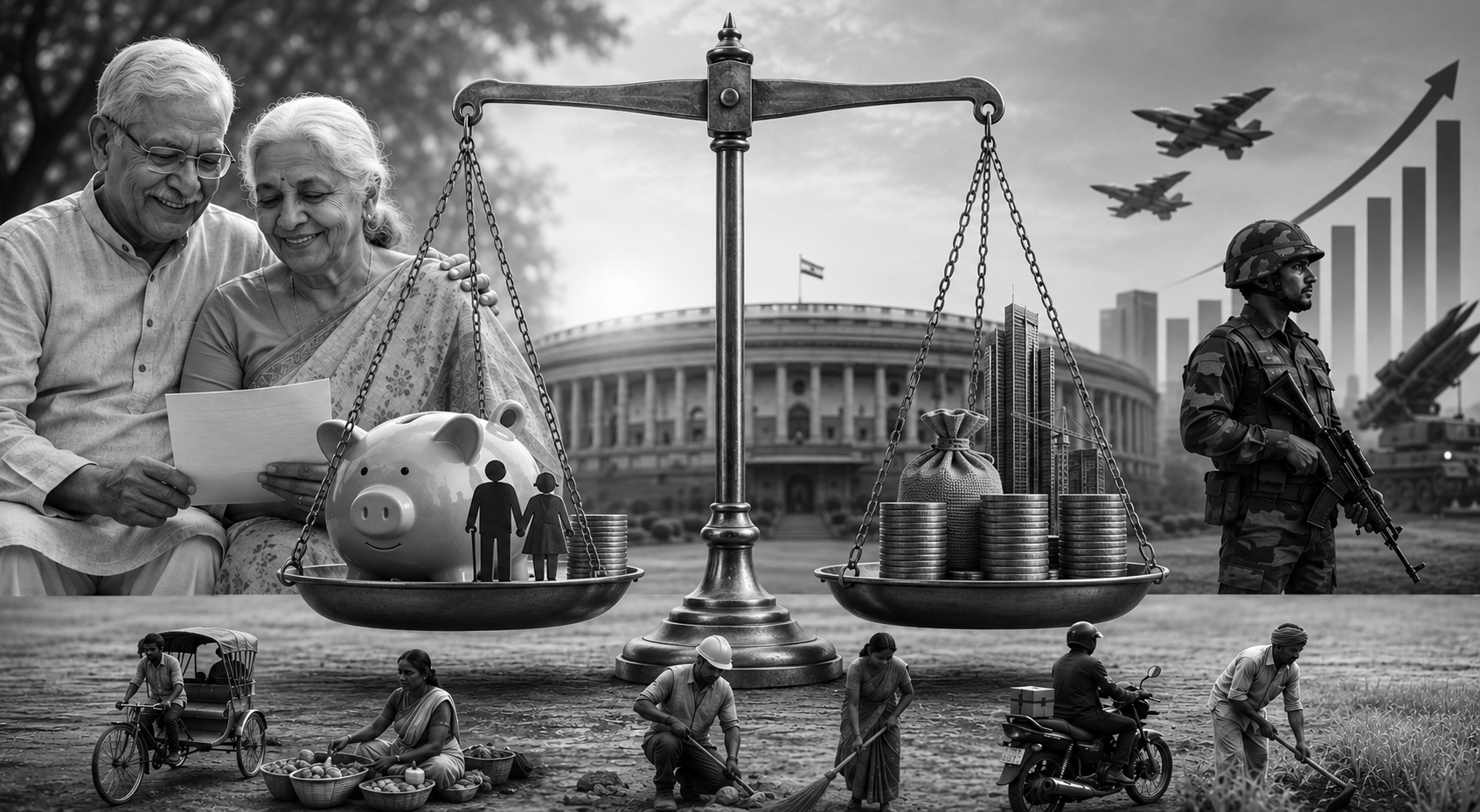
India’s Pension Revolution: Balancing Retirement Security and Economic Stability
India’s pension debate has once again moved to the centre of national policy discussions as the country attempts to balance employee welfare, rising pension liabilities and long-term economic sustainability. What began as a demand from government employees for restoring the Old Pension Scheme (OPS) has now evolved into a much larger debate involving fiscal discipline, defence expenditure, informal sector welfare and the future of India’s social security architecture.
The issue has gained renewed attention after the introduction of the Unified Pension Scheme (UPS) in 2025, which the Centre positioned as a middle path between the guaranteed benefits of OPS and the contributory structure of the National Pension System (NPS). While government employees continue demanding assured pensions, economists and policymakers warn that returning fully to OPS could place enormous financial pressure on future governments.
At the same time, India is also trying to expand pension coverage to millions of informal workers who historically remained outside any retirement safety net. This makes the pension conversation far more complex than a simple OPS-versus-NPS debate.
The Shift from OPS to NPS
For decades, government employees in India were covered under the Old Pension Scheme. Under OPS, employees received a guaranteed lifelong pension after retirement, generally amounting to around 50% of the last drawn salary along with inflation-linked Dearness Allowance increases. The entire pension burden was borne by the government, and employees did not contribute from their salaries.
The system offered financial certainty and social security, making government jobs highly attractive. However, rising pension liabilities gradually became a major concern for governments. Increasing life expectancy meant pensioners continued receiving benefits for much longer periods, while the number of retirees steadily increased.
To address this challenge, the Central Government introduced the National Pension System in 2004 for new recruits. NPS shifted India towards a contributory and market-linked pension model. Both employees and the government contribute towards a retirement corpus, and the pension amount depends on market returns generated over time.
The move was aimed at reducing the long-term pension burden on taxpayers and improving fiscal sustainability. Over the years, most state governments also adopted NPS for new employees, though political opposition to the scheme continued to grow.
Why OPS Continues to Have Strong Support
Despite the financial logic behind NPS, the Old Pension Scheme remains extremely popular among government employees because of the guaranteed income security it provides.
Employees argue that retirement benefits should not depend entirely on market performance. Under OPS, pensions increase with inflation through Dearness Allowance revisions, ensuring stable post-retirement income throughout life. Family pension provisions also offer long-term security to dependents.
This emotional and financial assurance has kept OPS politically powerful. Several states attempted to restore the scheme in recent years, arguing that employees who dedicate decades to public service deserve predictable retirement support.
However, economists caution that while OPS may appear beneficial in the short term, the long-term financial consequences could become severe.
The Rising Pension Burden on Governments
India’s pension expenditure has expanded rapidly over the years and now forms one of the largest components of government revenue spending.
The Union Government spends several lakh crore rupees annually on civilian pensions, railway pensions, defence pensions and social welfare pensions. Unlike capital investments, pension expenditure is a recurring financial commitment that continues rising over time without directly creating economic assets.
The defence sector reflects the scale of the burden most clearly.
For the financial year 2026–27, the Centre allocated around ₹1.71 lakh crore for defence pensions alone. This amount is meant to support pensions for more than 34 lakh defence pensioners across the country. Defence pensions now account for nearly one-fourth of India’s defence budget.
This creates a major policy dilemma. India requires substantial investments in defence modernisation amid growing geopolitical tensions, especially with China. However, a large portion of defence expenditure is consumed by salaries and pensions rather than weapons procurement and technological upgrades.
Why Defence Pensions Are Different
Defence pensions are structurally different from civilian pensions because military personnel retire much earlier than most government employees.
Jawans often retire in their late 30s or early 40s, while many officers also retire earlier than civil servants. As a result, the government may continue paying pensions for several decades after retirement.
The implementation of One Rank One Pension (OROP) further increased pension liabilities. OROP ensures that defence personnel retiring at the same rank and service duration receive equal pension benefits irrespective of retirement date.
While the move addressed long-standing concerns among veterans and improved morale within the armed forces, it also significantly increased recurring financial obligations.
Analysts believe reforms like the Agnipath recruitment model are partly aimed at reducing future pension liabilities by limiting the number of personnel eligible for lifelong pensions.
Pension Inclusion Beyond Government Employees
India’s pension challenge is not limited to government staff. Nearly 85–90% of the country’s workforce is employed in the informal sector, where workers generally lack retirement benefits, insurance or stable social security.
Street vendors, agricultural labourers, gig workers, domestic workers and small traders often continue working even in old age because they have no pension support.
Recognising this vulnerability, the government expanded pension schemes for informal workers over the last decade.
The Atal Pension Yojana (APY), launched in 2015, became India’s flagship pension programme for low-income workers. Subscribers contribute small monthly amounts and receive guaranteed pensions after retirement.
Similarly, the Pradhan Mantri Shram Yogi Maandhan scheme introduced government-supported contributory pensions for unorganised workers earning below ₹15,000 per month.
India also launched the e-Shram Portal to digitally register informal workers and connect them with welfare schemes. More than 31 crore workers have already enrolled on the platform, making it one of the world’s largest labour databases.
These initiatives indicate that India’s pension debate is gradually shifting from a government-employee issue to a broader social security discussion.
The Emergence of the Unified Pension Scheme
Growing dissatisfaction with NPS and concerns over the fiscal burden of OPS pushed the government towards introducing the Unified Pension Scheme in 2025.
UPS attempts to create a middle path between the two systems. While it retains the contributory structure of NPS, it also offers certain assured pension benefits and inflation-linked protections under specific conditions.
The scheme reflects the government’s attempt to balance employee expectations with long-term fiscal realities. Policymakers appear to recognise that a complete return to OPS could create serious economic risks, while purely market-linked retirement systems may not provide sufficient confidence to employees.
Can India Afford a Full Return to OPS?
This remains the central question in the pension debate.
Many economists believe that restoring OPS nationwide could become financially unsustainable over time. Unlike NPS, OPS does not create an investment corpus to finance future pensions. Instead, pensions are paid directly from government revenues, effectively shifting the burden to future taxpayers.
As pension liabilities rise, governments may face reduced fiscal space for spending on infrastructure, healthcare, education, climate adaptation and employment generation.
Several experts have warned that states returning to OPS may eventually struggle with rising debt and declining development expenditure.
At the same time, employees argue that retirement security should not be sacrificed entirely for fiscal considerations. They believe the government must guarantee dignity and stability after decades of public service.
India’s Real Pension Challenge
India’s real challenge is not simply deciding between OPS and NPS. The larger task is building a pension system that balances social security with economic sustainability.
The country is simultaneously dealing with: Rising pension liabilities, Expanding defence expenditure, An ageing population, Informal sector vulnerabilities, Employee demands for guaranteed pensions, The need for higher public investment in growth sectors.
This balancing act will shape India’s economic and social landscape for decades.
As India aspires to become a developed economy, pension reforms will increasingly determine not only the quality of retirement for millions of citizens, but also the government’s ability to sustain long-term growth, strengthen national security and expand welfare coverage simultaneously.