
India’s Nuclear Moment: The Ecosystem Behind the 100 GW Ambition
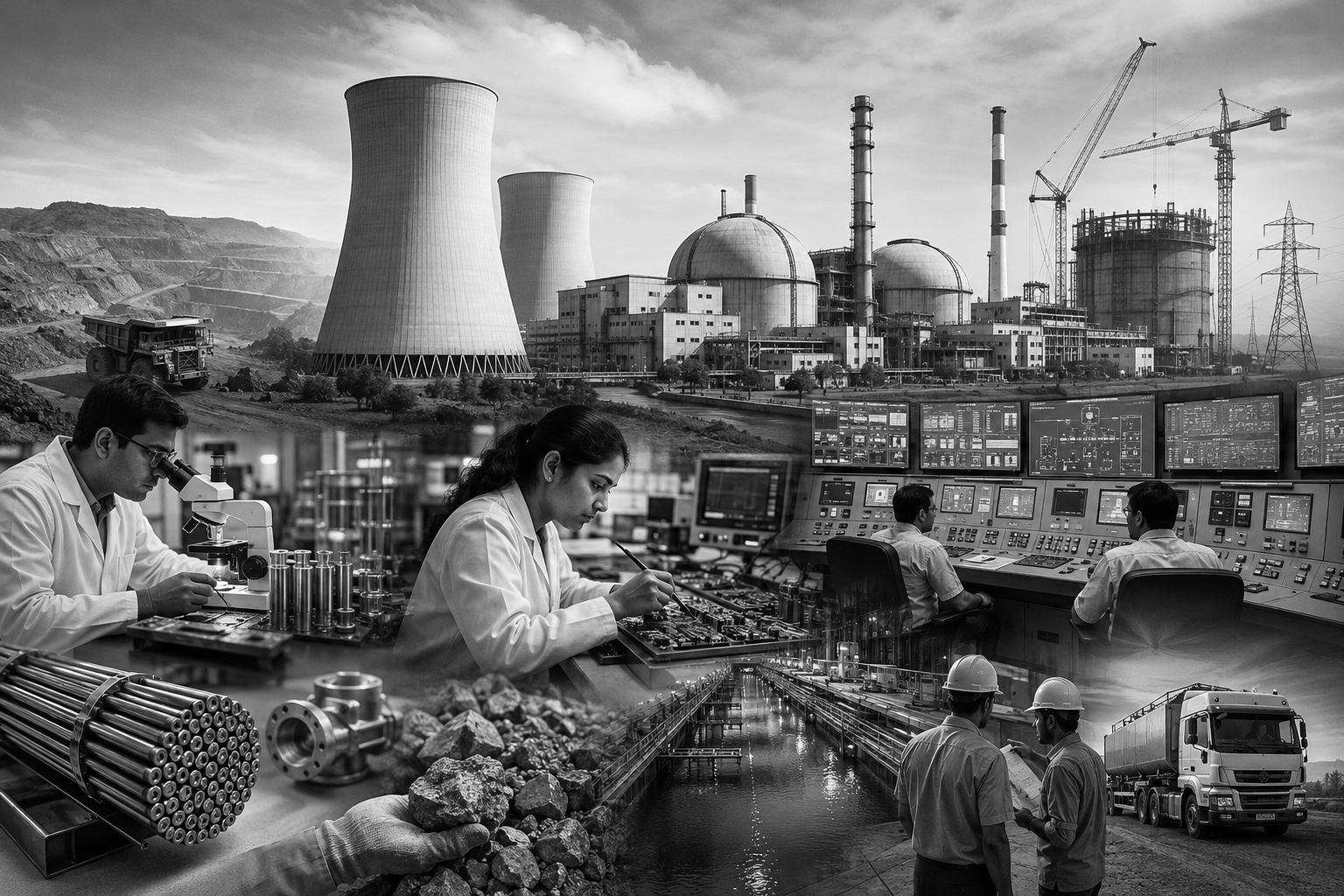
India's ambition to generate 100 GW of nuclear power by 2047 is about far more than building new reactors. It represents an attempt to expand an entire national ecosystem of scientists, fuel manufacturers, electronics specialists, research laboratories, mining operations, engineering companies and skilled workers.
The numbers underline the scale of the challenge. India currently has 24 nuclear reactors in commercial operation, with an installed capacity of 8.78 GW. Nuclear power contributes only a small share of the country's electricity generation, yet the government wants to raise capacity to around 22 GW by 2031-32 and ultimately to 100 GW by 2047.
The central question is therefore clear: Can India build another 91 GW of nuclear capacity while creating the industrial ecosystem needed to sustain it?
From reactors to an industrial ecosystem
The public imagination of nuclear power is dominated by reactor domes and cooling towers. But a nuclear power plant is only the visible end of a much larger chain.
Every reactor needs a secure supply of fuel, sophisticated control systems, specialised materials, precision engineering, radiation monitoring, highly trained personnel and a long-term mechanism to manage spent fuel and radioactive waste.
That is why institutions such as Bhabha Atomic Research Centre (BARC), the Nuclear Power Corporation of India Ltd. (NPCIL), the Nuclear Fuel Complex (NFC), Electronics Corporation of India Ltd. (ECIL) and the Indira Gandhi Centre for Atomic Research (IGCAR) could become the real growth engines behind the 100 GW mission.
India's strategy combines indigenous 700 MWe Pressurised Heavy Water Reactors, larger reactors developed with international cooperation, fast reactor technology and a new generation of Small Modular Reactors (SMRs).
The immediate test will come much sooner than 2047. India has a pipeline of projects under construction and development and aims to progressively expand nuclear capacity to about 22 GW by 2031-32. Whether these projects are completed on schedule will offer the first serious indication of how realistic the larger 100 GW target is.
NFC: The fuel lifeline
No reactor can operate without a reliable fuel cycle.
As India's reactor fleet expands, the role of the Nuclear Fuel Complex will become increasingly important. Nuclear expansion will require a steady supply of specialised fuel assemblies and materials capable of meeting stringent nuclear standards.
India's long-term nuclear strategy has also been shaped by its resource profile. The country has relatively limited uranium resources but significant thorium reserves, leading to the development of the country's three-stage nuclear power programme.
The challenge ahead is not simply securing uranium. It is about expanding the entire chain from exploration and mining to processing, fuel fabrication and specialised nuclear materials.
For a country targeting 100 GW, fuel security will be as important as reactor construction.
ECIL: The electronic nervous system
If NFC represents a vital industrial lifeline, ECIL, headquartered in Hyderabad, represents another critical layer of India's nuclear infrastructure.
Modern reactors depend on sophisticated networks of instrumentation, sensors, control systems, radiation monitoring and electronic protection systems. These systems constantly monitor plant operations and provide the information required to safely control complex nuclear processes.
The 100 GW expansion could significantly increase demand for advanced nuclear electronics, digital control systems, automation and secure communication technologies.
But scaling nuclear manufacturing presents a unique challenge. It is not simply about producing more equipment faster.
Every component must meet demanding standards of reliability, quality assurance and safety.
The nuclear expansion, therefore, will test whether institutions such as ECIL can expand capacity without compromising the precision that the sector demands.
Private capital enters the picture
India's nuclear programme has traditionally been driven by the state. But the scale of the 100 GW target has made a new model increasingly necessary.
The government's roadmap envisages a significant role for other public-sector entities, private companies and joint ventures, alongside NPCIL. The recent policy reforms, including the SHANTI Act, are part of a wider effort to create space for broader participation in the nuclear sector.
However, private participation alone will not guarantee new reactors.
Investors will seek clarity on technology approvals, regulatory requirements, tariffs, commercial returns and project risks. The success of India's nuclear expansion may ultimately depend on whether the country can attract capital while retaining the stringent safety and strategic controls associated with atomic energy.
SMRs and the technology bet
Small Modular Reactors could become another important piece of the puzzle.
India is developing indigenous SMR technologies for potential use at retiring coal power plants, energy-intensive industries and remote locations.
Their promise is significant. Smaller units could potentially offer greater flexibility than conventional large reactors.
But the critical distinction is between a technology that works in a laboratory and one that can be deployed commercially at scale.
India's nuclear future will depend on turning research into demonstration, demonstration into commercial operation, and commercial operation into mass deployment.
Beyond electricity
Nuclear science is already reaching far beyond power generation.
In healthcare, nuclear technologies support cancer treatment, radiopharmaceuticals, medical imaging and the sterilisation of medical devices. The source material highlights the role of the Tata Memorial Centre, which registered 1.3 lakh patients and screened around five lakh women for major cancers during 2024-25.
In agriculture, BARC has developed 70 crop varieties, including new varieties released in 2025. Radiation technologies are also being used in food preservation to extend shelf life and reduce post-harvest losses.
At Kalpakkam, the Department of Atomic Energy recently inaugurated a technology demonstrator using nuclear process heat for hydrogen production through the Copper-Chlorine thermochemical cycle —offering a glimpse of how future reactors could support industry beyond electricity generation.
Safety, waste and public trust
No expansion of nuclear power can succeed without public confidence.
India's safety framework is built around Defence in Depth, multiple physical barriers, backup systems and continuous radiation monitoring. Following the Fukushima accident, Indian nuclear facilities underwent safety reviews and further upgrades.
Waste management, however, will remain a long-term challenge. India uses vitrification to convert high-level radioactive waste into a stable glass form, but the wider question of long-term management and eventual geological disposal will continue to demand scientific and regulatory attention.
Perhaps the most important challenge lies beyond technology: public trust.
Communities near nuclear plants want answers about safety, livelihoods, fishing, land and emergency preparedness. As India builds more reactors, transparency and engagement will become just as important as engineering.
The road to 100 GW will not be built by reactors alone. It will depend on the fuel produced by institutions such as NFC, the electronics and control systems developed by organisations such as ECIL, the research of BARC and IGCAR, the construction capacity of India's engineering sector and, ultimately, the confidence of the communities living alongside the country's nuclear infrastructure.
India's nuclear ambition is, therefore, not simply a story about generating more electricity. It is a test of whether the country can build an entire nuclear-industrial ecosystem at unprecedented scale, without compromising safety, precision or public trust on its journey towards 2047.