
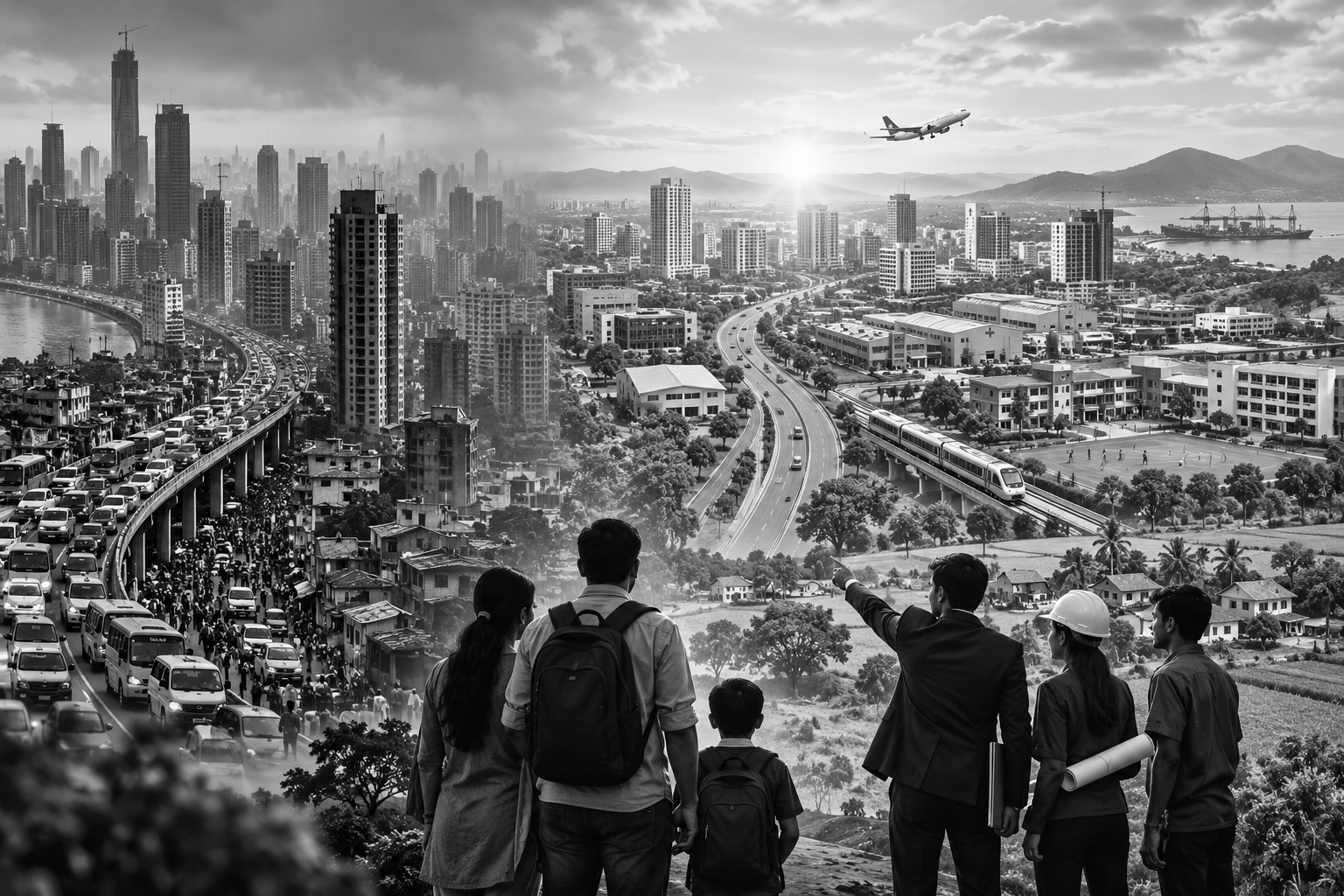
India’s Next Metros: Why B-Cities Hold the Key to Urban Growth
India’s urban story has long been dominated by cities such as Mumbai, Delhi, Bengaluru, Hyderabad, Chennai and Kolkata. These metropolitan centres have attracted people with the promise of better jobs, healthcare, education, business opportunities and higher incomes. But their success has also produced a new challenge: population concentration is placing enormous pressure on housing, traffic, water, sewage systems, waste management and air quality. As India prepares for a massive new wave of urbanisation, the question is no longer whether people will move to cities, but whether the country can create enough successful cities to accommodate them.
The Urbanisation Pressure
India had about 377 million urban residents in 2011, representing 31.2% of the population. Census data recorded 468 Class-I urban agglomerations and towns, while 53 urban agglomerations had populations exceeding one million. These 53 centres alone housed 160.7 million people, or 42.6% of India's urban population. Greater Mumbai, Delhi and Kolkata had crossed the 10-million mark and were classified as megacities. Meanwhile, cities such as Indore, Visakhapatnam, Coimbatore, Jaipur, Lucknow, Nagpur, Vadodara, Vijayawada and Bhubaneswar had already emerged as substantial urban centres.
The pressure is expected to intensify. The World Bank estimates India's urban population could rise from around 480 million in 2020 to 951 million by 2050, with cities expected to generate 70% of new jobs by 2030. India could require more than 144 million additional urban dwelling units between 2022 and 2070. This scale of expansion makes it difficult to depend entirely on existing metros.
Why B-Cities Matter
This is where India's emerging B-cities — Tier-2 and Tier-3 urban centres — become crucial. Their development is not about replacing Mumbai, Delhi or Bengaluru, but about creating additional economic engines. NITI Aayog has called for stronger Tier-2 and Tier-3 service hubs supported by digital infrastructure, logistics, skills, innovation and links between industry and academia. Its work points towards developing cities according to their regional strengths rather than forcing every city to copy the metropolitan model.
A successful B-city could therefore develop its own economic identity. Coimbatore can deepen its engineering and manufacturing base, Visakhapatnam can combine maritime activity with industry, logistics and technology, Bhubaneswar can strengthen technology and education, while Indore can build around manufacturing, services, food processing and logistics. The objective should be to create regional economic hubs, not merely larger residential cities.
MSMEs: The Economic Foundation
Large industries and IT companies may attract headlines, but MSMEs can provide the economic depth required for a city to sustain long-term growth. Government data puts the MSME sector at about 30% of India's GDP and around 45% of foreign trade, with millions of enterprises employing hundreds of millions of people.
For emerging cities, the ideal model is an “anchor industry plus local ecosystem”. An automobile, pharmaceutical, electronics or engineering company can generate demand for hundreds of component manufacturers, logistics firms, maintenance providers, packaging companies and service businesses. This creates a cycle of industry, MSMEs, employment, skills, consumption and further investment. Connecting universities, skill centres, startups, MSMEs and large industries can help talent remain within the region instead of migrating to established metros.
The Semi-Urban Opportunity
B-city development must also extend beyond municipal boundaries. India's semi-urban economy — small towns, peri-urban settlements and Census Towns — connects villages with larger urban markets through agriculture, food processing, logistics, retail, healthcare, education and small industries. The World Bank has identified Census Towns as an underutilised opportunity for economic growth, particularly because many are already experiencing urban characteristics without receiving equivalent urban infrastructure and governance.
This creates an urbanisation ladder: village to semi-urban settlement, small town to B-city, and B-city to regional metropolitan area. Planning this transition early can prevent tomorrow's cities from repeating today's infrastructure crises.
Build Before the Population Arrives
The greatest opportunity may be timing. The World Bank estimates India will require more than $2.4 trillion in resilient and green urban infrastructure by 2050, potentially rising to around $10.9 trillion by 2070 under broader long-term requirements. At the same time, India faces serious water and waste challenges, with around 600 million people already experiencing water stress. Urban solid waste could reach 285 million tonnes annually by 2035 and 415 million tonnes by 2050.
Future B-cities therefore need water supply, sewage treatment, scientific waste management, drainage, affordable housing and public transport before population growth overwhelms them. Urban planning must shift from the traditional model of population growth followed by infrastructure expansion to an approach where infrastructure and economic capacity are created ahead of demand.
Air Connectivity and Global Business
Connectivity will determine whether emerging cities can attract global investment. India's regional aviation programme has already expanded access to smaller cities. By June 2026, UDAN had 95 operational airports, 677 routes and 168 lakh passengers, while the government has proposed further investment to strengthen regional connectivity.
For IT companies, GCCs, investors and high-value industries, reliable air connectivity can influence the ease of moving executives, clients and skilled professionals. For manufacturing and trade, airports linked with cargo facilities, highways, railways and logistics parks can create a wider economic gateway. The objective, however, should not be an airport for every town, but reliable connectivity for cities with genuine economic potential.
Changing the “Metro Means Better” Mindset
Infrastructure alone will not decentralise India's urban economy. There is also a psychological barrier: the perception that the best hospital, college, job or business opportunity must be in a major city. Major metros genuinely possess concentrations of specialised healthcare, premier institutions and corporate opportunities, but individuals can increasingly evaluate quality through accreditation, expertise, outcomes, faculty, curriculum and employment records rather than location alone.
The goal is not to discourage people from travelling to metros when specialised services genuinely require it. Instead, India needs to create a situation where migration becomes a choice rather than a necessity. Better local institutions will retain residents, strengthen local demand and encourage further investment.
A New Urban Policy
The transformation ultimately requires stronger city governments. NITI Aayog has highlighted fragmented urban responsibilities and recommended stronger municipal authority, greater financial autonomy and clearer responsibility for functions such as water, sanitation, waste management, public transport and urban planning.
India could identify high-potential emerging cities and provide coordinated long-term support for MSMEs, industries, universities, IT, airports, public transport, water, sewage, waste management and climate resilience. The success of these cities should be measured not simply by population, but by jobs, investment, productivity, exports, clean air, reliable water, efficient waste processing and quality public services.
India's future urban challenge is therefore not simply to build bigger cities. It is to build more capable cities. If the country can develop B-cities before they become overcrowded, connect them to global markets, build strong local industries and provide quality education and healthcare, the next generation of Indian metros could emerge as planned regional economic engines rather than congested extensions of today's cities.