
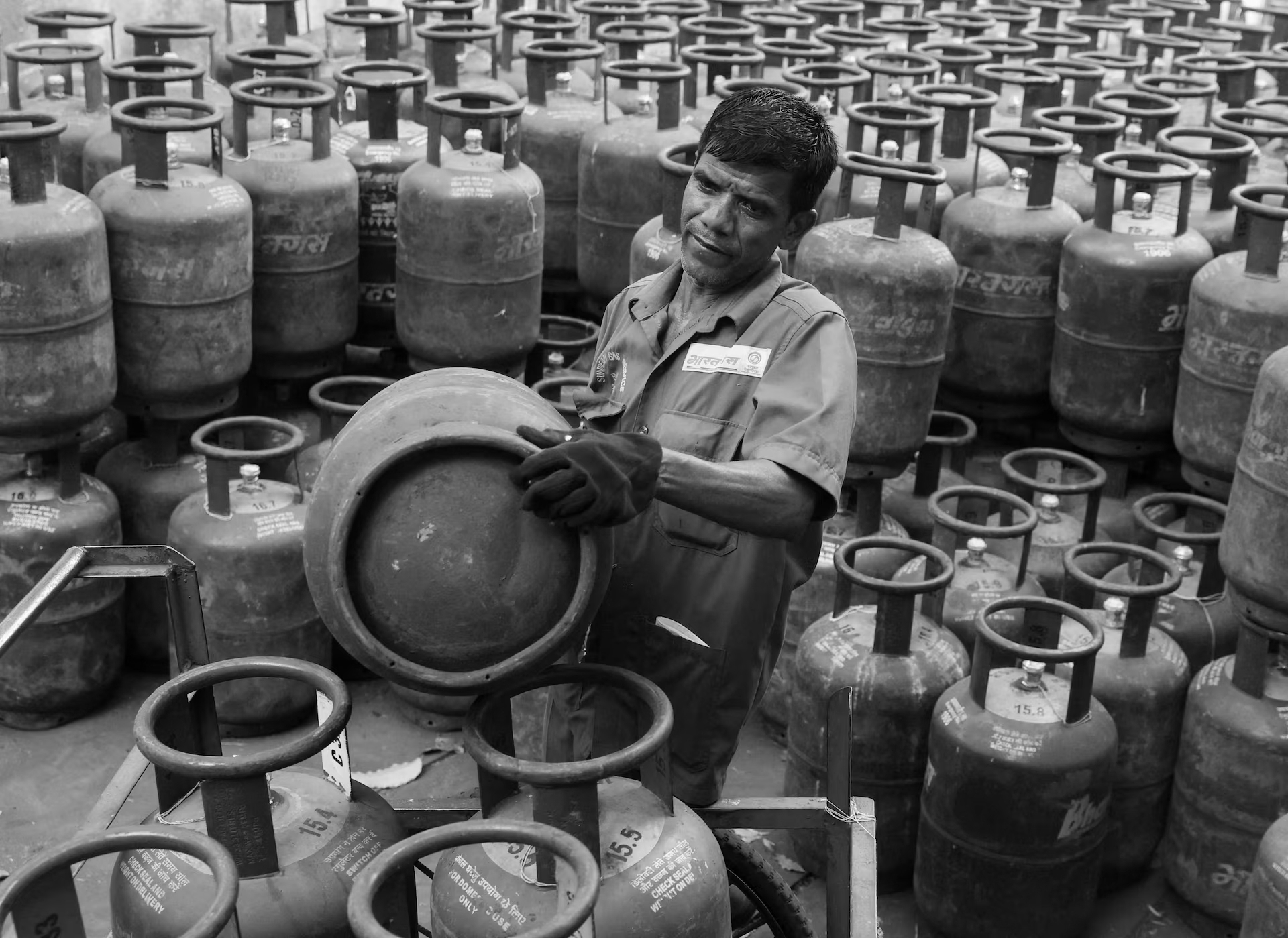
India's LPG crisis: The subsidy that forgot its supply chain
India's LPG emergency of March 2026 did not arrive without warning. It arrived with decades of warning, each one politely filed away. The immediate trigger was American and Israeli strikes on Iran, prompting Tehran to effectively close the Strait of Hormuz — the 21-mile passage through which roughly 90 percent of India's LPG imports ordinarily flow. But the wound is self-inflicted. India consumed 31.3 million metric tonnes of LPG in FY2025, yet domestic refineries cover barely 40 percent of demand. The rest is imported, almost entirely through that single chokepoint. When it closed, India discovered it held only ten days of LPG stocks — not a buffer, but a cliff edge.
Supply lines collapsed within days. QatarEnergy declared Force Majeure. Saudi Aramco's terminal was disrupted. Insurance premiums for Gulf tankers surged over 500 percent. Weekly imports fell by an estimated 30 percent. The government invoked the Essential Commodities Act , prioritised household cylinders, and effectively cut off commercial LPG from March 9 — the 19-kg cylinders that power India's 7.5 million restaurants, dhabas, and canteens. The National Restaurant Association warned that 85 percent of eateries had no alternative fuel whatsoever.
The human consequences were immediate. Tamil Nadu reported 10,000 restaurants facing closure, prompting the state government to announce a ₹2 per unit power subsidy for eateries switching to induction stoves . Bengaluru's Hotels Association announced shutdowns, while in Delhi , restaurants have trimmed menus, paused large bookings and corporate gatherings, and black‑market LPG cylinder prices hit ₹5,000 , over five times the official rate. LPG shortages have also triggered a migrant worker exodus from Kerala ahead of Ramzan and upcoming polls , as many restaurants and hotels cease operations and workers return to their native states amid dwindling jobs and uncertain prospects. In Mumbai , residents took leave from work to queue for hours, returning empty-handed. Autorickshaws across Kolkata and Bengaluru were forced off roads entirely. Families reverted to firewood , and induction cooktops sold out citywide. The situation in Hyderabad has worsened, with hotels and eateries rationing gas, cutting menu items, and turning to alternatives like firewood as commercial LPG supply remains uncertain.
Every state told a version of the same story. Andhra Pradesh's Chief Minister publicly declared no shortage existed while privately ordering officials to monitor black-marketing. West Bengal's Chief Minister directly intervened to restore cylinder bookings. The Northeast, already India's most underserved region for LPG, faced compounding deprivation.
The core failure is not the geopolitical shock — it is decades of deferred structural reform . Countries with serious energy security frameworks maintain 30 to 90 days of reserves. India chose ten. It allowed 91 percent of LPG imports to remain concentrated in one geopolitically volatile region, despite years of available warnings. The PMUY programme — which genuinely transformed clean cooking for 330 million households — created a massive new import dependency without building the storage, diversification, or distribution resilience to sustain it safely.
This pattern has repeated itself. The 2013 rupee crisis, the 2022 Ukraine price shock — each produced emergency measures, political speeches about energy security, and then quiet inaction. The government's current response, including a 28 percent boost in domestic production and emergency US Gulf Coast procurement, is real but belated. What costs millions in a crisis would have cost thousands in preparation.
Five states go to elections in 2026. LPG prices are among the most viscerally felt economic issues in Indian households. But beyond the electoral calculus lies a more fundamental question: when a government invites hundreds of millions of people to depend on a single fuel and builds their welfare around it, it assumes a corresponding obligation to keep that fuel available. That obligation was not met. Not by this government alone — by a succession of them, each deferring the hard infrastructure choices to the next.