
India’s labour law reforms: A Big Bang, a Big Gamble, and a Bigger Transition
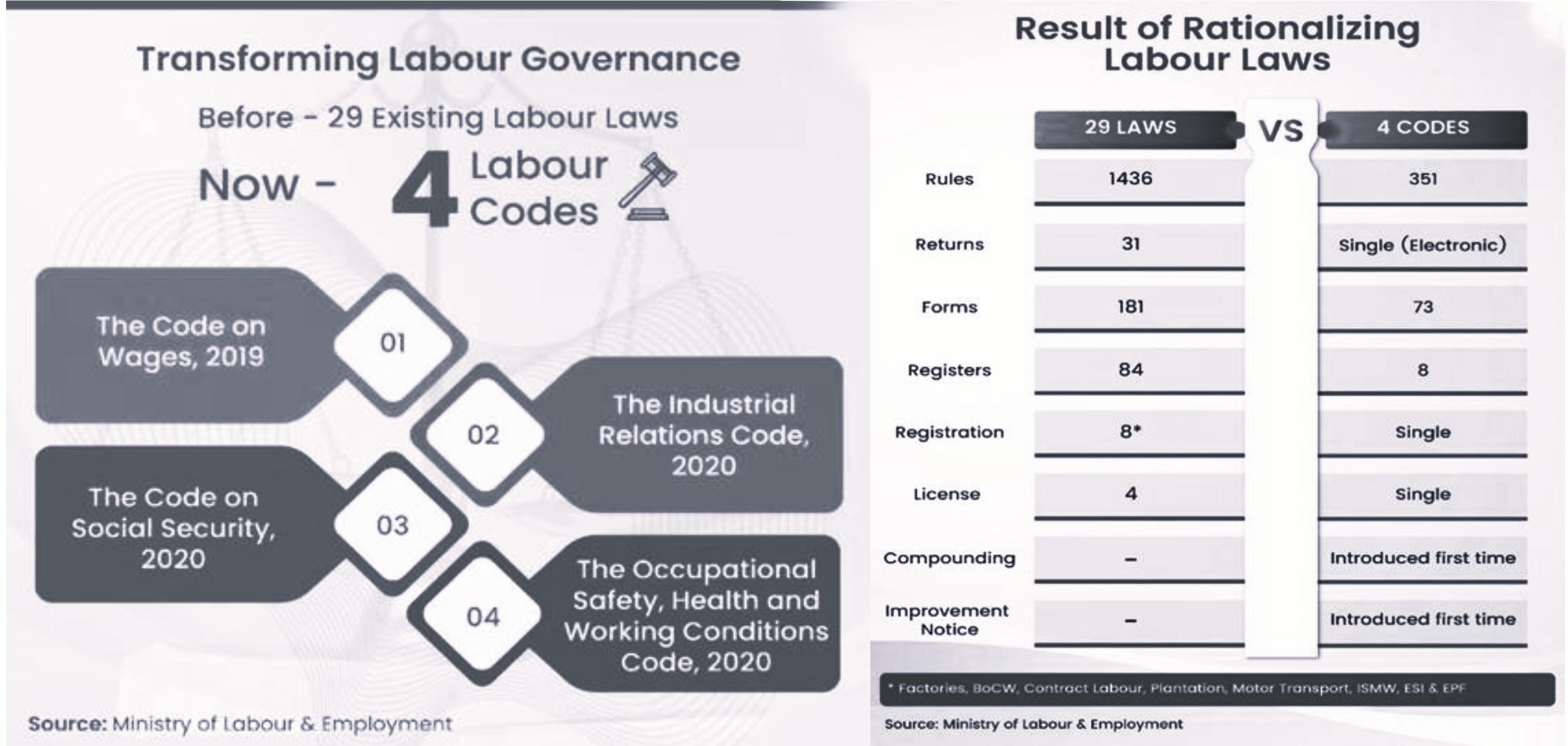
In November 2025, India finally rolled out the long-pending labour law reforms that governments had tried, hesitated, negotiated, and debated for almost two decades. With the enactment of four major labour codes on Wages, Social Security, Industrial Relations, and Occupational Safety & Working Conditions the country officially discarded 29 old labour laws, some of which originated during the British era.
This is not a small tinkering of rules; this is a full-scale renovation of India’s labour architecture. It is the biggest reform since Independence in terms of its reach, affecting crores of workers from factory hands to tech-platform gig workers, from contract labourers to salaried professionals while also touching employers, industries, state governments, and the future of India’s workforce dynamics. The debate, of course, is not simple. Some call the reform a much-needed modernization. Others fear it might undermine worker rights. And still others believe the reform is something India had to do whether workers and employers like the transition or not.
Let us walk through the background, the major changes, the reasons behind the overhaul, and the real-world pros and cons that will play out in the coming years.
Why India Needed Labour Reforms in the First Place
For decades, India’s labour law landscape looked like a huge old building: massive, confusing, with dozens of rooms connected by long, dusty corridors where nobody knew which door led where.
There were:
• separate laws for wages, bonuses, minimum wages, payment of dues, and equal remuneration
• multiple laws on factory safety, contractual labour, migrant workers, shops and establishments
• different record-keeping formats, registers, licences, inspections and penalties for each law
• overlapping state and central requirements, each with their own rules and notifications;
outdated definitions like “worker,” “industry,” “employer,” “wages” that created endless legal disputes, no proper recognition of gig workers, platform workers, domestic workers or many categories of informal labour.
This fragmented system created three major problems:
1. Compliance was a nightmare
Companies needed HR teams, lawyers and consultants just to keep up with which register had to be maintained, which inspector could visit, and which rule applied on which day.
2. Workers outside the formal sector remained invisible
Almost 90% of India’s workforce is informal. Most weren’t covered by wage protections, social security, or safety standards.
3. Modern workplaces evolved, but laws remained stuck in the past
The laws did not account for gig platforms, home-based online work, flexible hours, fixed-term contracts, multi-location employers, or new business models. Clearly, reform was overdue. The new codes aim to clean up the clutter and build one coherent system.
What the Four New Codes Do
Let’s break them down in simpler language.
1. Code on Wages, 2019
This code replaces laws dealing with minimum wages, bonus, wage payments and equal pay.
Its main goals:
• Universal minimum wage for all workers, not just select industries.
• Uniform definition of wages at least 50% of salary must be basic pay + dearness allowance.
• Makes salary structures more transparent and reduces manipulation through allowances.
• Ensures timely wage payments.
This is huge because some sectors earlier had confusing variations, and employees often didn’t know what actually counted as “wage.”
2. Code on Social Security, 2020
• This one expands the idea of who deserves social protection.
• EPF, ESI, maternity benefits, insurance now potentially extendable to gig workers, contract workers and the unorganised sector.
• Creates a national database of workers through online registration.
• Platforms like Swiggy, Zomato, Ola, Uber may have to contribute to worker welfare funds.
• The big idea is: no worker should remain unseen or unprotected.
3. Industrial Relations Code, 2020
This is the most debated one. Simplifies how companies hire, fire, and manage industrial disputes. Increases the retrenchment threshold from 100 workers to 300 workers (for requiring government permission). Promotes fixed-term employment. Strengthens rules for strikes—more notice, more formality. Creates reskilling funds. Employers say it brings flexibility; unions say it weakens job security. Both aren’t wrong.
4. Occupational Safety, Health and Working Conditions Code, 2020
This consolidates everything related to safety, working hours, health and conditions in factories, mines, construction sites, and other workplaces.
• Single licence for contractors.
• Clear standards for working hours, overtime, welfare facilities.
• Rules for women working at night, with mandatory safety measures.
• Better protection for migrants, contract workers, and those in hazardous sectors.
It tries to modernize an outdated safety regime.
What’s New and Why It Matters
1. Basic pay must be at least 50% of salary
This alone will change how Indian companies design salaries. Many earlier reduced PF or gratuity liability by keeping basic pay low and allowances high.
Now that won’t work.
2. A giant push toward formalisation
• Appointment letters become mandatory.
• Unified returns replace mountains of paperwork.
• Companies must maintain cleaner, digital records.
3. Gig and platform workers finally get attention
For the first time, the law acknowledges that gig workers are real workers, not some grey-zone entities.
4. Women’s participation could increase
• Night-shift permissions with safety conditions
• equal wage mandates
• safer work environments = More women may join the workforce.
5. Disputes may reduce (at least in theory)
When definitions are clearer, arguments reduce. India had so many labour disputes simply because the law was fuzzy.
Pros of the Reforms
Let’s look at the good side first, because there is a lot of good.
1. Finally, a simpler system
Earlier: 29 laws, multiple licences, multiple inspectors.
Now: 4 codes, one registration, fewer forms. Both employers and workers benefit from clarity.
2. More transparency for workers
Many employees never knew what counted as wage, what their rights were, or how social security applied. Now the rules are easier to understand, making exploitation harder.
3. Social security for informal and gig workers
This is a major leap. Gig workers form one of the fastest-growing segments in India. Recognising them legally is the first step toward benefits, insurance and job dignity.
4. Women’s safety and workforce inclusion
Allowing night shifts with proper safeguards gives women more opportunities in services, manufacturing, transportation, hospitality sectors that rely on 24×7 operations.
5. Greater flexibility for industries
Easier hiring, fixed-term contracts, and simpler compliance may attract more investment and reduce fear of expansion. India wants to become a manufacturing hub but no investor wants to be trapped in decades-old labour rigidity.
6. Unified digital systems reduce corruption
A single registration and online portals reduce the inspector-raj-style harassment businesses often faced.
Cons and Concerns
No reform is perfect. These codes raise serious concerns too.
1. Job security may weaken
Raising the retrenchment threshold from 100 to 300 workers means more companies can lay off workers without government permission. Unions fear a hire-and-fire culture.
2. Fixed-term contracts could undermine permanency
Workers worry that companies will avoid creating permanent jobs and rely only on fixed-term contracts, which may reduce long-term security.
3. Social security remains dependent on implementation
The law mentions gig worker benefits, but:
• How much will platforms contribute?
• How much will the government pay?
• Who ensures timely payments?
• How will informal workers enrol?
The details are fuzzy.
4. State-level differences will continue
Labour is a concurrent subject.
Some states may be quick to implement new rules; others may delay.
This creates uneven protection for workers.
5. Companies fear higher salary costs
With the new wage definition, many companies expect a rise in PF, gratuity and other contributions. This might affect take-home pay or hiring strategy.
6. Migrant workers still face identity and documentation challenges
The codes talk about welfare, but India’s migrant workforce often lacks:
• documents,
• local proofs,
• continuous employment,
• awareness.
• Benefits may not reach them immediately.
Will Workers Actually Benefit?
This is the million-dollar question.
Short term:
Confusion will be high. Companies are recalculating salary structures.
States are notifying rules. Workers are unsure what exactly changes for them.
Medium term:
If implemented well, the codes will bring more formalisation. Companies will adjust, and workers will start receiving clearer wage and safety benefits.
Long term:
The real benefit will depend on enforcement. India has good laws, but weak ground implementation. If inspectors, employers and governments apply the codes sincerely, the workforce will get stronger protection. If not, only paperwork will change.
Will Employers Benefit?
• Yes, but with conditions.
• Compliance becomes easier.
• Expansion becomes easier.
• Hiring and firing becomes clearer.
• Digital records reduce pressure.
But they also face:
• higher contribution burdens,
• costlier salary structures,
• the need to upgrade payroll systems,
• pressure to maintain work safety standards.
For responsible employers, this reform is beneficial.
For those who preferred loopholes, the reforms close many backdoors.
Where Do State Governments Fit In?
This is important. Central government passed the codes.
But each state must draft rules. Some states are ahead; some slow.
Implementation will not be uniform across India. Think of this like a central recipe that states must cook.
• Some will cook it well.
• Some will delay.
• Some may change ingredients.
For workers, this could mean different rights depending on where they work.
Broader Economic Impact
The big-picture impact includes:
• More formal jobs in long term
• Increased investor confidence
• Higher labour mobility
• Better productivity due to safety standards
• More women in the workforce
• Slight rise in manpower costs
• More stable and predictable industrial relations
But also:
• Short-term disruptions
• Possible rise in contractual hiring
• Conflicts between unions and management
• Strain on small businesses adjusting to new wage definitions
Why These Reforms Matter for India’s Future
India wants to become:
• a manufacturing powerhouse,
• a global supply chain hub,
• a service sector leader,
• a major economy relying on digital and gig work,
• a country with safer work environments.
Outdated laws couldn’t support these ambitions. The new codes are a structural reset like renovating the foundation of a building, not just painting the walls. These reforms won’t magically transform the workforce overnight. But they provide a framework for a modern economy.
The success will depend on:
• how sincerely states implement the codes,
• how industries adapt,
• how much awareness workers gain,
• how transparent platforms remain,
• how effectively governments enforce rules.
A Bold Step, But a Long Road Ahead
India’s new labour codes are bold, ambitious and sweeping. They simplify a messy system, expand protections to millions, and align India’s regulatory framework with global practices. They also introduce new risks especially related to job security, worker vulnerability and employer cost pressures.
In short:
• The reforms were needed.
• They have great potential.
• But their real impact will depend on how the country navigates the transition.
India has pressed the reset button on labour governance. The next few years will decide whether this reset becomes a transformation or just another chapter in the long story of India’s struggle to modernise its labour market.